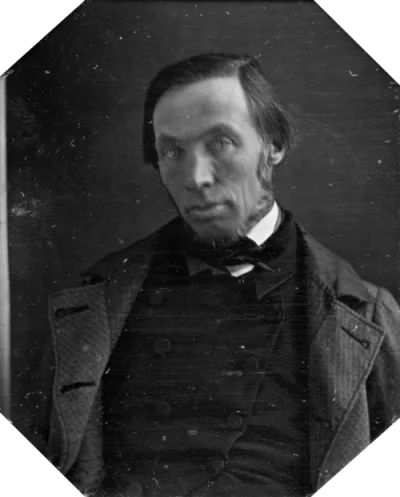
Robert Dale Owen was a social reformer, politician, and writer who championed public education, women's rights, and spiritualism.
Born in Scotland in 1801, Robert Dale Owen was the son of socialist reformer Robert Owen. He immigrated to the United States in 1825 and helped establish the utopian community of New Harmony, Indiana. Owen was deeply involved in socialist doctrines and co-edited influential publications like the New-Harmony Gazette and the Free Enquirer, advocating for radical social changes.
Owen had a significant career in Indiana politics, serving in the state legislature and as a delegate to the Indiana Constitutional Convention of 1850. He was instrumental in securing tax-supported public schools and advocating for women's property and divorce rights. He also represented Indiana in the U.S. House of Representatives, where he played a key role in the establishment of the Smithsonian Institution and served on its first Board of Regents. Owen's later life included a diplomatic post in Naples and continued advocacy for social reform, including support for emancipation.
Social Reform and Utopianism
Robert Dale Owen actively promoted the socialist ideals inherited from his father, Robert Owen. He was a key figure in the management of New Harmony, Indiana, an experimental community founded on principles of social equality. Alongside Frances Wright, he co-edited the New-Harmony Gazette and later the Free Enquirer, platforms through which they disseminated their progressive views on a wide array of social issues. These included the abolition of slavery, women's rights, universal suffrage, and public education. Owen's commitment to these principles extended to his personal writings and public addresses throughout his adult life.
Political Career and Legislative Achievements
Owen's political career spanned both state and federal levels. He served multiple terms in the Indiana House of Representatives, where he successfully advocated for state funding for public schools and championed legislation for married women's property rights and easier divorce. His role in the 1850 Indiana Constitutional Convention was pivotal in establishing a uniform system of free public schools and the office of the Superintendent of Public Instruction. As a U.S. Congressman, Owen was instrumental in the passage of the bill that created the Smithsonian Institution and was part of its initial governing board.
Spiritualism and Personal Beliefs
Beyond his political and social reform activities, Robert Dale Owen was a proponent of spiritualism. His writings and public discourse often reflected his personal beliefs in this area, alongside his other reformist agendas. This aspect of his life contributed to his multifaceted public persona as a reformer and thinker who engaged with both material and metaphysical dimensions of human experience. His advocacy for social change was often intertwined with a broader philosophical outlook that embraced unconventional ideas for his time.
Key Ideas
- Advocacy for tax-supported free public schools
- Support for married women's property rights
- Advocacy for liberal divorce laws
- Belief in spiritualism
- Socialist doctrines and utopian community management
Books by
5 free public domain books · Read online or download