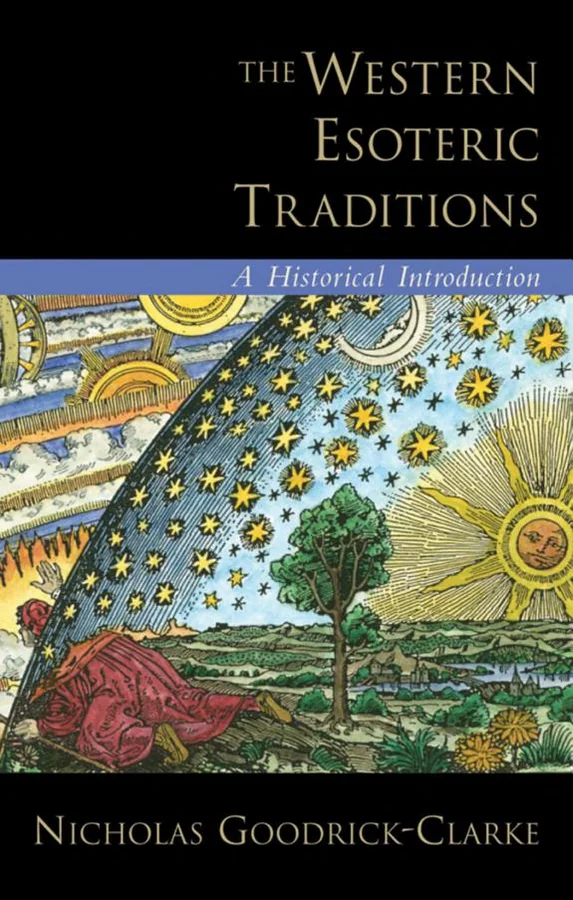
The Western Esoteric Traditions
 80
80

The Western Esoteric Traditions
Nicholas Goodrick-Clarke's *The Western Esoteric Traditions* offers a commendably balanced and historically grounded perspective on a subject often obscured by myth and misinterpretation. Its strength lies in its clear chronological structure, meticulously charting the evolution of esoteric ideas from antiquity to the modern era. The author's ability to synthesize vast amounts of material into a coherent narrative is impressive, particularly in his treatment of the complex relationship between esoteric thought and scientific paradigms. For instance, his discussion of how figures like Giordano Bruno engaged with Hermetic cosmology in the late 16th century effectively illustrates the intellectual ferment of the period. A potential limitation, however, is the book's necessarily broad scope, which at times might leave specialists wanting deeper dives into specific sub-traditions. Nevertheless, for its intended purpose as a comprehensive introduction, the work is exceptionally well-executed. It provides a solid foundation for understanding the enduring influence of esoteric currents in Western thought.
📝 Description
80
Nicholas Goodrick-Clarke published *The Western Esoteric Traditions* in 2008, cataloging centuries of hidden thought.
Nicholas Goodrick-Clarke's *The Western Esoteric Traditions* provides a scholarly survey of the historical currents and figures that shaped Western esotericism. Published in 2008, the book traces a lineage from ancient philosophical and religious systems, through medieval alchemy and Renaissance magic, to modern occultism and its connections with science. It aims to offer a clear, accessible overview for those new to these complex subjects, situating them within their historical and intellectual contexts. This work is chiefly for students and scholars of Western esotericism, religious studies, and intellectual history. It serves as a solid starting point for individuals interested in the historical development of Hermeticism, Gnosticism, Kabbalah, Rosicrucianism, Freemasonry, and various forms of magic and occultism. Readers wanting a grounded, academic introduction that emphasizes historical evolution over sensationalism will find it particularly useful. Goodrick-Clarke systematically examines core concepts like Hermetic principles, Neoplatonic cosmology, Gnostic dualism, Kabbalistic correspondences, and the alchemical pursuit of transformation. He discusses how these ideas were adapted and reinterpreted over centuries, shaping subsequent intellectual currents.
The early 21st century saw growing academic interest in Western esotericism, a field previously often overlooked. Goodrick-Clarke's book emerged in this environment, aiding the recognition of esoteric studies as a valid academic discipline. It follows scholars like Frances Yates and Antoine Faivre, who focused on historical context rather than dismissing esoteric ideas. The book's 2008 release placed it within ongoing scholarly discussions about the definition and scope of Western esotericism.
💡 Why Read This Book?
• Gain a clear understanding of the historical lineage of key esoteric systems, from ancient Hermeticism and Gnosticism to modern occultism, as presented in the book's chronological survey. • Grasp the foundational principles of Western esoteric thought, such as Neoplatonic cosmology and Kabbalistic correspondences, and their transformation across centuries, detailed in the 'Key Concepts' section. • Appreciate the academic context of esoteric studies, understanding how figures like Frances Yates paved the way for scholarly engagement with these traditions, as discussed in 'Historical Context'.
⭐ Reader Reviews
Honest opinions from readers who have explored this book.
❓ Frequently Asked Questions
What is the primary focus of Nicholas Goodrick-Clarke's *The Western Esoteric Traditions*?
The book provides a historical survey of Western esoteric thought, tracing its development from ancient roots in Hermeticism, Gnosticism, and Neoplatonism through to modern occultism and its connections with scientific thinking.
Which historical periods are covered in *The Western Esoteric Traditions*?
The work spans from the early Christian era, exploring Gnosticism and Neoplatonism, through the Renaissance and Enlightenment periods, up to contemporary scientific paradigms and occult revivals.
Is *The Western Esoteric Traditions* suitable for beginners?
Yes, it is designed as an introduction, offering a concise and academically grounded overview that makes complex esoteric traditions accessible to those new to the subject.
What are some of the core esoteric traditions discussed in the book?
Key traditions explored include Hermeticism, Gnosticism, Neoplatonism, Kabbalah, Rosicrucianism, Freemasonry, alchemy, and various forms of magic and occultism.
How does Goodrick-Clarke connect esoteric thought to science?
The book examines the historical intersections and sometimes adversarial relationships between esoteric beliefs and prevailing scientific or philosophical paradigms, showing how esoteric ideas have engaged with or responded to scientific developments.
When was *The Western Esoteric Traditions* first published?
The book was first published on October 14, 2008, placing it within the modern academic resurgence of esoteric studies.
🔮 Key Themes & Symbolism
Lineage of Esoteric Thought
The book meticulously traces the continuity and transformation of esoteric ideas across millennia. It highlights how ancient Gnosticism and Hermeticism provided foundational cosmologies and philosophical frameworks that were later adapted by Renaissance magi, Enlightenment secret societies, and 19th-century occultists. Goodrick-Clarke demonstrates that these traditions are not isolated phenomena but part of an evolving intellectual heritage, showing how concepts like divine correspondence and spiritual ascent reappeared in different forms throughout Western history.
Esotericism and Science
A significant aspect of the work is its examination of the dynamic relationship between esoteric traditions and the development of Western science. Goodrick-Clarke explores periods where esoteric ideas influenced scientific inquiry, as seen in Renaissance alchemy, and conversely, how the rise of empirical science in later centuries often led to the marginalization or reinterpretation of esoteric doctrines. The book addresses how modern esoteric movements sometimes engage with or react to contemporary scientific paradigms.
Hermeticism and Neoplatonism
The author places substantial emphasis on Hermeticism, stemming from the Corpus Hermeticum, and Neoplatonism, particularly the philosophy of Plotinus, as crucial early sources for Western esotericism. He details how their concepts of divine emanation, the correspondences between the macrocosm and microcosm, and the path of spiritual ascent profoundly shaped subsequent esoteric movements, including Gnosticism, Kabbalah, and Renaissance magic.
Modern Occultism
Goodrick-Clarke provides a historical overview of the major figures and movements that defined modern Western occultism, particularly from the 19th century onwards. This includes discussions of spiritualism, the Hermetic Order of the Golden Dawn, Theosophy, and figures like Aleister Crowley. He analyzes how these movements synthesized older esoteric traditions with new philosophical and psychological ideas, often in response to the perceived spiritual vacuum of the industrial age.
💬 Memorable Quotes
Direct passages from the work, attributed to the author.
“The author explores the origins of Hermeticism and Gnosticism in the early Christian era.”
— This highlights Goodrick-Clarke's focus on the foundational intellectual and religious milieu from which many Western esoteric currents emerged, emphasizing their historical roots.
“The work traces the reverberations of esoteric thought in modern day's scientific paradigms.”
— This indicates the book's engagement with the complex and often contentious relationship between esoteric beliefs and empirical science, particularly in contemporary contexts.
“The book covers traditions from Hermeticism and Neoplatonism to modern occultism.”
— This points to the broad chronological and thematic scope of the work, showcasing its intention to provide a comprehensive overview of diverse esoteric currents.
“The author situates esoteric thought within its historical and intellectual contexts.”
— This emphasizes the book's academic approach, prioritizing historical accuracy and intellectual analysis over speculative interpretations of esoteric phenomena.
💡 Key Ideas
Editorial paraphrase of the work's core concepts — not direct quotes.
Nicholas Goodrick-Clarke examines the historical development of Western esoteric traditions.
This summarizes the book's core objective: a chronological and analytical study of how esoteric ideas have evolved and manifested across different historical epochs.
🌙 Esoteric Significance
Tradition
This work is firmly situated within the academic study of Western Esotericism, a field seeking to understand traditions originating from Hermeticism, Gnosticism, Neoplatonism, and Kabbalah. Goodrick-Clarke's approach departs from purely devotional or practitioner-focused accounts by emphasizing historical development and intellectual lineage. He synthesizes these disparate threads into a coherent historical narrative, showing how core ideas like spiritual ascent and cosmic correspondence mutated and persisted through various movements.
Symbolism
The book frequently references symbols central to Western esotericism, such as the Ouroboros, representing cyclicality and the unity of opposites in alchemy, and the Tree of Life from Kabbalah, symbolizing divine emanation and cosmic structure. Goodrick-Clarke explains how these symbols function not merely as decorative elements but as mnemonic devices and conceptual maps for understanding the universe and the individual's place within it.
Modern Relevance
Contemporary thinkers and practitioners in fields ranging from comparative religion to psychospiritual development often cite Goodrick-Clarke's work as a foundational text. His historical mapping provides context for modern occult orders, New Age spirituality, and even contemporary philosophical discussions that engage with concepts like consciousness, cosmology, and the critique of materialism, demonstrating the enduring legacy of these historical esoteric currents.
👥 Who Should Read This Book
• Students of religious studies and intellectual history: You will gain a structured understanding of how esoteric ideas have shaped Western thought, complementing studies of mainstream philosophy and theology. • Individuals curious about occultism and alternative spiritualities: This book offers a scholarly, non-sensationalized introduction to the historical roots and development of traditions like Hermeticism, Gnosticism, and modern magic. • Researchers of comparative mythology and symbolism: You can explore the recurring motifs and symbolic languages that run through diverse esoteric traditions, providing a comparative framework for analysis.
📜 Historical Context
Published in 2008, *The Western Esoteric Traditions* emerged during a period of significant academic legitimization for the study of esotericism. Scholars like Antoine Faivre had already established frameworks for understanding these traditions, moving them from the margins of religious and intellectual history into mainstream discourse. Goodrick-Clarke’s work contributed to this by offering a comprehensive, historically grounded survey. It engaged with ongoing debates concerning the definition and classification of 'esotericism' itself, a field often contrasted with exoteric or mainstream religious and philosophical systems. The book's reception was generally positive within academic circles, seen as a valuable synthesis that built upon the foundational scholarship of figures like Frances Yates, who had previously explored the Renaissance magical worldview. Unlike earlier, more popular accounts, Goodrick-Clarke’s approach prioritized historical context and critical analysis over esoteric advocacy.
📔 Journal Prompts
The Hermetic principle of 'As Above, So Below' and its historical manifestations.
Neoplatonic concepts of emanation and their influence on Gnostic cosmologies.
The role of Kabbalah in Renaissance magic and later occult revivals.
Connections between alchemical symbolism and modern psychological archetypes.
The discourse between esoteric traditions and scientific paradigms from the 17th century onwards.
🗂️ Glossary
Hermeticism
A religious, philosophical, and esoteric tradition based on writings attributed to Hermes Trismegistus. It emphasizes divine knowledge, cosmology, and the interconnectedness of all things, particularly the macrocosm and microcosm.
Gnosticism
A diverse set of religious ideas and systems prominent in the early Christian era, characterized by a belief in salvation through esoteric knowledge (gnosis) and a dualistic worldview separating a transcendent God from a flawed material creator.
Neoplatonism
A philosophical system derived from Plato, particularly developed by Plotinus in the 3rd century CE. It posits a hierarchical reality emanating from a supreme, ineffable 'One', with the goal of mystical union with the divine.
Kabbalah
A system of Jewish mysticism that explores the nature of God and the universe through esoteric interpretations of the Torah, often involving symbolic representations like the Tree of Life.
Alchemy
An ancient proto-scientific and philosophical tradition concerned with the transformation of matter, often seeking to transmute base metals into gold, but also pursuing spiritual purification and immortality.
Corpus Hermeticum
A collection of Greco-Egyptian philosophical and religious writings attributed to Hermes Trismegistus, which formed a central text for Renaissance Hermeticism and influenced Western esotericism.
Occultism
A broad category of esoteric or supernatural beliefs that are outside the scope of established scientific understanding. It often involves the study of magic, divination, and spiritualism.
This book appears in 1 collection
🔮 Readers Also Liked
Browse all →









From the “Western Esotericism” Collection
View all →






More Free Occult Philosophy Books
View all →