Footfalls on the Boundary of Another World

 71
71

Footfalls on the Boundary of Another World
Robert Dale Owen's *Footfalls on the Boundary of Another World* presents a formidable collection of anecdotal evidence for spiritualist phenomena. Its strength lies in Owen's earnest attempt to apply rational scrutiny to experiences that defied 19th-century scientific understanding. He meticulously documents cases, citing dates, locations, and witnesses, which lends a sense of credibility to the presented accounts. However, the sheer volume of these accounts, often presented without rigorous disproof of fraud or psychological explanation, can become overwhelming. A particularly memorable section details the alleged 'materializations' experienced by mediums like Daniel Dunglas Home, showcasing Owen's fascination with the tangible manifestations of the unseen. While the book offers a valuable historical snapshot, its conclusions are inherently limited by the subjective nature of the evidence presented and the scientific limitations of its era. It serves as a crucial historical document rather than definitive proof.
📝 Description
71
Robert Dale Owen published *Footfalls on the Boundary of Another World* in 1886, documenting spiritualist phenomena.
Robert Dale Owen's 1886 book, *Footfalls on the Boundary of Another World*, collects accounts of spiritualist phenomena. Owen, a politician and reformer, approached spiritualism with a mix of scientific scrutiny and personal belief, aiming to show evidence for an afterlife. The book functions as a detailed catalog, organized by the types of manifestations or the people involved, rather than a flowing narrative. It covers séances, materializations, and spirit communications.
This work is for serious students of 19th-century spiritualism and psychical research. It will interest those looking into the connections between science, religion, and the paranormal during a time of significant public attention. Readers should come with a critical yet open mind, ready to consider historical accounts that challenge standard scientific views. The book also serves researchers studying the social and intellectual forces that shaped early modern spiritual movements.
Published in 1886, *Footfalls* appeared during a peak in spiritualism's popularity, following events like the Fox sisters' séances. Grief from wars and epidemics, along with a reaction against materialism, fueled widespread interest in communicating with the dead. Owen sought to provide factual support for beliefs often dismissed by mainstream science. This occurred in an intellectual climate where figures like Alfred Russel Wallace, a key figure in evolutionary theory, were also investigating psychic phenomena, showing that such pursuits could gain serious attention.
💡 Why Read This Book?
• Gain firsthand accounts of 19th-century séances and mediumistic phenomena, as documented by Robert Dale Owen, offering a unique perspective on the spiritualist movement's early days. • Understand the intellectual climate of the 1880s, where figures like Alfred Russel Wallace were exploring psychical research, challenging prevailing scientific materialism. • Examine detailed descriptions of 'materializations' and 'rappings,' providing concrete examples of the phenomena that captivated and perplexed Victorian society.
⭐ Reader Reviews
Honest opinions from readers who have explored this book.
❓ Frequently Asked Questions
What is the primary focus of Robert Dale Owen's *Footfalls on the Boundary of Another World*?
The book's primary focus is on documenting alleged supernatural phenomena, including spirit communications, materializations, and séances, based on accounts gathered by the author in the 19th century.
When was *Footfalls on the Boundary of Another World* first published?
Robert Dale Owen's *Footfalls on the Boundary of Another World* was first published in 1886.
Who was Robert Dale Owen and what was his perspective on spiritualism?
Robert Dale Owen was a prominent 19th-century politician and social reformer who became a serious investigator of spiritualism, seeking to present empirical evidence for phenomena beyond the physical realm.
Does the book present scientific proof of the afterlife?
The book presents anecdotal evidence and testimonies from the 19th century. While Owen sought a rational approach, it does not offer scientific proof in the modern sense but rather historical accounts of alleged spiritualist phenomena.
What historical period does this book best illuminate?
The book vividly illuminates the mid-to-late 19th century, a period of intense interest in spiritualism, séances, and the exploration of consciousness beyond the material body.
What are 'materializations' as described in the book?
Materializations, as described in *Footfalls on the Boundary of Another World*, refer to alleged instances where spirits or unseen entities manifest in a physical, visible form during séances.
🔮 Key Themes & Symbolism
Mediumship and Manifestation
The core of Owen's work lies in detailing various forms of mediumship, where individuals act as conduits for supposed spiritual forces. He meticulously records instances of 'rappings,' 'voices,' and particularly 'materializations,' where spirits allegedly coalesced into visible forms. These accounts are presented as evidence for the agency of discarnate entities, challenging the materialist worldview of the era. Owen distinguishes between different types of mediums and their associated phenomena, aiming to categorize and understand the mechanisms of spiritual interaction.
The Survival of Consciousness
Owen builds a case for the persistence of human consciousness after physical death. The phenomena he documents, from direct communications to the appearance of spiritual forms, are interpreted as proof that the individual self endures. This theme addresses a profound human yearning for continuity and connection beyond the grave, presenting spiritualism not merely as a curiosity but as a potential pathway to understanding the eternal nature of the soul and the existence of an 'other world'.
Rational Inquiry into the Paranormal
A significant aspect of the book is Owen's attempt to reconcile spiritualist experiences with a framework of rational investigation. He emphasizes witness testimonies, documented séances, and attempts to rule out fraud. While operating within the scientific limitations of the 1880s, his approach reflects a desire to move beyond mere belief towards an evidence-based understanding of phenomena that seemed to defy conventional explanation. This theme highlights the intellectual struggle to integrate the unseen with the observable.
The Nature of the Spirit World
The collected accounts implicitly paint a picture of the 'other world' as a realm populated by intelligences and energies that can interact with our physical plane. Owen explores concepts of spiritual progression, the nature of communication, and the potential for humans to perceive or influence this unseen dimension. The book suggests that this spirit realm is not entirely alien but possesses laws and characteristics that can be, at least partially, understood through careful observation of its manifestations.
💬 Memorable Quotes
Direct passages from the work, attributed to the author.
“The phenomena of spiritualism are not to be judged by the same rules as ordinary occurrences.”
— This statement highlights Owen's understanding that spiritualist manifestations were considered extraordinary and required a different interpretive lens than everyday events, acknowledging their perceived deviation from normal physical laws.
“We are surrounded by intelligences with whom we may communicate.”
— This interpretation reflects Owen's conviction, supported by the accounts in his book, that unseen conscious entities exist alongside us and that channels for interaction, such as mediumship, are available.
“The boundary between worlds is not an impassable barrier.”
— This signifies Owen's belief, central to the book's thesis, that the separation between the physical world and the spirit realm is permeable, allowing for interaction and observation under specific conditions.
💡 Key Ideas
Editorial paraphrase of the work's core concepts — not direct quotes.
The direct voice, the materialization of forms, the intelligent movement of objects—these are but glimpses.
This paraphrase captures the essence of Owen's view that the documented spiritualist phenomena, such as direct voice communication and physical manifestations, represented only partial access to a much larger, unseen spiritual reality.
The evidence points to the survival of the essential self beyond corporeal dissolution.
This paraphrased concept emphasizes Owen's conclusion from the presented phenomena: that the core of a person's being, their essential self, continues to exist even after the physical body has ceased to function.
🌙 Esoteric Significance
Tradition
While not strictly adhering to a single esoteric lineage like Hermeticism or Gnosticism, Owen's work draws heavily from the broad currents of 19th-century spiritualism and psychical research. This movement sought to empirically validate concepts of an afterlife and spirit communication, often positioning itself as a scientific or rational alternative to traditional religion. It shares common ground with Theosophy, which also emerged in this period, in its exploration of unseen realities and non-physical consciousness, though Owen's focus remains more narrowly on direct mediumistic phenomena rather than broader cosmologies.
Symbolism
The primary 'symbol' in Owen's work is the phenomenon itself – the 'footfall' from another world. This includes specific motifs like 'rappings' (auditory manifestations symbolizing direct communication), 'materializations' (visual manifestations representing the tangible presence of spirits), and the 'medium' (a human conduit symbolizing the permeable boundary between realms). These are not symbolic in a traditional iconographic sense but function as perceived evidence or 'signs' of a spiritual reality interacting with the physical.
Modern Relevance
Owen's meticulous cataloging of 19th-century spiritualist phenomena remains a vital resource for contemporary researchers in parapsychology, consciousness studies, and the history of religion. Modern thinkers exploring altered states of consciousness, remote viewing, and the nature of subjective experience can find historical precedents and comparative data in his documented cases. His work also informs discussions on the philosophy of mind and the ongoing debate about evidence for survival of consciousness, resonating with those who continue to seek empirical approaches to the paranormal.
👥 Who Should Read This Book
• Researchers of 19th-century social and intellectual history seeking primary source material on the spiritualist movement and its impact. • Students of psychical research and parapsychology interested in foundational texts documenting early investigations into mediumship and alleged paranormal phenomena. • Skeptics and believers alike who wish to understand the historical arguments and anecdotal evidence presented by prominent figures advocating for the reality of spiritual communication.
📜 Historical Context
Published in 1886, Robert Dale Owen’s *Footfalls on the Boundary of Another World* emerged during the zenith of 19th-century spiritualism, a movement deeply influenced by the grief and spiritual searching following the American Civil War and widespread epidemics. This era saw a surge in interest in contacting the deceased, a phenomenon amplified by figures like the Fox sisters and later explored by intellectuals and scientists. Owen, a respected statesman and social reformer, approached these phenomena with a desire for empirical validation, attempting to bridge the gap between the materialist scientific establishment and the burgeoning spiritualist belief system. His work contributed to the intellectual discourse surrounding psychical research, a field that also attracted figures like William James and Alfred Russel Wallace, who sought to investigate claims of psychic phenomena seriously. The book's reception was polarized, aligning with the broader societal division between skeptics and believers, and it became a key text for spiritualists seeking rational justification for their beliefs.
📔 Journal Prompts
The documented 'materializations' described by Owen: what psychological or physical explanations seem most plausible given 19th-century understanding?
Reflect on the role of grief and social upheaval in fostering belief in an 'other world' during the period Owen writes about.
Consider the concept of 'mediumship' as presented in the book; how does it challenge or align with modern ideas of consciousness?
Analyze the author's approach to evidence and testimony; how does it compare to scientific standards of the era and today?
The significance of 'rappings' as a form of communication: what might this seemingly simple phenomenon represent to those seeking contact?
🗂️ Glossary
Spiritualism
A religious movement and belief system that asserts the possibility of communication between the living and the spirits of the dead, often through the agency of mediums.
Medium
An individual believed to possess the ability to act as an intermediary, channeling communication or phenomena from the spirit world to the physical world.
Séance
A meeting or gathering where individuals attempt to make contact with spirits, typically involving a medium and various forms of alleged spiritual manifestation.
Materialization
In spiritualist contexts, the alleged phenomenon where spirits or spiritual energy coalesce to form a visible, tangible physical form.
Rappings
Supernatural sounds, often described as knocks or taps, believed to be produced by spirits to communicate messages or attract attention during séances.
Psychical Research
The interdisciplinary field that investigates alleged paranormal phenomena and psychic abilities, including telepathy, clairvoyance, and mediumship.
Discarnate Entity
A being or consciousness that exists without a physical body; typically refers to spirits or souls after death.
🔮 Readers Also Liked
Browse all →









More by Robert Dale Owen
All books →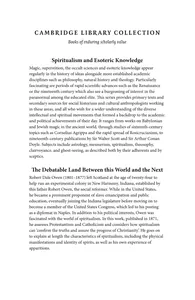


More Free Occult Philosophy Books
View all →