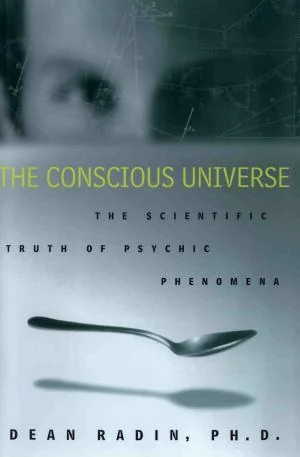
The Conscious Universe
 72
72

The Conscious Universe
Dean Radin's "The Conscious Universe" is a formidable compendium of scientific investigation into the seemingly impossible. Radin, a scientist deeply immersed in parapsychology, presents decades of research, much of it his own, with admirable clarity and rigor. He skillfully navigates the often-controversial terrain of ESP and psychokinesis, employing statistical analysis and experimental design to build a case for phenomena that defy conventional explanation. A particular strength lies in his meticulous detailing of experiments, such as those involving remote viewing and the influence on random number generators, which lend the book an air of empirical authority. However, the sheer volume of technical data might prove daunting for the casual reader, requiring a sustained focus to fully grasp the implications. The chapter discussing quantum entanglement as a potential model for consciousness offers a compelling, albeit speculative, bridge between physics and metaphysics. Ultimately, "The Conscious Universe" serves as a critical, data-driven examination of consciousness's frontiers, challenging established scientific dogma without succumbing to pseudoscience.
📝 Description
72
Dean Radin's 1997 book surveys empirical research into anomalous psychological phenomena.
Dean Radin's "The Conscious Universe," published in 1997, examines experimental research on phenomena often labeled as psychic. Radin, a scientist at the Institute of Noetic Sciences, analyzes data from studies on extrasensory perception (ESP), psychokinesis (PK), and consciousness that appears independent of the physical body. He connects these experimental findings with theoretical ideas from quantum physics and traditional mystical thought.
The book's goal is to suggest that consciousness might interact with the physical world more actively than standard scientific explanations allow. It is written for readers who are open to but also critical of new ideas, especially those interested in the connections between science and consciousness. The work is relevant for individuals curious about parapsychology, the scientific investigation of topics like telepathy and precognition. Students and researchers in psychology, physics, and philosophy who want to understand the empirical evidence for non-physical aspects of consciousness will find this book useful. It also speaks to those within spiritual traditions seeking a scientific examination of their beliefs, bridging subjective experience and objective study.
Published in 1997, "The Conscious Universe" entered a discourse where scientific materialism often dominated explanations of reality. Radin's work engages with traditions that posit a mind or consciousness as fundamental, or at least capable of influencing the physical world independently of known physical forces. This echoes historical spiritualist and metaphysical movements that explored similar ideas, but Radin's approach is distinct in its reliance on rigorous, quantitative experimental data and statistical analysis. He seeks to provide empirical support for concepts that have long been part of esoteric thought, aiming to bridge the gap between subjective spiritual experiences and objective scientific inquiry.
💡 Why Read This Book?
• Understand the empirical evidence for phenomena like micro-PK, including the specific experimental setups used to test human intention's effect on random number generators, as detailed in Radin's own research presented from the 1990s. • Explore the scientific rationale behind Remote Viewing experiments, learning about the protocols and statistical outcomes that suggest information can be perceived across space and time. • Grasp how Radin connects concepts from quantum physics, such as entanglement, to the study of consciousness, offering a theoretical framework that departs from purely materialistic explanations.
⭐ Reader Reviews
Honest opinions from readers who have explored this book.
❓ Frequently Asked Questions
What kind of experiments does Dean Radin describe in 'The Conscious Universe'?
Radin details experiments on extrasensory perception (ESP), including remote viewing and ganzfeld studies, and psychokinesis (PK), particularly micro-PK influencing random number generators. These studies often employ rigorous statistical analysis to assess results.
How does 'The Conscious Universe' relate to quantum physics?
The book explores how certain quantum principles, like entanglement and non-locality, might provide a theoretical framework for understanding consciousness and its potential non-local interactions, moving beyond classical physics.
Is 'The Conscious Universe' considered a scientific text?
Yes, it is presented as a scientific investigation into parapsychological phenomena. Radin uses empirical data, experimental methodology, and statistical analysis, aiming to meet scientific standards, though the subject matter remains controversial within mainstream science.
What is 'noetic science' as defined in the book?
Noetic science, as explored by Radin, is the study of consciousness and its relationship to the physical world. It encompasses phenomena that challenge conventional scientific understanding, such as psi abilities and the mind-matter connection.
Who was J.B. Rhine and why is he mentioned?
J.B. Rhine was a pioneering parapsychologist at Duke University who established the scientific study of psychic phenomena in the mid-20th century. Radin's work builds upon and extends Rhine's foundational research into ESP and PK.
What is 'micro-PK'?
Micro-PK refers to microscopic psychokinesis, the hypothesized ability of consciousness to subtly influence physical systems, particularly random processes. Radin's research extensively examines experiments designed to detect and measure these subtle effects.
🔮 Key Themes & Symbolism
Empirical Investigation of Psi
The book systematically presents experimental evidence for extrasensory perception (ESP) and psychokinesis (PK). Radin focuses on reproducible results from controlled laboratory settings, often involving high-tech apparatus like random number generators (RNGs) and the ganzfeld sensory deprivation technique. He details studies aiming to demonstrate correlations between consciousness and physical events, challenging the traditional view that mind and matter are entirely separate. The emphasis is on statistical significance and the cumulative weight of evidence from numerous experiments conducted over decades.
Consciousness and Quantum Physics
Radin explores how principles from quantum mechanics, such as entanglement and non-locality, might offer a framework for understanding consciousness. He posits that the observer effect in quantum physics, where observation influences reality, could be analogous to how consciousness might interact with the physical world. This connection suggests that consciousness may not be strictly localized or solely a product of the brain, but could possess properties that transcend classical space-time limitations.
The Role of Intention
A significant theme is the potential for human intention to influence external physical systems. This is most directly explored through micro-PK experiments where participants attempt to mentally influence the output of RNGs. Radin presents data suggesting statistically significant deviations from chance when intention is applied, indicating a subtle but measurable mind-matter interaction. This concept extends to other areas, suggesting intention's role in healing and remote viewing.
Bridging Science and Mysticism
The work attempts to bridge the gap between ancient mystical traditions and modern scientific inquiry. Radin draws parallels between the reported experiences of mystics and the findings from parapsychological research, suggesting that both may be pointing towards a deeper understanding of consciousness. By examining phenomena like ESP and PK through a scientific lens, he seeks to validate experiences often dismissed by mainstream science and connect them to established physical laws or propose new ones.
💬 Memorable Quotes
Direct passages from the work, attributed to the author.
“The universe is not only stranger than we imagine, it is stranger than we *can* imagine.”
— This interpretation of a concept explored in the book highlights the vastness of reality beyond current human comprehension. It suggests that phenomena like ESP and PK, while seemingly impossible, may simply be aspects of a reality far more complex and interconnected than our everyday experience allows.
“Consciousness is not merely a passive observer but an active participant in the unfolding of reality.”
— This captures Radin's core argument that mind possesses agency. It challenges the purely mechanistic view of the universe by proposing that our thoughts and intentions can have tangible effects on the physical world, supported by experimental data.
“The boundary between mind and matter is far more permeable than conventional science assumes.”
— This statement expresses the book's central thesis. Radin uses empirical evidence from parapsychology to argue that the separation between subjective experience (mind) and the objective physical world (matter) is not as absolute as commonly believed.
“Quantum mechanics suggests that the observer and the observed are inextricably linked.”
— This highlights Radin's use of quantum physics as a conceptual model. It implies that the act of observation itself is not neutral but can influence the outcome, drawing a parallel to how consciousness might interact with physical systems.
“Anomalous phenomena challenge our fundamental assumptions about the nature of reality.”
— This points to the disruptive potential of the research presented. Radin suggests that phenomena like ESP and PK, when examined scientifically, force us to reconsider deeply ingrained beliefs about causality, consciousness, and the limits of the physical universe.
🌙 Esoteric Significance
Tradition
Radin's work doesn't strictly adhere to a single esoteric lineage but draws from a broad spectrum of traditions that posit consciousness as fundamental. It aligns with perennialist philosophies that suggest a common underlying truth in various mystical experiences. While not overtly Hermetic or Kabbalistic, it reflects the Hermetic principle of "As Above, So Below" by suggesting a correspondence between mental states and physical reality. Its empirical approach also positions it as a modern, science-oriented manifestation of gnosis – direct knowledge of the divine or ultimate reality.
Symbolism
The book uses the concept of 'micro-PK' as a symbolic representation of mind's subtle influence over matter, a core tenant in many esoteric traditions where focused will can manifest change. Random Number Generators (RNGs) become symbolic tools, representing the objective, chaotic baseline of reality that consciousness allegedly perturbs. The 'observer effect' from quantum physics functions symbolically, mirroring esoteric ideas of the 'witness consciousness' that is both part of and separate from the manifest world, capable of shaping it.
Modern Relevance
Radin's research continues to influence contemporary thinkers and practitioners in consciousness studies, transpersonal psychology, and even quantum mysticism. His work provides a scientific foundation for exploring topics like intuition, precognition, and the mind-matter connection, resonating with modern meditation movements, mindfulness practices, and fields like quantum consciousness research. Thinkers exploring the integration of science and spirituality often cite Radin as a key figure demonstrating the empirical viability of phenomena previously relegated to subjective experience or mysticism.
👥 Who Should Read This Book
• Skeptical inquirers interested in the scientific evidence for psychic phenomena, seeking rigorous data beyond anecdotal accounts. • Students and researchers of psychology, physics, and philosophy exploring the boundaries of consciousness and mind-matter interaction. • Practitioners of contemplative traditions looking for empirical validation or scientific perspectives on experiences related to intuition, subtle energies, and non-local awareness.
📜 Historical Context
Published in 1997, "The Conscious Universe" emerged at a time when consciousness studies were gaining academic traction, albeit on the fringes of mainstream science. The preceding decades had seen significant work in parapsychology, notably by figures like J.B. Rhine at Duke University, who had attempted to establish a scientific methodology for studying psychic phenomena. However, the field faced persistent skepticism. Radin's book arrived as quantum physics was increasingly being invoked, sometimes speculatively, to explain consciousness. While figures like Fritjof Capra had already explored connections between physics and mysticism in works like "The Tao of Physics" (1975), Radin focused more intently on empirical parapsychological data. The book's rigorous presentation of experimental results, particularly its own research, aimed to counter criticisms of methodological flaws that plagued earlier studies. It sought to legitimize the scientific investigation of consciousness beyond the brain, positioning itself against purely materialistic explanations prevalent in neuroscience and physics at the time.
📔 Journal Prompts
The experimental design for detecting micro-PK, as described by Radin.
The implications of quantum entanglement for a non-local consciousness.
Remote Viewing protocols and their potential to bypass conventional sensory input.
The concept of 'noetic science' and its place in contemporary research.
Radin's synthesis of mystical teachings with empirical findings.
🗂️ Glossary
Extrasensory Perception (ESP)
The purported ability to acquire information not through the recognized senses but through paranormal means, including telepathy, clairvoyance, and precognition.
Psychokinesis (PK)
The purported ability to influence physical systems or objects with the mind, without physical intervention. Also known as telekinesis.
Micro-PK
A specific form of psychokinesis involving the influence of consciousness on microscopic or random physical processes, such as the output of random number generators.
Random Number Generator (RNG)
A device or algorithm designed to produce a sequence of numbers or symbols that cannot be reasonably predicted better than by random chance. Used extensively in Radin's experiments.
Ganzfeld Experiment
A sensory deprivation procedure used in parapsychology research. A participant is placed in a state of reduced sensory input, with the aim of increasing receptivity to psi information.
Noetic Science
The study of consciousness and its relationship to the physical world, often encompassing phenomena not explained by conventional science, such as psi abilities.
Entanglement
A quantum mechanical phenomenon where two or more particles become linked in such a way that they share the same fate, regardless of the distance separating them. Radin explores its potential relevance to consciousness.
🔮 Readers Also Liked
Browse all →









More Free Occult Philosophy Books
View all →