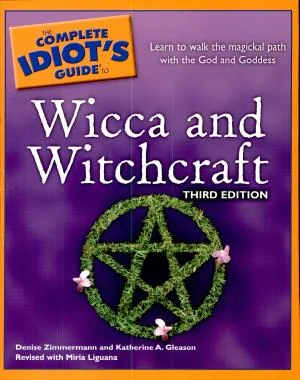
The complete idiot's guide to wicca and witchcraft
 72
72

The complete idiot's guide to wicca and witchcraft
The "Complete Idiot's Guide to Wicca and Witchcraft" attempts to distill a vast and varied subject into digestible chapters. Its strength lies in its clear, jargon-free presentation of complex ideas, making concepts like the Wheel of the Year accessible to absolute beginners. The inclusion of practical advice on setting up a sacred space is particularly commendable for those starting out. However, the book's broad approach occasionally leads to oversimplification, particularly concerning the historical nuances of witchcraft's evolution and the diversity within modern Wicca. While it correctly identifies Gerald Gardner's influence, it could benefit from further exploration of other significant movements that shaped contemporary Paganism. Overall, it serves as a competent, if somewhat generalized, primer for the uninitiated.
📝 Description
72
Published in 2000, this guide demystifies Wicca and witchcraft for newcomers.
Denise Zimmermann and Katherine A. Gleason's "The Complete Idiot's Guide to Wicca and Witchcraft" offers a clear introduction to nature-based spiritual practices. The book breaks down core Wiccan principles, moving beyond fringe perceptions to present it as a spiritual path. It covers essential elements like the Wheel of the Year, the concept of the divine feminine, and the practical aspects of spellcasting and ritual.
This work is aimed at those beginning their exploration of witchcraft and Wiccan traditions. It serves those curious about earth-centered spirituality, paganism, and the history of folk magic. Readers who appreciate straightforward explanations and a structured learning method will find this book useful. It details key concepts such as the God and Goddess duality, the elemental forces, and the ethics guiding magical work. The authors also explain the importance of sabbats and esbats, common ritual tools, and the threefold law, building a basic vocabulary for beginners.
This book emerged in 2000, a time when public interest in Neopaganism grew, partly fueled by renewed attention to witchcraft history. It acknowledges influences from figures like Gerald Gardner, who shaped modern Wicca. The guide addresses a public seeking accessible information on diverse witchcraft paths that developed following Gardner's work and earlier revivals of pagan traditions.
💡 Why Read This Book?
• Understand the seasonal cycles of the Wheel of the Year, learning how its eight sabbats, like Samhain and Beltane, connect to nature's rhythms and ancient agricultural festivals. • Grasp the fundamental principles of Wiccan ethics, including the concept of the Threefold Law, which guides practitioners in understanding the consequences of their actions and intentions. • Learn about essential ritual tools such as the athame and wand, and their symbolic roles in directing energy and focusing magical intent within a ritual context.
⭐ Reader Reviews
Honest opinions from readers who have explored this book.
❓ Frequently Asked Questions
What is the origin of the term 'Wicca' as presented in this guide?
The book explains that 'Wicca' is derived from an Old English word meaning 'witch' or 'sorcerer'. It traces the modern usage and popularization of the term to figures like Gerald Gardner in the mid-20th century.
Does the book discuss the role of the Goddess in Wicca?
Yes, it emphasizes the central role of the Divine Feminine, often referred to as the Goddess, within Wiccan theology. It explores her various aspects and associations with nature and fertility.
What are the key differences between Wicca and general witchcraft according to this book?
The guide differentiates Wicca as a specific, organized religion with distinct tenets and practices, often focusing on the God and Goddess. Witchcraft, it suggests, can be a broader term encompassing various magical practices and beliefs, not necessarily tied to Wiccan theology.
Are there practical exercises for beginners in this guide?
Certainly. The book includes guidance on creating a sacred space, basic meditation techniques, and performing simple rituals, offering hands-on steps for newcomers to engage with the material.
What is the significance of the 'Book of Shadows' mentioned?
The 'Book of Shadows' is presented as a personal or coven record of spells, rituals, and magical knowledge. It's described as a vital tool for documenting personal practice and preserving traditions.
Does the book cover the historical persecution of witches?
While focusing on modern practice, the book touches upon the historical context of witchcraft, acknowledging the legacy of persecution during periods like the witch trials, framing modern Wicca as a revival and redefinition.
🔮 Key Themes & Symbolism
The Wheel of the Year
This guide details the cyclical nature of Wiccan practice, centered around the Wheel of the Year. It elaborates on the eight major festivals (sabbats) that mark the solar year, from the winter solstice to the autumn equinox. Each sabbat, such as Yule, Imbolc, Ostara, Beltane, Litha, Lughnasadh, Mabon, and Samhain, is presented with its associated themes, symbolism, and potential ritual elements, connecting practitioners to the earth's natural rhythms and ancient agricultural traditions.
The God and Goddess
Central to Wiccan theology as presented here is the concept of the divine duality: the God and the Goddess. The book explores their archetypal roles, often depicting the Goddess as the embodiment of nature, fertility, and the moon, and the God as the horned god of the wild, representing virility and the sun. This dyad represents the balance of cosmic forces and is invoked in rituals to honor the sacred masculine and feminine principles.
Ethical Practice and the Threefold Law
The work emphasizes responsible magic use through a clear ethical framework, most notably the Threefold Law. This principle posits that whatever energy a practitioner sends out, whether positive or negative, will return to them threefold. This concept serves as a cautionary guide, encouraging practitioners to act with intention, respect, and consideration for all beings and the natural world.
Ritual and Sacred Space
Building a sacred space and performing rituals are presented as fundamental skills for any witch or Wiccan. The book provides guidance on consecrating a ritual area, using tools like the athame, chalice, and wand, and casting a circle to define sacred time and space. It explains the purpose behind these actions: to create a focused environment for connecting with the divine and directing magical will.
💬 Memorable Quotes
Direct passages from the work, attributed to the author.
“Wicca is a religion that honors the Earth and its cycles.”
— This statement captures the core of Wiccan practice as presented: a nature-based spirituality deeply connected to the seasonal changes and the inherent sacredness of the natural world.
“The Goddess is the source of all life, death, and rebirth.”
— This highlights the prominent role of the Divine Feminine in Wiccan cosmology, viewing her not just as a deity but as the fundamental generative force underlying existence.
“Magic is the art of causing change in conformity with will.”
— This definition frames magic as a skill and a practice, emphasizing the importance of focused intent and personal agency in manifesting desired outcomes.
“Harm none is the guiding principle of our actions.”
— This succinctly expresses the ethical imperative within Wicca, often linked to the Threefold Law, stressing the importance of non-maleficence in all magical and mundane endeavors.
“The Book of Shadows is a personal grimoire passed down or created.”
— This defines a key artifact in witchcraft, explaining its function as a repository for spells, rituals, and personal magical knowledge, essential for tradition and individual development.
🌙 Esoteric Significance
Tradition
This work fits within the broader category of modern Western Esotericism, specifically focusing on Wicca, a contemporary Pagan religion. While Wicca draws inspiration from older folk magic traditions and ceremonial magic, it largely departs from strictly Hermetic or Kabbalistic frameworks, instead centering on nature worship, the divine feminine, and cyclical time. It represents a significant development in post-Theosophical esoteric movements seeking nature-based spiritual paths.
Symbolism
Key symbols explored include the pentacle, representing the five elements (spirit above, and earth, air, fire, water below) and protection, and the athame, a ritual knife symbolizing the element of fire or air and the practitioner's will. The Wheel of the Year, with its eight sabbats, is a paramount symbolic representation of life, death, and rebirth, mirroring the cycles of nature and human experience.
Modern Relevance
The accessible format of this guide continues to be relevant for individuals exploring contemporary Paganism and witchcraft. It serves as a gateway for many into traditions influenced by Gardnerian Wicca and related paths. Its straightforward explanations of concepts like the God/Goddess duality and ethical principles remain foundational for many beginner practitioners in online communities and study groups.
👥 Who Should Read This Book
• Aspiring practitioners of Wicca and witchcraft seeking a structured, step-by-step introduction to core beliefs and practices. • Individuals curious about earth-centered spirituality and Paganism who desire a clear overview of nature-based religious traditions. • Comparative religion students or enthusiasts interested in understanding modern Pagan movements and their historical influences.
📜 Historical Context
Published in 2000, "The Complete Idiot's Guide to Wicca and Witchcraft" arrived as Neopaganism, particularly Wicca, was gaining broader public recognition beyond niche circles. This period followed the significant influence of figures like Gerald Gardner, whose system emerged in the mid-20th century, and Raymond Buckland, who published his influential "Complete Book of Witchcraft" in 1986. The book addresses a growing audience interested in earth-centered spirituality, partly fueled by feminist theology and environmental movements. It sought to explain witchcraft, which had long been associated with negative stereotypes often stemming from the 17th-century witch trials. While contemporary authors like Starhawk were exploring more radical and political dimensions of witchcraft, this guide focused on providing a foundational, accessible introduction, aiming to counter sensationalism and present Wicca as a legitimate spiritual path.
📔 Journal Prompts
Reflect on the symbolism of the Goddess as described in the text.
Consider the ethical implications of the Threefold Law in your daily life.
Explore the concept of the Wheel of the Year and its potential personal significance.
Document your initial thoughts on casting a sacred circle.
How might the elements (Earth, Air, Fire, Water, Spirit) inform your understanding of the world?
🗂️ Glossary
Wicca
A modern Pagan religion that emphasizes reverence for nature, the worship of the God and Goddess, and the practice of magic. It is often characterized by its cyclical view of time and its connection to the seasons.
Witchcraft
A broad term encompassing magical practices, often associated with nature, intuition, and the manipulation of energies. While Wicca is a specific religion, witchcraft can refer to a wider range of practices.
Wheel of the Year
The Wiccan annual cycle of eight seasonal festivals (sabbats), celebrating the changing seasons and the interplay of the God and Goddess throughout the year.
Sabbats
The eight major festivals celebrated in Wicca, marking significant points in the agricultural and solar year, such as Samhain, Yule, and Beltane.
Esbats
Rituals performed in Wicca in accordance with the phases of the moon, typically held monthly, honoring the Goddess.
Athame
A ritual dagger, typically double-edged, used in Wiccan and witchcraft practices primarily for directing energy and inscribing symbols, not for physical cutting.
Threefold Law
An ethical principle in Wicca stating that energy sent out into the universe returns to the sender threefold, encouraging positive actions and intentions.
🔮 Readers Also Liked
Browse all →








More Free Witchcraft & Paganism Books
View all →