Pagans and Christians in the Roman Empire
 82
82

Pagans and Christians in the Roman Empire
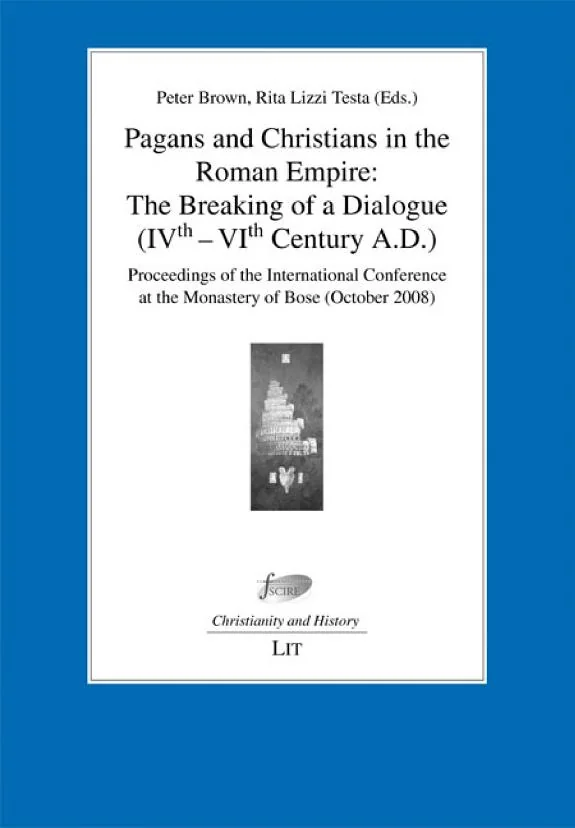
Peter Brown and Rita Lizzi Testa's collected volume revisits the contested terrain between paganism and Christianity, a subject Arnaldo Momigliano famously charted fifty years prior. The strength of this work lies in its granular examination of local dynamics and individual agency, moving beyond broad pronouncements of conflict. One finds a particularly compelling analysis of how certain pagan cults persisted, adapting their rituals or symbolism to coexist with, and sometimes even be absorbed by, Christian practices. However, the collection occasionally suffers from an over-reliance on academic discourse, which may render certain essays less accessible to the general reader. Despite this, the scholarly rigor and depth of research make it an important contribution to understanding the complex religious landscape of the late Roman world.
📝 Description
82
Essays published in 2011 consider Arnaldo Momigliano's 1963 study of pagan and Christian conflict.
This collection of essays, stemming from a 2011 conference, examines the relationship between pagan traditions and Christianity in the Roman Empire. It moves past a simple narrative of opposition to look at the complex interactions, conversions, and societal changes that occurred as Christianity grew. The authors consider how pagan practices were adapted or rejected, and how Christian life was shaped by these encounters.
The work is aimed at academics and students of Late Antiquity, religious history, and classical studies. It is especially relevant for those studying the social and religious dynamics between the 3rd and 5th centuries CE. The focus is on the practical, everyday aspects of religious life and cultural blending, rather than on theological arguments alone.
While not strictly esoteric in the occult sense, this book engages with the historical processes of religious transformation and adaptation that occurred during the Roman Empire's shift towards Christianity. It scrutinizes how pagan beliefs and practices were integrated, reinterpreted, or supplanted by the rising Christian faith. This focus on the lived reality and cultural negotiation of religious change provides a historical perspective on how belief systems evolve and interact, a subject of interest to those studying the historical development of religious traditions and their social impact.
💡 Why Read This Book?
• Understand the subtle shifts in Roman religious life before 400 CE, as detailed in the essays exploring local cultic practices and their interactions with emerging Christianity. • Gain insight into the scholarly legacy of Arnaldo Momigliano, whose 1963 work is a direct point of reference, providing a historical perspective on the study of Late Antiquity. • Appreciate the multifaceted nature of conversion, moving beyond simple narratives of religious replacement to explore the complex process of cultural and personal transformation in the Roman Empire.
⭐ Reader Reviews
Honest opinions from readers who have explored this book.
❓ Frequently Asked Questions
What specific period of the Roman Empire does 'Pagans and Christians' focus on?
The book primarily examines the Late Roman Empire, roughly from the 3rd to the 5th centuries CE, a period marked by significant religious and social upheaval.
How does this book build on Arnaldo Momigliano's earlier work?
It serves as a scholarly dialogue, initiated in 2011, reflecting on Momigliano's 1963 "The Conflict between Paganism and Christianity" by offering new perspectives and detailed studies.
Are the essays primarily about theological disputes?
No, the essays tend to focus more on the socio-religious dynamics, cultural interactions, and lived experiences of individuals and communities, rather than solely on theological arguments.
What is meant by 'religious syncretism' in the context of this book?
Syncretism refers to the blending of different religious beliefs and practices, which the book explores as a key mechanism in the interactions between pagan traditions and Christianity.
Who are the primary editors or authors of the essays?
The book is edited by Peter Brown and Rita Lizzi Testa, with contributions from various scholars reflecting on the topic.
Does the book discuss the persecution of Christians by pagans?
While the historical context of the Roman Empire includes periods of persecution, this work emphasizes the more complex interactions and gradual transformations that occurred, especially from the 3rd century onwards.
🔮 Key Themes & Symbolism
Religious Transformation Dynamics
This work dissects the mechanisms of religious change in the Roman Empire, moving beyond a simple narrative of pagan decline and Christian ascent. It highlights how existing pagan structures, cults, and philosophical ideas were not merely erased but actively engaged with, adapted, or reinterpreted by the growing Christian communities. The focus is on the gradual process of Christianization and its impact on the fabric of Roman society, examining instances where pagan practices persisted or were integrated in subtle ways, reflecting a complex, multi-directional cultural exchange rather than a swift conquest.
Social and Cultural Assimilation
The essays study how religious identity intertwined with social and cultural belonging in the Roman Empire. It examines the lived experiences of individuals and communities working through the transition from polytheistic traditions to monotheistic Christianity. This includes exploring how pagan festivals, rituals, and even sacred sites were sometimes Christianized, and how Christian practices themselves evolved under the influence of the surrounding pagan culture. The work underscores that conversion was often a gradual, socially embedded process, not an isolated event.
The Legacy of Arnaldo Momigliano
A central organizing principle of this collection is its engagement with Arnaldo Momigliano's foundational 1963 study, 'The Conflict between Paganism and Christianity.' The scholars contributing to this volume reflect on and extend Momigliano's arguments, fifty years after his influential work. They build upon his insights into the importance of religion as a transformative force in Late Antiquity, offering updated research and new interpretations of the complex relationship between pagan and Christian worldviews in the Roman context.
Pagan Survival and Adaptation
Contrary to a simplistic view of paganism's demise, this book illustrates its resilience and capacity for adaptation within the Roman Empire. It explores how various pagan cults, philosophical schools, and their associated customs continued to exist and evolve, often in dialogue or tension with Christianity. The work investigates the strategies employed by pagans to maintain their traditions, and how some elements of paganism were absorbed into the developing Christian framework, demonstrating a more fluid and less confrontational historical reality than often portrayed.
💬 Memorable Quotes
Direct passages from the work, attributed to the author.
“The collection reflects on Arnaldo Momigliano's 1963 study, fifty years on.”
— This highlights the book's origin as a scholarly retrospective, engaging with a foundational text in the study of Late Antiquity and reassessing its conclusions with new evidence and perspectives.
“Focus on the lived experience of religious change.”
— This indicates a shift from purely theological or institutional analysis towards understanding how ordinary people and communities experienced the transition between paganism and Christianity.
“Exploration of the complex relationship between paganism and Christianity.”
— This points to a nuanced approach, moving beyond a simple conflict narrative to examine interactions, syncretism, and mutual influences between the two religious systems.
“The essays examine the period of Late Antiquity.”
— This situates the book's subject matter within a specific historical era, known for its significant religious and cultural transformations within the Roman world.
“The work considers religion as a factor of transformation and development.”
— This emphasizes the book's core thesis: that religious shifts were not peripheral but central drivers of change in Roman society, shaping its institutions, culture, and social relationships.
🌙 Esoteric Significance
Tradition
While not strictly an esoteric text, this work engages with the historical context from which many Western esoteric traditions later drew inspiration. It examines the late Roman period, a crucible where Neoplatonism, Gnosticism (though often suppressed), and early Christian mysticism coexisted and influenced each other. The book's focus on the dissolution of older cosmologies and the rise of new spiritual frameworks provides background for understanding the intellectual currents that would later be reinterpreted by Hermeticists and Theosophists.
Symbolism
The book implicitly touches upon symbols of transition and syncretism. The persistence of pagan iconography within Christian art, or the adaptation of pagan sacred sites for Christian worship, represents a symbolic layering. For instance, the transformation of a Mithraic temple into a Christian church signifies the absorption and recontextualization of sacred space. The very act of scholars revisiting Momigliano's work can be seen as a symbolic engagement with the past, seeking hidden meanings in historical narratives.
Modern Relevance
Contemporary practitioners of Western esotericism, particularly those interested in Hermeticism, Neoplatonism, and comparative religion, find relevance in this book's detailed examination of late antiquity. It offers a scholarly grounding for understanding the historical roots of concepts and practices that have been revived or reinterpreted in modern occultism. Thinkers and groups exploring the evolution of consciousness, the nature of belief systems, and the historical interplay of myth and religion can draw upon its insights into an important period of religious synthesis and transformation.
👥 Who Should Read This Book
• Comparative religion scholars: To understand the historical processes of religious interaction, syncretism, and conversion within a specific imperial context. • Students of Late Antiquity: To gain a nuanced perspective on the social, cultural, and religious dynamics shaping the Roman Empire from the 3rd to 5th centuries CE. • Those interested in the historical roots of Western esotericism: To explore the intellectual and spiritual landscape from which later esoteric traditions emerged, appreciating the complex interplay of pagan and Christian thought.
📜 Historical Context
Published in 2011, this collection emerges from a scholarly tradition deeply invested in understanding Late Antiquity, a field significantly shaped by figures like Arnaldo Momigliano. His 1963 work, "The Conflict between Paganism and Christianity," serves as a direct intellectual ancestor, prompting this volume's reflection fifty years later. The era of its own publication saw continued scholarly engagement with the complexities of religious transition in the Roman Empire, moving beyond earlier triumphalist narratives of Christianity. Contemporaries like Averil Cameron were also producing influential works on the period. This book's focus on nuanced interactions, social dynamics, and local variations offered a vital counterpoint to more generalized accounts, contributing to a richer understanding of how pagan traditions persisted and interacted with the ascendant Christian faith.
📔 Journal Prompts
The adaptation of pagan cults to Christian contexts.
Momigliano's thesis on pagan-Christian conflict fifty years later.
Individual agency in religious transition during the Roman Empire.
The role of social relationships in religious conversion.
Syncretic practices observed in Late Antiquity.
🗂️ Glossary
Late Antiquity
A historical period generally spanning from the 3rd to the 7th century CE, characterized by significant social, political, and religious transformations within the Roman Empire and its successor states.
Paganism
A broad term used historically to refer to polytheistic or indigenous religious traditions of the Roman world, distinct from Judaism and Christianity, often encompassing a wide array of cults and practices.
Christianization
The process by which individuals, communities, or societies adopt Christianity, often involving gradual cultural and social change alongside religious conversion.
Syncretism
The merging or blending of different religious beliefs, myths, and practices, often occurring when cultures come into contact, leading to new forms of religious expression.
Arnaldo Momigliano
An influential Italian historian (1908-1987) known for his significant contributions to the study of ancient history, particularly Roman history and the history of historiography.
Religious Interaction
The dynamic processes through which different religious groups and traditions influence, compete with, or coexist alongside each other within a given society or historical period.
Social Dynamics
The patterns of social relationships, interactions, and changes that occur within groups and societies, particularly relevant to understanding how religious shifts impacted community structures.
This book appears in 1 collection
🔮 Readers Also Liked
Browse all →






From the “Paganism” Collection
View all →






More Free Witchcraft & Paganism Books
View all →