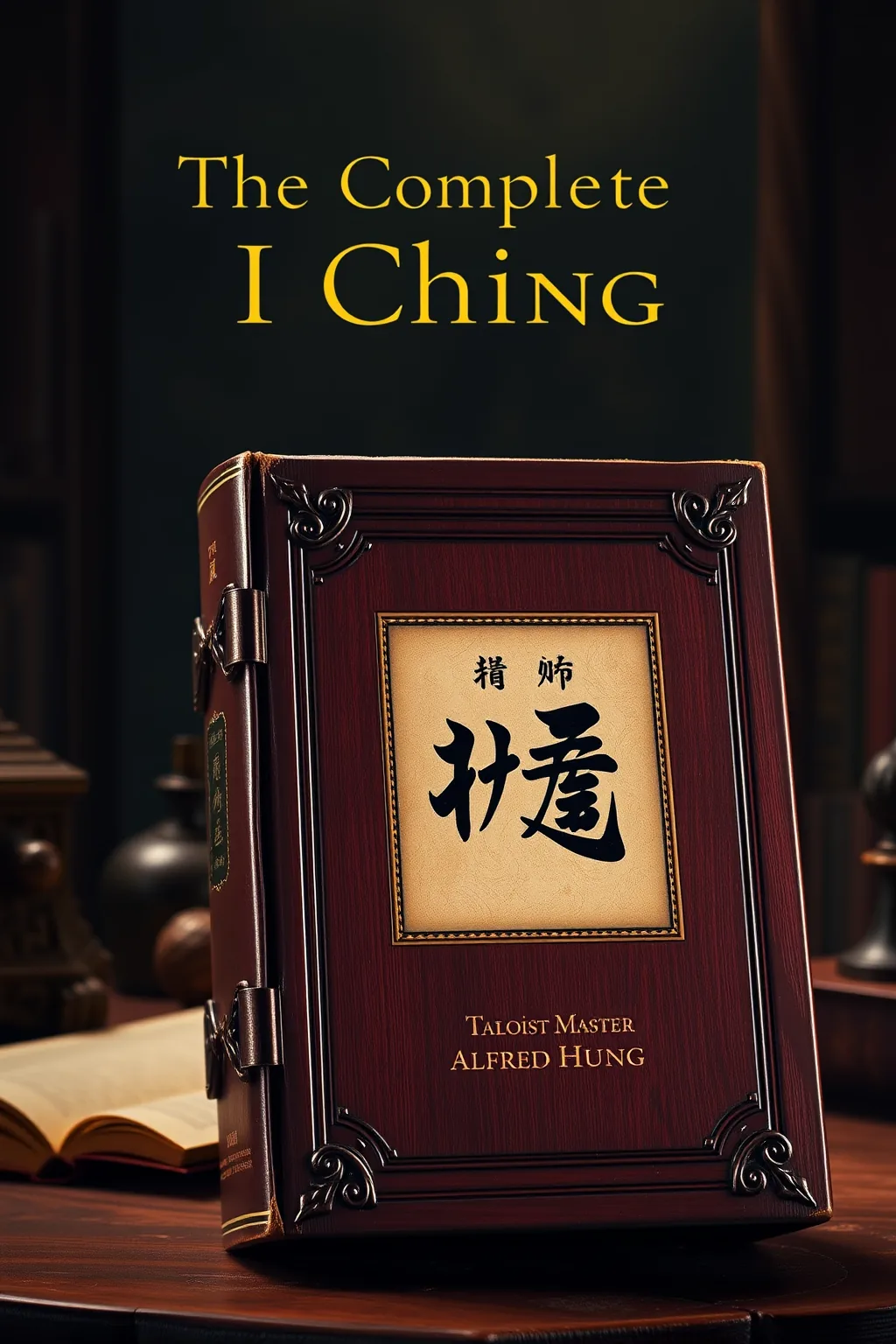
The Complete I Ching
 63
63

The Complete I Ching



Alaric Kestrel (Metaphysical Studies Reviewer) — 'The Complete I Ching' by Alfred Huang is an indispensable cornerstone for any serious student of esoteric philosophy and divination. Huang’s profound understanding of Taoist principles imbues this translation with an unparalleled depth, moving beyond mere literal interpretation to capture the true spirit of the text. He masterfully deciphers the complex symbolism, revealing the I Ching not just as a predictive tool, but as a profound guide to navigating life's ever-shifting currents. This edition is a treasure for those seeking authentic insights into ancient Chinese cosmology and its practical application for personal growth and spiritual development. Essential for practitioners and scholars alike.
📝 Description
63
Alfred Huang's 1998 translation of the I Ching offers a complete rendering of the classic text.
This translation and commentary by Taoist Master Alfred Huang presents the sixty-four hexagrams of the I Ching. Huang's work goes beyond its use as a divination tool, treating the Book of Changes as a philosophical text that describes the principles of change and harmony with the natural world. He details the meanings within each hexagram, their connections to one another, and their relevance to human experience and the environment.
The book aims to reveal the fundamental patterns of the universe. It discusses concepts of cosmic balance and the nature of dynamic change. Huang's interpretation is intended for those who study esoteric practices, philosophy, or seek personal understanding through ancient texts. It invites readers to connect with a long-standing source of knowledge to cultivate wisdom and intuition.
The I Ching, or Book of Changes, is a foundational text in Chinese philosophy and esoteric traditions, dating back over three thousand years. It is central to Taoism, Confucianism, and various folk religions, influencing divination practices, political thought, and personal ethics. Its core is the idea that the universe is in constant flux, governed by opposing forces, and that understanding these patterns allows for alignment with the Tao, or the Way. Alfred Huang's translation and commentary place this ancient system within a Taoist framework, emphasizing its practical application for navigating life's complexities and achieving inner harmony.
💡 Why Read This Book?
Unlock ancient secrets to life's flux. 'The Complete I Ching' offers unparalleled clarity on the Book of Changes, revealing its philosophical depth and practical divination wisdom. Ideal for seekers of truth, scholars of Eastern thought, and practitioners aiming to deepen their intuitive connection to universal patterns. This comprehensive guide illuminates the path to wisdom and harmonious living.
⭐ Reader Reviews
Honest opinions from readers who have explored this book.
❓ Frequently Asked Questions
What is the I Ching?
The I Ching, or Book of Changes, is an ancient Chinese divination text and philosophical classic. It consists of 64 hexagrams, each representing a fundamental situation or archetype, used to understand and navigate the changes in life.
Who was Taoist Master Alfred Huang?
Alfred Huang was a renowned scholar and practitioner of Taoism, deeply respected for his insightful translations and commentaries on classic Chinese texts, particularly the I Ching. His work is celebrated for its spiritual depth and accessibility.
How is the I Ching used for divination?
Divination with the I Ching typically involves casting yarrow stalks or coins to generate a hexagram. The resulting hexagram, along with its changing lines, is then interpreted using the text to provide guidance on a question or situation.
What makes this translation 'complete'?
This edition is considered 'complete' due to its comprehensive nature, including detailed explanations of each hexagram, its associated trigrams, lines, and extensive commentary that delves into both philosophical and practical applications.
Is prior knowledge of Chinese philosophy required to read this book?
While beneficial, prior knowledge is not strictly necessary. Master Huang's clear explanations and thoughtful commentary make the profound concepts accessible to newcomers, guiding them through the foundational principles.
🔮 Key Themes & Symbolism
The Dynamics of Change
Fundamentally, the I Ching is a profound exploration of change, positing that transformation is the only constant in the universe. It illustrates how everything is in a perpetual state of flux, influenced by yin and yang forces. Understanding these dynamics allows one to adapt, flow with circumstances, and make wise decisions by recognizing the opportune moment for action or stillness. This theme encourages a philosophical acceptance of impermanence and a practical approach to navigating life's inevitable shifts with grace and foresight.
Cosmic Harmony and Balance
The I Ching serves as a mirror to the cosmos, reflecting the intricate interplay of forces that govern both the universe and the human experience. It emphasizes the importance of maintaining balance and harmony, not just within oneself but also in relation to the external world. By understanding the principles of yin (passive, receptive) and yang (active, creative), readers can learn to cultivate inner equilibrium and align their actions with the natural order, leading to greater peace, efficacy, and spiritual integration.
Symbolism and Archetypal Wisdom
Each of the 64 hexagrams is a potent symbol, representing a fundamental situation, archetypal pattern, or stage in a life cycle. These symbols are not merely abstract concepts but embody deep psychological and spiritual truths. The text provides a wide range of imagery drawn from nature, human relationships, and societal structures, offering clear insights into the human condition. Deciphering this symbolic language unlocks a universal wisdom that transcends time and culture, fostering self-awareness and intuitive understanding.
💬 Memorable Quotes
Direct passages from the work, attributed to the author.
“Wisdom lies in knowing when to act and when to wait.”
— Emphasizes the crucial discernment required to navigate situations effectively, aligning action with the opportune moment revealed by the hexagrams.
“The superior man acts before it is time.”
— Speaks to proactive engagement and seizing opportunities, demonstrating foresight and the courage to initiate change when conditions are favorable.
“Stillness reveals the hidden.”
— Highlights the importance of introspection and quiet contemplation to gain deeper understanding and perceive subtle truths that are obscured by haste.
“Harmony arises from the balanced interplay of opposing forces.”
— Illustrates the core concept of yin and yang, suggesting that true balance and peace are achieved through the dynamic interplay and integration of seemingly opposite elements.
💡 Key Ideas
Editorial paraphrase of the work's core concepts — not direct quotes.
Change is the only constant.
A fundamental tenet of the I Ching, this quote highlights the impermanence of all things and the necessity of adapting to life's ever-shifting nature.
🌙 Esoteric Significance
Tradition
The I Ching is intrinsically linked to the esoteric traditions of Taoism and ancient Chinese cosmology. It embodies the principles of Tao, the fundamental, ineffable force that underlies all existence. Its practice is deeply intertwined with concepts of wu wei (non-action), the balance of yin and yang, and the flow of chi (life force). It is considered a living oracle, capable of reflecting the spiritual state of the inquirer and guiding them towards alignment with the Tao.
Symbolism
The hexagrams and their constituent trigrams are potent visual and conceptual symbols. The unbroken line (yang) represents the active, masculine principle, while the broken line (yin) signifies the passive, feminine principle. Their combinations create 64 archetypal images, each with a rich lexicon of symbolic meanings drawn from nature, elements, and human experience. These symbols serve as a universal language for understanding cosmic patterns, psychological states, and the unfolding of events.
Modern Relevance
In the modern era, the I Ching offers a profound antidote to the fragmentation and rapid pace of contemporary life. Its emphasis on balance, adaptability, and understanding natural cycles provides a framework for navigating uncertainty and making conscious choices. It serves as a powerful tool for self-reflection, intuitive development, and fostering a deeper connection to the wisdom of the universe, offering timeless guidance for personal growth and spiritual insight in a complex world.
👥 Who Should Read This Book
This indispensable volume is crafted for a diverse audience united by a quest for deeper understanding. For the **beginner** seeking an authentic introduction to Eastern philosophy and divination, it offers clear pathways. **Scholars** of comparative religion, philosophy, and cultural studies will find its depth and meticulous commentary important for academic research. **Seekers** of spiritual insight and personal growth will discover a profound guide for self-discovery and navigating life's challenges. **Practitioners** of various esoteric arts, from meditation to energy work, will find it a powerful tool for enhancing intuition and aligning with universal principles.
📜 Historical Context
The I Ching, or Book of Changes, has a history stretching back at least 3,000 years, making it one of the oldest and most influential texts in Chinese civilization. Its origins are shrouded in legend, attributed to figures like Fu Xi and King Wen. Over centuries, it evolved from a divinatory manual into a profound philosophical and cosmological text, deeply integrated into Taoism, Confucianism, and Chinese governance. During periods of intellectual flourishing, such as the Zhou Dynasty and the Song Dynasty, the I Ching was extensively studied, commented upon, and became a core part of scholarly and spiritual life. Its influence permeated art, medicine, strategy, and everyday life, shaping the worldview of East Asia. Master Huang's translation situates this ancient wisdom within its rich historical range, making its enduring relevance accessible to a modern audience.
📔 Journal Prompts
Reflect on a recent significant change in your life. Which hexagram from the I Ching might best represent this transformation, and why?
Consider the interplay of yin and yang in your daily life. Where do you see balance, and where might you seek greater equilibrium?
If you were to consult the I Ching on a personal challenge, what question would you pose, and what qualities would you hope the hexagram would illuminate?
Explore the archetypal symbolism of a hexagram that appeals to you. How does its imagery reflect your inner landscape or current circumstances?
How can the principles of adaptability and understanding natural cycles, as presented in the I Ching, be applied to foster greater peace and resilience in your modern life?
🗂️ Glossary
Hexagram
A figure composed of six stacked horizontal lines, each line being either solid (yang) or broken (yin). There are 64 hexagrams in the I Ching, representing fundamental situations and archetypes.
Trigram
A figure composed of three stacked horizontal lines, either solid or broken. The eight trigrams (Pa Kua) form the building blocks of the hexagrams and have distinct symbolic meanings.
Yin
The passive, receptive, dark, feminine principle in Taoist philosophy. Represented by a broken line (--) in the I Ching.
Yang
The active, creative, light, masculine principle in Taoist philosophy. Represented by a solid line (—) in the I Ching.
Tao
The fundamental, ineffable principle underlying all reality in Taoism. The 'Way' or 'Path' that governs the universe. The I Ching is seen as a reflection of the Tao.
This book appears in 2 collections
🔮 Readers Also Liked
Browse all →









More by Taoist Master Alfred Huang
All books →



From the “Tarot” Collection
View all →


![Cicero in twenty eight volumes. Vol.20: De senectute, De amicitia, De divinatione [Loeb 154]](/img/thumb/cicero-in-twenty-eight-volumes-vol-20-de-senectute-de-amicitia-de-divinatione-loeb-154-cicero-marcus-tulius-106-43-bce.webp)





More Free Divination & Tarot Books
View all →