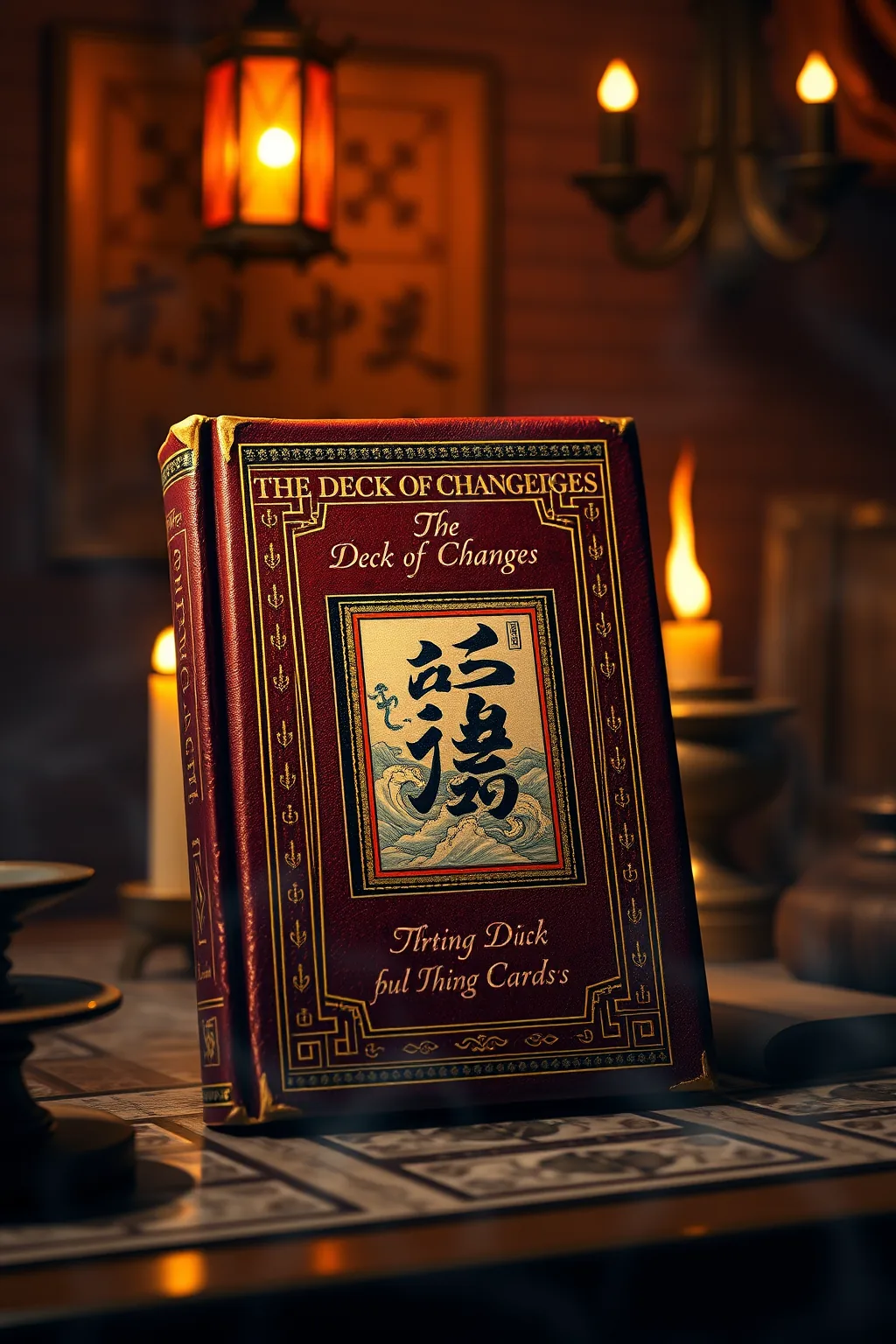
The Deck of Changes / Original I Ching Cards
 61
61

The Deck of Changes / Original I Ching Cards



Silas Hawthorne (Hermetic Studies Editor) — 'The Deck of Changes' is an indispensable artifact for anyone serious about delving into the Oracular arts. Its direct, unadorned presentation of the I Ching hexagrams and their associated imagery offers an unmediated experience of this foundational Eastern wisdom text. The raw, potent symbolism, stripped of later embellishments, allows for a profound connection to the archetypal energies at play. This is not a deck for the casual dabbler, but a serious instrument for the dedicated practitioner and scholar seeking to grasp the fundamental principles of cosmic dynamism and personal transformation. Its strength lies in its authenticity and its power to illuminate the subtle currents of destiny.
📝 Description
61
The Deck of Changes presents the I Ching in a unique card format, dating to the early 20th century.
This deck translates the classic I Ching into a set of cards, intended as a tool for divination and introspection. Unlike traditional texts, it uses individual cards to represent the hexagrams and their changing lines. The system draws upon the foundational principles of Yin and Yang, the sixty-four hexagrams, and the philosophy of change that has guided Chinese thought for centuries.
Users are meant to interact with the deck by drawing cards, which then reveal insights into cosmic order, personal destiny, and the cyclical patterns of existence. The deck aims to connect the user with a long tradition of thinkers who used the I Ching to understand universal forces and make decisions. It functions as a reflective aid, helping to clarify inner truths and the complexities of fate.
This deck is part of the Western esoteric tradition's engagement with Eastern philosophies, specifically the I Ching. It adapts a complex philosophical and divinatory system, originally presented in textual form, into a more accessible, tangible format. This aligns with trends in esoteric circles that seek to distill ancient wisdom into practical tools for personal development and spiritual understanding. The card format allows for a different kind of interaction with the I Ching's principles than the classical textual methods.
💡 Why Read This Book?
This deck is your direct conduit to the ancient wisdom of the I Ching, offering profound insights into life's challenges and opportunities. It's ideal for seekers yearning for deeper understanding, scholars pursuing esoteric traditions, and practitioners seeking authentic divination tools. Engage with timeless principles of change and balance, unlocking personal growth and cosmic harmony.
⭐ Reader Reviews
Honest opinions from readers who have explored this book.
❓ Frequently Asked Questions
What is the I Ching?
The I Ching, also known as the Book of Changes, is an ancient Chinese divination text and one of the oldest of the Chinese classics. It is a complex system of philosophy and divination that uses hexagrams to represent universal patterns of change.
How do I use these cards for divination?
Typically, one meditates on a question, then uses a method (like coin tossing or yarrow stalks, often simulated with the cards themselves) to generate hexagrams, which are then interpreted using the accompanying guidebook or your own intuition.
Are the 'Original I Ching Cards' different from modern I Ching decks?
Yes, these are often presented as closer to the original conceptualization, emphasizing core symbolism and meaning without extensive modern interpretations or added artistic flourishes that might obscure the fundamental energies.
What kind of insights can I expect from using this deck?
You can expect insights into the underlying dynamics of situations, guidance on navigating change, understanding of potential outcomes, and deeper self-awareness regarding your choices and their consequences.
Is prior knowledge of the I Ching necessary?
While prior knowledge is beneficial, the deck is designed to be accessible. The accompanying materials and the inherent symbolism can guide newcomers, though deeper study will enhance the interpretive power.
🔮 Key Themes & Symbolism
The Dance of Yin and Yang
This theme explores the fundamental duality of the universe as represented in the I Ching. Yin, the receptive, passive, feminine principle, and Yang, the active, creative, masculine principle, are in constant interplay, forming the basis of all phenomena. Understanding this dynamic balance is crucial for interpreting the hexagrams and reading through the ebb and flow of life. The cards serve as a visual lexicon of these interactions, revealing how opposing forces create harmony, conflict, and ultimately, transformation.
Cycles of Change and Transformation
The I Ching is fundamentally a book of change. This theme focuses on the cyclical nature of existence, illustrating how all things are in a perpetual state of flux. The hexagrams depict specific stages of these cycles, from nascent beginnings to ultimate decline, and the necessary adaptations required at each point. The deck acts as a map of these transformations, encouraging practitioners to embrace impermanence, adapt to new circumstances, and recognize the opportunities for growth inherent in every shift.
The Art of Oracular Wisdom
This theme examines the practice of divination itself, positioning the deck as a sacred tool for accessing higher wisdom. It emphasizes the intuitive and symbolic language of the I Ching, encouraging a deep, contemplative engagement with the cards. The focus is on how to pose meaningful questions, interpret the subtle messages conveyed by the hexagrams, and integrate this knowledge into one's life for guidance and self-understanding. It highlights the deck's role in fostering introspection and aligning oneself with the natural order of the cosmos.
💬 Memorable Quotes
Direct passages from the work, attributed to the author.
“The wise adapt, the foolish resist.”
— This aphorism underscores the core principle of change within the I Ching, advocating for flexibility and understanding in the face of life's inevitable shifts, contrasting it with the futility of stubborn opposition.
“The hexagrams are the whispers of destiny.”
— This evocative phrase frames the I Ching cards as divine messengers, offering guidance and revealing the subtle currents that shape our path, urging us to listen closely.
“Balance is the foundation of all.”
— This emphasizes the crucial role of equilibrium, particularly between Yin and Yang, as the a core part of harmony and stability in both the external world and within oneself.
“The present moment holds the key.”
— This highlights the I Ching's focus on the immediate, urging the practitioner to engage fully with the now as the point where past influences converge and future possibilities are shaped.
💡 Key Ideas
Editorial paraphrase of the work's core concepts — not direct quotes.
In stillness, find the movement.
This quote points to the paradoxical nature of existence, suggesting that profound understanding and insight often arise not from outward action, but from deep internal contemplation and observation.
🌙 Esoteric Significance
Tradition
The Deck of Changes is a direct portal to the Taoist and Confucian traditions of ancient China, deeply intertwined with I Ching scholarship. It represents a foundational text within Chinese cosmology and esoteric philosophy, emphasizing the natural laws of the universe and the principles of harmonious living. Its study is central to understanding Eastern metaphysical thought, including concepts of wu wei (non-action), the cyclical nature of time, and the interconnectedness of all things. It serves as a bridge to ancient wisdom, offering practical application for spiritual growth and self-cultivation.
Symbolism
The core of the I Ching's symbolism lies in its eighty-one trigrams and sixty-four hexagrams, formed by combinations of solid (Yang) and broken (Yin) lines. Each line and hexagram represents specific archetypal forces, natural phenomena, and stages of human experience. The visual patterns are not arbitrary but are believed to reflect the fundamental structures of reality, from the celestial to the terrestrial. Understanding this rich visual language allows for nuanced interpretation of situations, revealing hidden dynamics, potential outcomes, and paths toward balance and wisdom.
Modern Relevance
In the modern era, the I Ching offers a vital counterpoint to the often fragmented and materialistic worldview. It provides a framework for understanding complex systems, navigating uncertainty, and fostering resilience in a rapidly changing world. Its emphasis on balance, adaptability, and the interconnectedness of all things resonates deeply with contemporary concerns about sustainability, personal well-being, and the search for meaning. The deck serves as a timeless tool for introspection, decision-making, and cultivating a more profound connection with oneself and the universe.
👥 Who Should Read This Book
This deck is a treasure for the dedicated seeker yearning to understand the fundamental forces of existence. Scholars of Eastern philosophy and mysticism will find its direct presentation important for in-depth study. Practicing diviners and tarot readers seeking to expand their repertoire will appreciate its profound depth and unique approach to divination. Beginners curious about the I Ching can use it as an accessible entry point, provided they approach it with diligence and an open mind. It is for anyone who believes in the power of ancient wisdom to illuminate the present and guide the future.
📜 Historical Context
The I Ching, or Book of Changes, emerged from ancient China, with its origins stretching back potentially to the Shang Dynasty (c. 1600–1046 BCE). Its foundational text, the *Zhou Yi*, developed significantly during the Western Zhou Dynasty (c. 1046–771 BCE) and was further elaborated by Confucian scholars in the Spring and Autumn period (771–476 BCE) and the Warring States period (475–221 BCE). Initially, it served as a practical manual for divination, guiding rulers and commoners through critical decisions by interpreting the patterns of nature and society through its sixty-four hexagrams. Over millennia, it evolved into a profound philosophical and cosmological text, influencing not only Chinese thought but also impacting East Asian cultures and, in more recent centuries, Western esoteric traditions. Its enduring appeal lies in its abstract yet universally applicable principles of change, balance, and interconnectedness.
📔 Journal Prompts
Reflect on a recent significant change in your life. Which hexagram or combination of lines best represents this transition and why?
Consider a current challenge you are facing. If you were to draw a hexagram for guidance, what question would you ask, and what would you hope to learn?
Explore the interplay of Yin and Yang in a relationship or situation. How does the balance (or imbalance) manifest, and what adjustments could bring greater harmony?
Meditate on the concept of 'timeliness' as depicted in the I Ching. How can you better align your actions with the opportune moments in your life?
What does the idea of 'perseverance' mean to you in the context of the I Ching? How can the hexagrams offer insight into enduring challenges?
🗂️ Glossary
Hexagram
A symbol composed of six horizontal lines, either solid (Yang) or broken (Yin). There are 64 unique hexagrams, each representing a specific cosmic situation or stage of change.
Trigram
A symbol composed of three lines, either solid (Yang) or broken (Yin). There are eight basic trigrams, which are the building blocks of the hexagrams.
Yin
The passive, receptive, dark, feminine principle in Taoist philosophy, often represented by broken lines in the I Ching.
Yang
The active, creative, light, masculine principle in Taoist philosophy, often represented by solid lines in the I Ching.
Wu Wei
A Taoist concept meaning 'non-action' or 'effortless action.' It refers to acting in accordance with the natural flow of the universe, without striving or forcing.
This book appears in 3 collections
🔮 Readers Also Liked
Browse all →









From the “I Ching” Collection
View all →







More Free Divination & Tarot Books
View all →