Theosophy
 78
78

Theosophy
René Guénon's "Theosophy" presents a formidable, if unsparing, critique of the movement founded by Helena Blavatsky. Guénon’s strength lies in his rigorous analytical method, dissecting Theosophical claims with the precision of a metaphysician. He meticulously traces the lineage of Theosophical doctrines, often demonstrating their derivation from diverse sources but questioning the authenticity of their transmission within the Society's framework. A particularly incisive section examines the concept of the "Masters," exposing the potential for illusion in such claims from a Traditionalist viewpoint. However, the book's limitation is its uncompromisingly critical stance, which offers little room for the positive spiritual impulse Theosophy may have ignited in its adherents. While Guénon’s analysis of the doctrine's coherence is compelling, his dismissal of the movement's impact on individuals seeking spiritual understanding can feel austere. The work's value is undeniable for scholars of esotericism, providing a crucial counterpoint to uncritical acceptance. Guénon’s "Theosophy" serves as an essential, albeit challenging, text for understanding the intellectual architecture of a foundational modern spiritual movement.
📝 Description
78
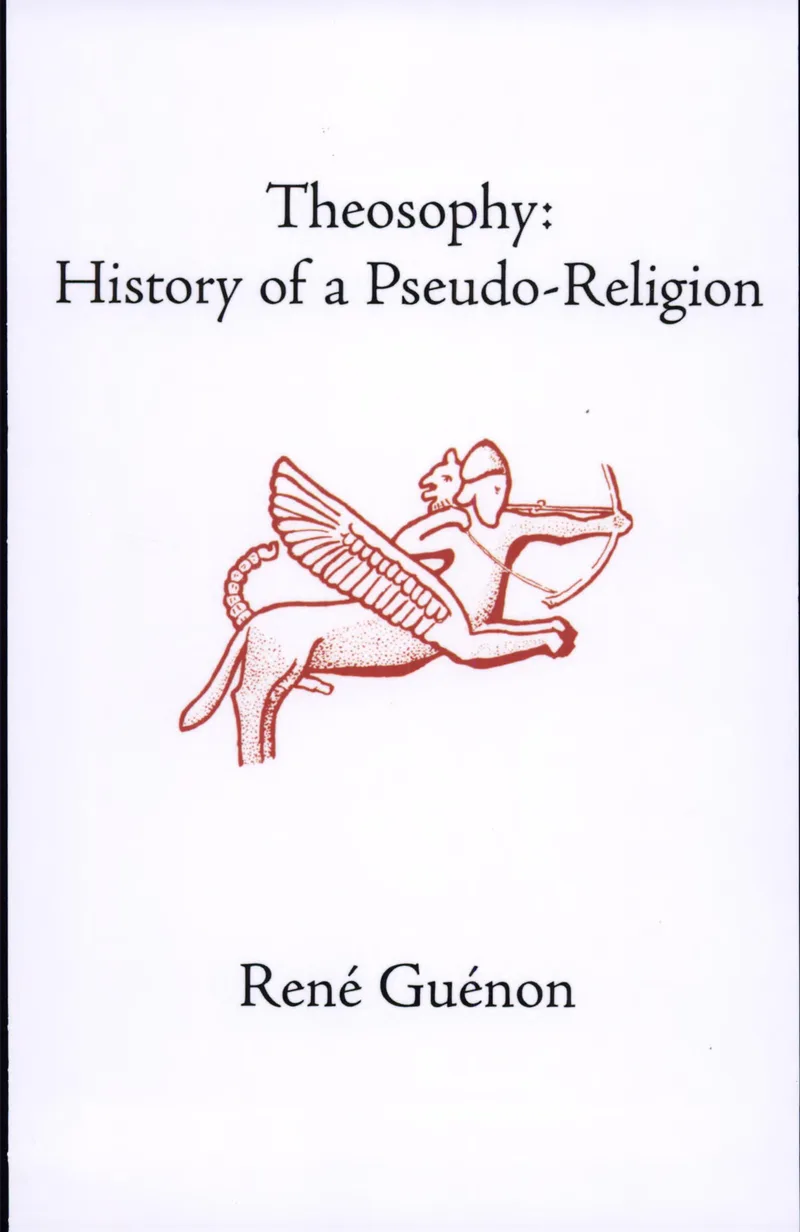
René Guénon published "Theosophy" in 1930, critically examining Helena Blavatsky's movement.
René Guénon's 1930 book, "Theosophy" (originally "Le Théosophisme, Histoire d'une pseudo-religion"), offers a rigorous critique of the Theosophical Society and its doctrines. Writing from the perspective of Traditionalism, Guénon assesses Theosophy not as a direct continuation of authentic metaphysical traditions, but as a synthesis of various disparate elements. He scrutinizes the Society's claims by tracing the origins of its ideas, often relating them to Western esoteric thought and Eastern philosophies. Guénon questions the true transmission and understanding of these elements within the Theosophical framework.
The book focuses on the systematic presentation of Theosophical doctrines and their philosophical consequences. Guénon's analysis seeks to expose what he perceived as a lack of genuine metaphysical coherence in the movement's teachings. This work is aimed at serious students of esotericism, comparative religion, and intellectual history who are interested in the development of modern occult movements. It requires a reader with a working knowledge of metaphysical concepts and a willingness to engage with critical arguments. It is not an introduction to Theosophy but a detailed scholarly examination.
Guénon's "Theosophy" stands as a significant critique within the Traditionalist school of esoteric thought. This school, which Guénon championed, posits the existence of a primordial, universal tradition from which all exoteric religions and esoteric doctrines supposedly derive. Guénon saw modern esoteric movements, including Theosophy, as often being distorted or incomplete derivations, lacking the direct spiritual authority and metaphysical rigor of the ancient traditions. His book analyzes Theosophy through this lens, evaluating its claims against what he understood to be the principles of perennial wisdom.
💡 Why Read This Book?
• Learn to critically assess spiritual doctrines by examining Guénon's analysis of Theosophical concepts like the "Masters" and karma, understanding how he evaluates their metaphysical coherence against traditional metaphysics. • Understand the historical placement of the Theosophical Society by exploring its intellectual roots and Guénon's critique of its synthesis of Eastern and Western esoteric traditions, contextualized within the early 20th century. • Gain insight into the Traditionalist school of thought by observing Guénon's methodology in applying his principles to critique a modern spiritual movement, differentiating his perspective from syncretic approaches.
⭐ Reader Reviews
Honest opinions from readers who have explored this book.
❓ Frequently Asked Questions
What is the primary critique René Guénon levels against Theosophy?
Guénon's primary critique is that Theosophy, as articulated by Blavatsky and her successors, lacks genuine metaphysical coherence and authentic spiritual transmission, viewing it as a syncretic synthesis of disparate elements rather than a true spiritual tradition.
When was René Guénon's "Theosophy" first published?
René Guénon's work on Theosophy was first published in French as "Le Théosophisme, Histoire d'une pseudo-religion" in 1930.
What esoteric traditions does Guénon discuss in relation to Theosophy?
Guénon discusses various traditions, including Hinduism, Buddhism, Western Hermeticism, and Kabbalah, analyzing how Theosophy appropriated and synthesized elements from them, often questioning the validity of these appropriations.
Who are key figures within Theosophy that Guénon analyzes?
Guénon primarily analyzes Helena Blavatsky, the founder of the Theosophical Society, and prominent successors like Annie Besant and C.W. Leadbeater, whose interpretations and expansions of Theosophical doctrine are central to his critique.
Does Guénon offer any positive aspects of the Theosophical movement?
While Guénon's focus is critical, his work implicitly acknowledges the Theosophical Society's role in reintroducing esoteric and Eastern ideas to the West, though he maintains these were often misrepresented or misunderstood.
What is the Traditionalist perspective that Guénon represents?
The Traditionalist perspective, often associated with Guénon and René Schuon, posits the existence of a primordial, universal spiritual tradition from which all exoteric religions and esoteric schools derive. They critique modern movements for deviating from this original Truth.
🔮 Key Themes & Symbolism
Metaphysical Critique
Guénon's central aim is to dissect Theosophy from a rigorous metaphysical standpoint, contrasting its doctrines with what he terms "primordial tradition." He scrutinizes concepts like the nature of God, the cosmos, and human spiritual evolution, arguing that Theosophy presents a distorted or incomplete understanding. This theme involves Guénon's method of identifying the sources of Theosophical ideas (e.g., Hinduism, Buddhism, Western esotericism) and evaluating their integrity and authentic transmission within Blavatsky's system.
Authenticity of Spiritual Authority
A significant focus is Guénon's questioning of the claimed spiritual authority within the Theosophical Society. He examines the doctrine of the "Masters" and the hierarchical structure, probing whether these figures and their teachings represent genuine spiritual transmission or a construct lacking metaphysical basis. This theme examines Guénon's concern with the potential for illusion and deviation when spiritual authority is not grounded in universally recognized traditional principles.
Syncretism vs. Universal Tradition
Guénon distinguishes between genuine universal tradition and what he perceives as the superficial syncretism of Theosophy. He argues that Theosophy's attempt to blend various religious and esoteric elements often results in an eclectic patchwork that lacks the underlying unity of true spiritual wisdom. This theme explores Guénon's view that while many traditions share common roots, their superficial amalgamation without understanding the deeper principles leads to doctrinal confusion.
Theosophy's Historical Trajectory
The book traces the historical development and reception of Theosophy, particularly its emergence in the late 19th century. Guénon contextualizes Theosophy within the broader field of modern spiritual movements and critiques its intellectual lineage. This theme involves examining the influence of figures like Helena Blavatsky, Annie Besant, and C.W. Leadbeater, and assessing the societal and intellectual impact of the Theosophical Society's doctrines.
💬 Memorable Quotes
Direct passages from the work, attributed to the author.
“Theosophy is not a doctrine, but a history of a pseudo-religion.”
— This statement captures Guénon's core argument: that Theosophy, despite its claims, functions more as a historical phenomenon and a fabricated spiritual system rather than a genuine, coherent doctrine derived from authentic tradition.
“The Theosophical Society took possession of certain traditional symbols, but misunderstood their meaning.”
— Guénon suggests that Theosophy adopted esoteric symbols and concepts from various traditions but failed to grasp their profound metaphysical significance, reducing them to superficial interpretations or eclectic arrangements.
“The doctrine of the Masters is a modern invention, not part of an ancient lineage.”
— This highlights Guénon's skepticism regarding the purported spiritual guides of Theosophy, suggesting their existence and teachings do not align with the authentic channels of spiritual authority found in established traditional hierarchies.
“Syncretism is the mark of a declining spiritual understanding.”
— Guénon views the blending of diverse traditions, as seen in Theosophy, not as a sign of spiritual universality but as an indicator of the erosion of genuine understanding, leading to a superficial and incoherent spiritual outlook.
“True spiritual transmission requires adherence to immutable principles.”
— This reflects Guénon's emphasis on the necessity of continuity and fidelity to established metaphysical truths for any spiritual teaching or authority to be considered valid and authentic.
🌙 Esoteric Significance
Tradition
Guénon's work aligns with the Traditionalist school, which posits a universal, primordial spiritual tradition (Sophia Perennis) from which all exoteric religions and esoteric doctrines ultimately derive. He views Theosophy as a modern, flawed manifestation that deviates from this authentic lineage. His analysis critically assesses how Theosophy appropriates and reinterprets elements from Hermeticism, Kabbalah, and Eastern traditions, judging them against the standards of this perceived original, unbroken transmission.
Symbolism
Guénon scrutinizes the symbolic language employed by Theosophy, often pointing out that while symbols are drawn from ancient traditions (e.g., the serpent, the triangle, the 'ouroboros'), their interpretation within the Theosophical framework is frequently superficial or erroneous. He emphasizes that true esoteric understanding requires grasping the metaphysical principles symbolized, not merely cataloging or reinterpreting them eclectically.
Modern Relevance
Guénon's critique remains relevant for understanding the intellectual foundations of modern esotericism and the New Age movement, many of which trace their lineage or ideas back to Theosophy. Contemporary scholars of Western esotericism and students of Traditionalism continue to engage with his rigorous analysis to differentiate authentic spiritual transmission from syncretic or pseudo-esoteric systems.
👥 Who Should Read This Book
• Students of Helena Blavatsky and the Theosophical Society seeking a critical, scholarly assessment of its doctrines beyond popular interpretations. • Practitioners and scholars of Traditionalist philosophy interested in René Guénon's application of his metaphysical principles to analyze modern spiritual movements. • Researchers in comparative religion and intellectual history examining the development of esoteric thought in the late 19th and early 20th centuries.
📜 Historical Context
René Guénon's "Theosophy" was published in 1930, a period when the Theosophical Society, founded in 1875 by Helena Blavatsky, had achieved considerable influence. The early 20th century saw Theosophy disseminate Eastern philosophies and esoteric ideas throughout the West, impacting art, literature, and spiritual thought. Guénon, writing from his Traditionalist perspective, viewed Theosophy as a modern deviation, a "pseudo-religion" that misunderstood and misrepresented ancient traditions. He was critical of its syncretic approach, particularly the interpretations of Blavatsky's successors like Annie Besant and C.W. Leadbeater, whose writings expanded upon the initial doctrines. Guénon's work engaged with intellectual currents that included burgeoning anthroposophy, the philosophical critiques of Materialism, and various esoteric revivalist movements. His critique offered a stark contrast to the more celebratory reception of Theosophy by some contemporaries, positioning him as a sharp intellectual counterpoint.
📔 Journal Prompts
The nature of "pseudo-religion" as presented in Guénon's critique of Theosophy.
The concept of "spiritual transmission" and its perceived absence in Theosophy.
Guénon's distinction between "syncretism" and "universal tradition."
The role of "Theosophical symbols" and their interpretation.
The "Masters" doctrine and its metaphysical validity according to Guénon.
🗂️ Glossary
Pseudo-religion
A term used by Guénon to describe a system that mimics the form or outward appearance of a religion or spiritual tradition but lacks genuine metaphysical foundation or authentic spiritual transmission.
Traditionalism
A philosophical and spiritual perspective, championed by Guénon, asserting the existence of a primordial, universal spiritual truth (Sophia Perennis) from which all authentic traditions derive.
Metaphysical Coherence
The internal consistency and logical soundness of doctrines when examined from the perspective of fundamental reality and universal principles, a key criterion for Guénon's critique.
Syncretism
The blending or amalgamation of elements from different religious or philosophical traditions, which Guénon often viewed as superficial when lacking a unifying metaphysical principle.
Spiritual Transmission
The authentic passing down of spiritual knowledge, authority, or realization from one generation or teacher to another within an established lineage or tradition.
The Masters
The purported spiritual teachers or adepts central to Theosophical teachings, whose existence and authority Guénon critically examines.
Primordial Tradition
The concept, central to Traditionalism, of an original, uncorrupted spiritual revelation or wisdom from which all subsequent traditions are derived.