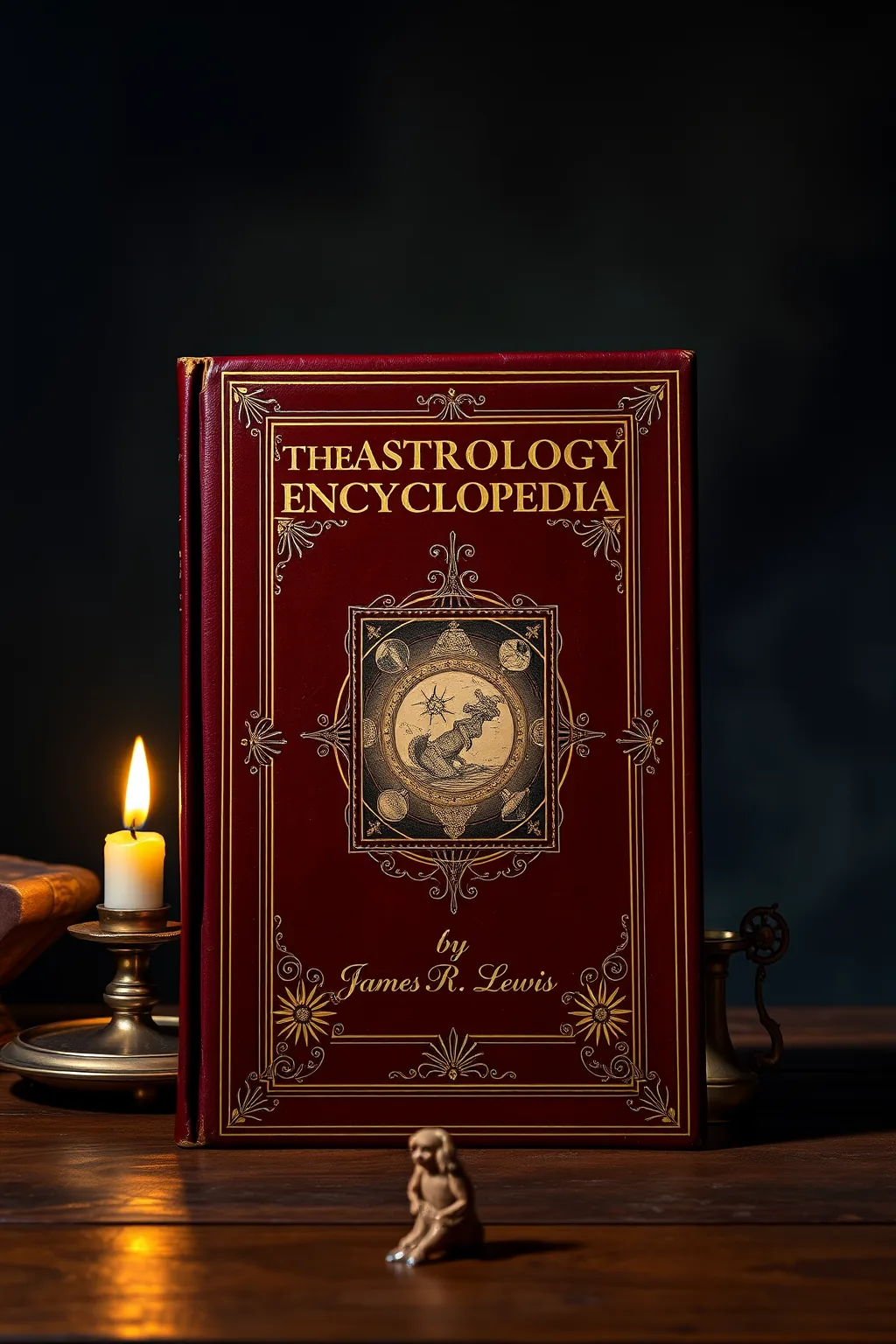
The astrology encyclopedia
 77
77

The astrology encyclopedia
James R. Lewis's *The Astrology Encyclopedia* is a remarkably thorough compilation, especially considering its 1994 publication date, a time when accessible, comprehensive references for astrological lore were less common. Its strength lies in its sheer breadth; it attempts to catalog nearly every conceivable term, figure, and historical movement associated with astrology, from the mundane to the esoteric. The entries are generally concise and informative, providing a valuable starting point for research. However, this encyclopedic ambition also presents a limitation. The desire to cover so much ground means that some entries, particularly on more complex or controversial topics, can feel somewhat superficial. For instance, the section on astrological psychology, while present, doesn't fully capture the depth of debate or the nuanced theories developed by figures like Jung, whose work significantly influenced modern astrological thought. Despite this, the encyclopedia remains an indispensable tool for anyone needing a quick, factual overview of astrological terminology and history. It’s a solid, if occasionally brief, guide to a vast subject.
📝 Description
77
James R. Lewis's The Astrology Encyclopedia was published in 1994.
Published in 1994, James R. Lewis's The Astrology Encyclopedia serves as a comprehensive reference for astrological thought and practice. It aims to explain concepts, figures, and traditions that have shaped astrology across cultures and time. The book covers a wide range, from ancient Babylonian astrology to modern psychological interpretations, with definitions, historical overviews, and contextual information for each entry.
This encyclopedia is for anyone interested in astrology, including students, practitioners, and researchers. It is a resource for understanding astrological principles and their varied forms. Whether examining natal charts, horary astrology, or the history of astrological ideas, Lewis's work offers a structured way to learn and clarify complex subjects. The book appeared during a time of growing academic and popular interest in subjects like astrology, seeking to synthesize and examine occult traditions.
The Astrology Encyclopedia was published in 1994, a period marked by increased academic and popular attention to esoteric subjects. It emerged as part of a broader effort to synthesize and critically analyze occult traditions, moving beyond anecdotal evidence. Lewis's work offered a structured, encyclopedic approach to astrology, acting as a counterpoint to more specialized or advocacy-focused texts. It reflects a scholarly attempt to map the field of astrology comprehensively.
💡 Why Read This Book?
• Gain a foundational understanding of astrological principles like the twelve zodiac signs and planetary rulerships, directly referencing the encyclopedia's detailed explanations to build your core knowledge. • Explore the historical trajectory of astrology, from its ancient Mesopotamian origins to its modern iterations, by examining specific entries on key historical periods and figures mentioned within the text. • Clarify the meaning of complex astrological concepts, such as the various aspects and houses, by consulting the encyclopedia's precise definitions and brief historical contexts.
⭐ Reader Reviews
Honest opinions from readers who have explored this book.
❓ Frequently Asked Questions
When was The Astrology Encyclopedia first published?
The Astrology Encyclopedia was first published in 1994, offering a comprehensive reference point for astrological concepts and history during a period of growing interest in the subject.
What kind of information can I expect to find in The Astrology Encyclopedia?
You can expect definitions of astrological terms, explanations of celestial bodies (planets, signs, houses), historical overviews of astrological traditions, and information on key figures in astrology.
Is The Astrology Encyclopedia suitable for beginners in astrology?
Yes, its encyclopedic format makes it highly suitable for beginners, providing clear definitions and foundational knowledge for those new to astrological studies.
Does the book cover different astrological traditions?
Indeed, the work explores a wide array of astrological traditions, spanning from ancient Babylonian astrology to more contemporary Western psychological approaches.
Who is the author of The Astrology Encyclopedia?
The author is James R. Lewis, a scholar known for his extensive work on religion and the occult, bringing a critical and comprehensive perspective to astrological studies.
Can this book help me understand astrological symbolism?
Absolutely. The encyclopedia provides context for understanding the symbolism associated with planets, signs, and houses, crucial for interpreting astrological charts and concepts.
🔮 Key Themes & Symbolism
Foundational Astrological Elements
The encyclopedia meticulously defines and contextualizes the core building blocks of Western astrology. This includes detailed entries on the twelve zodiac signs, such as Aries and Pisces, exploring their archetypal meanings, ruling planets, and elemental associations. Similarly, the ten classical planets, from the Sun and Moon to Saturn and Pluto, are explained in terms of their mythological associations and symbolic functions within a birth chart or predictive context. The twelve houses, representing different areas of life, are also thoroughly covered, providing a structured framework for understanding how these celestial energies manifest in the terrestrial realm.
Historical Development and Traditions
Lewis traces the evolution of astrology across millennia, highlighting its presence in ancient civilizations like Mesopotamia and Greece, and its subsequent development through Hellenistic, medieval Arabic, and Renaissance European periods. The encyclopedia offers insights into how astrological systems were adapted and transformed over time, often intertwined with astronomy, philosophy, and religious beliefs. It touches upon figures and movements that significantly shaped astrological thought, providing a historical narrative that underscores astrology's enduring influence and its complex relationship with scientific and cultural paradigms.
Astrological Techniques and Interpretations
Beyond basic definitions, the book studies various astrological techniques and interpretive frameworks. Entries cover concepts such as aspects (the geometric angles between planets), lunar nodes (representing karmic pathways), and fixed stars. It also explores different branches of astrology, including natal, horary, and mundane astrology, and discusses predictive methods like transits and progressions. This comprehensive approach allows readers to grasp the diversity of astrological practice and the various tools available for chart analysis and forecasting.
Astrology and Esoteric Thought
The encyclopedia acknowledges astrology's deep roots within broader esoteric traditions. It implicitly or explicitly connects astrological symbolism to Hermeticism, Kabbalah, and alchemy, illustrating how these systems have informed each other. By providing definitions for terms and concepts that appear across various occult disciplines, Lewis bridges the gap between astrology and its wider spiritual and mystical context, positioning it not merely as a predictive tool but as a symbolic language for understanding the cosmos and human consciousness.
💬 Memorable Quotes
Direct passages from the work, attributed to the author.
“The twelve zodiac signs form the fundamental framework of astrological interpretation.”
— This statement highlights the foundational nature of the zodiac in astrology. It suggests that understanding the archetypal energies and symbolism of signs like Taurus or Scorpio is essential before exploring more complex astrological calculations or interpretations.
“Planetary aspects reveal the dynamic interplay between different life forces.”
— This highlights that the angles between planets (e.g., conjunctions, squares, trines) are not just geometric measurements but represent how various energies within a horoscope interact, creating tension, harmony, or synthesis.
“Horary astrology seeks to answer specific questions through chart interpretation.”
— This points to a specialized branch of astrology where a chart is cast for the exact moment a question is posed, aiming to provide a direct answer based on the celestial configuration at that precise time.
“The houses delineate the spheres of experience in a natal chart.”
— This emphasizes that each of the twelve houses corresponds to a specific domain of life, such as career, relationships, or personal finances, and that planetary placements within these houses indicate where significant life events might occur.
“Astrology has been interpreted as a symbolic language of the cosmos.”
— This captures a philosophical view of astrology, suggesting it functions as a system of metaphors and archetypes that can be used to understand universal patterns and the human condition in relation to celestial movements.
🌙 Esoteric Significance
Tradition
The Astrology Encyclopedia fits broadly within the Western Esoteric tradition, particularly its historical and philosophical dimensions. While not strictly a practitioner's manual for a specific lineage like Hermeticism or Kabbalah, it systematically documents the concepts, figures, and historical developments that are integral to these traditions. By presenting astrological knowledge as a coherent system with a long lineage, it implicitly validates its place within the broader spectrum of esoteric thought, treating it as a significant symbolic language and divinatory art.
Symbolism
Key symbols detailed include the twelve zodiac signs (e.g., the Ram for Aries, the Bull for Taurus), representing archetypal energies and life stages. The planets, from Mercury (communication) to Jupiter (expansion), are explored as potent forces influencing human affairs. The book also clarifies the symbolism of astrological houses, which map celestial energies onto specific areas of life, such as relationships (7th House) or career (10th House), offering a framework for interpreting the symbolic language of the cosmos.
Modern Relevance
Contemporary astrologers and scholars of esotericism frequently cite Lewis's encyclopedia as a foundational reference. Its comprehensive nature makes it valuable for those exploring the historical roots of modern psychological astrology or seeking to understand the evolution of astrological techniques. Thinkers and practitioners interested in comparative religion and occult studies also draw upon its entries to contextualize astrology within broader patterns of symbolic thought and ancient wisdom traditions.
👥 Who Should Read This Book
• Students of Western Esotericism: Individuals exploring the historical development and conceptual frameworks of traditions like Hermeticism and Kabbalah will find crucial context for astrology's role. • Aspiring Astrologers: Beginners seeking to understand core concepts such as zodiac signs, planets, and houses will benefit from the clear, encyclopedic definitions and overviews. • Academic Researchers: Scholars of religion, cultural history, or the history of science can utilize this work as a reference for terms, figures, and the historical progression of astrological thought.
📜 Historical Context
Published in 1994, James R. Lewis's *The Astrology Encyclopedia* arrived at a time when interest in esoteric subjects, including astrology, was experiencing a notable resurgence in both academic and popular circles. The late 20th century saw a scholarly turn towards examining occult traditions with greater rigor, moving beyond earlier sensationalist portrayals. Lewis's work contributed by providing a structured, reference-based approach to a field often characterized by specialized texts and oral traditions. It offered a comprehensive catalog of terms, figures, and historical developments, serving as a valuable counterpoint to the more interpretive or practice-oriented astrological literature prevalent at the time. Its publication occurred within a landscape where authors like Nicholas Campion were also beginning to publish more historically grounded astrological studies, reflecting a broader academic engagement with the subject.
📔 Journal Prompts
The concept of planetary aspects and their interpretation.
Historical precedents for astrology in ancient Mesopotamia.
The archetypal meaning of the twelve zodiac signs.
The function of the astrological houses in a natal chart.
The relationship between astrology and other esoteric disciplines.
🗂️ Glossary
Zodiac
The band of the sky extending approximately 8 degrees north or south of the ecliptic, through which the Sun, Moon, and planets appear to move. It is divided into twelve 30-degree segments, each named after a constellation.
Planet
In astrology, the Sun and Moon are considered 'planets' along with Mercury, Venus, Mars, Jupiter, Saturn, Uranus, Neptune, and Pluto. They represent distinct energies or archetypes influencing human life.
House
One of twelve divisions of the celestial sphere, typically based on the local horizon and meridian, representing different areas of life experience in a natal chart.
Aspect
The angular relationship between two or more planets or sensitive points in an astrological chart, indicating how their energies interact.
Ascendant (Rising Sign)
The zodiac sign and degree that was rising on the eastern horizon at the moment of birth, representing the outward personality and physical appearance.
Natal Chart
A map of the heavens at the precise moment and location of a person's birth, used to interpret personality, potential, and life patterns.
Ecliptic
The apparent path of the Sun across the celestial sphere throughout the year. It is the basis for the zodiacal belt.
🔮 Readers Also Liked
Browse all →









More by James R. Lewis
All books →




More Free Astrology & Cosmology Books
View all →