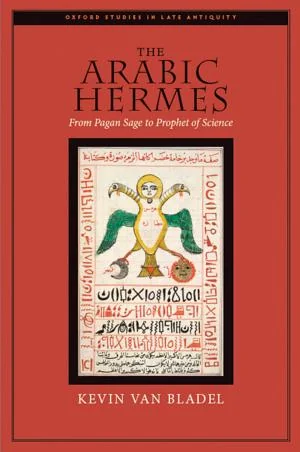
The Arabic Hermes
 76
76

The Arabic Hermes
Kevin Van Bladel's "The Arabic Hermes" offers a crucial examination of how the Hellenistic figure of Hermes Trismegistus was adopted and transformed within early Islamic intellectual circles. The work meticulously traces the transmission of Hermetic texts from Roman Egypt into Arabic, demonstrating how these philosophical and esoteric traditions interacted with nascent Islamic thought. Van Bladel highlights the intellectual fluidity of late antiquity and the early medieval period, showing that the boundaries between pagan, Christian, and Muslim scholarship were often porous. A particular strength lies in the detailed analysis of specific Arabic translations and commentaries, revealing how figures like Jabir ibn Hayyan engaged with Hermetic ideas. However, the book's academic rigor, while commendable, can sometimes make its dense arguments challenging for readers unfamiliar with the primary source material or the scholarly debates surrounding it. The exploration of the concept of the *tabula smaragdina* is particularly illuminating. "The Arabic Hermes" is an essential scholarly contribution for understanding the cross-cultural dissemination of esoteric wisdom.
📝 Description
76
### What It Is ### Who It's For ### Historical Context ### Key Concepts
💡 Why Read This Book?
• Learn how the figure of Hermes Trismegistus was reinterpreted within early Islamic intellectual traditions, moving beyond the Greek Hermetica of the 2nd and 3rd centuries CE. • Understand the complex transmission pathways of esoteric texts across cultures and religions, particularly concerning the influence of Hermeticism on figures like Jabir ibn Hayyan. • Gain insight into the philosophical and alchemical concepts embedded in Arabic Hermetic texts, such as the *tabula smaragdina*, and their impact on medieval thought.
⭐ Reader Reviews
Honest opinions from readers who have explored this book.
❓ Frequently Asked Questions
What is the significance of Hermes Trismegistus in Arabic traditions?
In Arabic traditions, Hermes Trismegistus was often identified with the prophet Idris or the ancient sage Thoth. His wisdom, particularly concerning alchemy and astrology, was preserved and adapted in texts like the *Picatrix* and the works attributed to Jabir ibn Hayyan.
When were the early Arabic translations of Hermetic texts made?
The translation movement of Greek texts into Arabic began in earnest in the 8th century CE, during the Abbasid Caliphate. Many Hermetic works were translated during this period, making them accessible to Islamic scholars.
How did Arabic scholars engage with Hermetic philosophy?
Arabic scholars integrated Hermetic philosophy into their own intellectual frameworks. They studied its astrological, alchemical, and philosophical content, often syncretizing it with Islamic theology and Neoplatonic ideas.
What role did alchemy play in the Arabic reception of Hermes?
Alchemy was a central aspect of the Arabic engagement with Hermes Trismegistus. The legendary sage was considered a master alchemist, and his supposed teachings on the transmutation of metals and the elixir of life were widely studied.
Who was Jabir ibn Hayyan and what is his connection to Hermes?
Jabir ibn Hayyan, a prominent 8th-9th century alchemist, is strongly associated with Hermetic traditions. Many works attributed to him show significant influence from Hermetic philosophy and alchemical practices, often referencing Hermes Trismegistus.
What is the *tabula smaragdina*?
The *tabula smaragdina*, or Emerald Tablet, is a short, cryptic text attributed to Hermes Trismegistus. It is considered a foundational document in alchemy and Hermeticism, containing principles like 'As above, so below.'
🔮 Key Themes & Symbolism
Hermeticism in the Islamic World
This work charts the fascinating transmission and adaptation of the Hermetic tradition from its Hellenistic origins in Roman Egypt to its reception within early Islamic intellectual milieus. It moves beyond the Greek Hermetica to explore how Arabic scholars, alchemists, and philosophers engaged with these texts, often identifying Hermes Trismegistus with figures like the prophet Idris. The book details how concepts of cosmology, astrology, and particularly alchemy were integrated into Islamic scholarship, influencing prominent figures and shaping esoteric discourse for centuries.
The Figure of Hermes Trismegistus
The study focuses on how the legendary Egyptian sage, Hermes Trismegistus, was perceived and utilized within Arabic scholarship. Far from a static figure, Hermes's persona evolved as his teachings were translated and commented upon. He was revered as a source of ancient wisdom, a master alchemist, and a philosophical guide. Van Bladel examines the evolution of this figure, tracing how his attributes and the ascribed texts were interpreted and recontextualized by Islamic thinkers, bridging the gap between ancient philosophy and medieval esotericism.
Transmission of Esoteric Knowledge
A core theme is the complex process by which esoteric knowledge, particularly Hermetic literature, traversed cultural and linguistic boundaries. The book meticulously details the translation efforts from Greek into Arabic during the early Abbasid period (8th-9th centuries CE) and subsequent commentaries. It illustrates the dynamic nature of intellectual exchange, revealing how ideas from late antiquity found new life and meaning within a different religious and cultural context, influencing fields from philosophy to medicine and magic.
Alchemy and the Emerald Tablet
The alchemical dimension of Hermeticism receives significant attention, with a particular focus on the *tabula smaragdina* (Emerald Tablet). This cryptic text, attributed to Hermes, was a starting point for alchemical theory and practice in the Arabic world. The book explores how Arabic alchemists interpreted its pronouncements, such as the famous 'As above, so below,' and how these interpretations informed their understanding of material transformation and spiritual ascent.
💬 Memorable Quotes
Direct passages from the work, attributed to the author.
“The Arabic reception of Hermes Trismegistus was not merely preservation but active adaptation.”
— This highlights that early Islamic scholars didn't just copy Greek Hermetic texts; they critically engaged with them, reinterpreting concepts and integrating them into their own philosophical and religious frameworks.
“Hermes was identified with the prophet Idris, linking ancient wisdom to Islamic revelation.”
— This points to a significant syncretic move, where the revered Hellenistic sage was equated with a prophetic figure within Islam, legitimizing Hermetic teachings through an established religious narrative.
“The *tabula smaragdina* offered a condensed, powerful statement of Hermetic principles.”
— This emphasizes the foundational importance of the Emerald Tablet, suggesting its brevity belied its profound influence on alchemical and cosmological thought in the Arabic tradition.
“Translation efforts in the 8th and 9th centuries were crucial for the spread of Hermetic ideas.”
— This underscores the historical significance of the Abbasid translation movement, positioning it as the primary engine for making Greek esoteric literature accessible to the burgeoning Islamic intellectual world.
“The work explores the diverse interpretations of Hermetic texts by figures like Jabir ibn Hayyan.”
— This indicates the book's focus on specific intellectual contributions, demonstrating how prominent figures in Islamic science and philosophy actively shaped the understanding and application of Hermeticism.
🌙 Esoteric Significance
Tradition
This work situates itself within the Hermetic tradition, a lineage tracing back to the Hellenistic period and the figure of Hermes Trismegistus. It specifically examines how this tradition was transmitted, adapted, and integrated into the intellectual field of the early Islamic world. It departs from a purely Greek or Roman focus, highlighting the crucial role of Arabic scholarship in preserving, transforming, and disseminating Hermetic wisdom, thus extending its lineage and influence into new cultural and religious spheres.
Symbolism
Key symbols explored include the *tabula smaragdina* (Emerald Tablet), the foundational text of alchemy, whose cryptic verses like 'As above, so below' encapsulate the Hermetic principle of correspondence between macrocosm and microcosm. Another significant motif is the identification of Hermes Trismegistus with the Islamic prophet Idris, a syncretic act that imbued the ancient sage with prophetic authority within an Islamic context, linking esoteric knowledge to divine revelation.
Modern Relevance
Contemporary thinkers and practitioners in Western esotericism, comparative religion, and the history of science continue to draw on the understanding of Hermeticism's transmission provided by this study. It informs modern interpretations of alchemy, astrology, and Gnosticism by demonstrating their complex historical development and cross-cultural interactions. Scholars and practitioners interested in the roots of occult traditions and their evolution across different civilizations find this work essential for grasping the foundational role of Arabic Hermeticism.
👥 Who Should Read This Book
• Scholars of religious studies and intellectual history interested in the cross-cultural transmission of ideas between the ancient Greco-Roman world and the early Islamic empires. • Students of Hermeticism, alchemy, and esoteric traditions seeking to understand the development and adaptation of these practices beyond their classical origins. • Researchers focusing on the philosophical and scientific currents of the Abbasid Caliphate and the specific contributions of figures like Jabir ibn Hayyan to esoteric thought.
📜 Historical Context
The early Arabic reception of Hermes Trismegistus occurred during a period of intense intellectual ferment in the Islamic world, particularly from the 8th century CE onwards. The Abbasid Caliphate actively sponsored translation movements, bringing Greek, Syriac, and Persian knowledge into Arabic. This era saw the flourishing of sciences like astronomy, medicine, and alchemy, often built upon pre-Islamic foundations. Hermetic texts, originating in Roman Egypt centuries earlier, found a receptive audience. Scholars like Hunayn ibn Ishaq were instrumental in translating Greek medical and philosophical works, a context in which Hermetic material also circulated. While not a formal 'school' in the modern sense, Hermeticism competed and interacted with other philosophical currents, including Neoplatonism and early Islamic theological schools like Mu'tazilism. The work of scholars such as Jabir ibn Hayyan in the late 8th and early 9th centuries exemplifies this engagement, integrating Hermetic ideas into alchemical theory.
📔 Journal Prompts
The concept of Hermes Trismegistus as the prophet Idris.
The influence of the *tabula smaragdina* on Arabic alchemical thought.
How the translation movement impacted the reception of Hermetic texts.
The relationship between Hermetic philosophy and early Islamic cosmology.
The adaptation of astrological traditions within Islamic Hermeticism.
🗂️ Glossary
Hermes Trismegistus
A legendary Hellenistic figure, identified as the author of numerous esoteric texts on astrology, alchemy, theology, and philosophy. Revered as a wise sage and prophet in various traditions.
Hermetica
A body of ancient philosophical and religious texts attributed to Hermes Trismegistus, originating primarily in Roman Egypt and influential in late antiquity and beyond.
Tabula Smaragdina
The Emerald Tablet, a short, cryptic alchemical text attributed to Hermes Trismegistus, considered a foundational document in Western and Islamic alchemy.
Jabir ibn Hayyan
A major 8th-9th century alchemist and philosopher, often associated with Hermetic traditions and credited with numerous influential works on alchemy and chemistry.
Idris
An Islamic prophet, often identified with the biblical Enoch and sometimes equated with Hermes Trismegistus in Arabic Hermetic traditions.
Abbasid Caliphate
The third caliphate, established in 750 CE, known for its significant intellectual and cultural achievements, including the translation of numerous Greek and Syriac texts into Arabic.
Hellenistic Period
The period of ancient Greek history and culture following the death of Alexander the Great (323 BCE) and preceding the Roman conquest (c. 146 BCE or 30 BCE), during which much Hermetic literature originated.
This book appears in 1 collection
🔮 Readers Also Liked
Browse all →









From the “Gnosticism” Collection
View all →





More Free Occult Philosophy Books
View all →