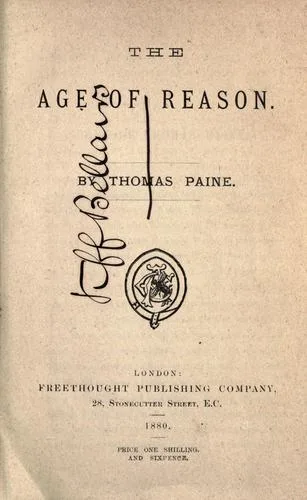
The Age of Reason
 77
77

The Age of Reason
Thomas Paine's The Age of Reason is less a gentle invitation to contemplation and more a direct challenge to the foundations of established faith. Paine's unvarnished prose, particularly his dissection of biblical narratives in Part Second, reads with the same revolutionary fervor that characterized his political pamphlets. He forces the reader to confront the logical inconsistencies he perceives within scripture, a strength that remains potent. However, the work's relentless focus on textual critique, while historically significant, can feel less revelatory to a modern audience already steeped in secular thought or alternative spiritualities. The central argument for deism, while clearly articulated, is presented with an intellectual certainty that leaves little room for the mystical or the ineffable, a notable limitation for those seeking broader spiritual exploration. Ultimately, it serves as a vital historical document of radical Enlightenment thought, essential for understanding the secularization of Western discourse.
📝 Description
77
Thomas Paine published The Age of Reason in 1794, challenging established religious authority.
Thomas Paine's The Age of Reason argues for a faith based on reason and the natural world, rather than religious dogma or scripture. Paine, a prominent figure of the American and French Revolutions, believed that individual intellect and observation of the universe were the true paths to understanding divinity. He systematically examined biblical accounts, pointing out what he saw as inconsistencies and historical errors to support his deistic viewpoint.
This work is for those who question traditional religious beliefs and seek a rational basis for faith. It will resonate with skeptics, deists, and anyone interested in the Enlightenment's intellectual debates about religion. Readers prepared for philosophical arguments and historical critiques of religious texts will find it particularly engaging. Paine's direct confrontation with the religious establishments of his era made the book controversial, leading to efforts to suppress it.
While not strictly an esoteric text in the sense of occult traditions, The Age of Reason engages with a form of rational spirituality that aligns with Enlightenment deism. This tradition, emphasizing natural law and a creator God who does not intervene in human affairs, sought a universal, accessible form of religious understanding independent of sectarian doctrines. Paine's insistence on individual reason as the sole guide to truth echoes the broader esoteric quest for direct experience and inner knowledge, albeit through a distinctly rationalist lens.
💡 Why Read This Book?
• Learn Paine's argument for deism, based on the observable 'religion of nature' rather than scripture, providing a distinct philosophical approach to divinity beyond traditional dogma. • Understand the historical context of the Enlightenment's challenge to religious authority, specifically Paine's direct critique of biblical accounts and the reception he faced around the late 18th century. • Grasp Paine's method of using reason and empirical observation to evaluate religious claims, offering a framework for critical thinking applicable to modern belief systems.
⭐ Reader Reviews
Honest opinions from readers who have explored this book.
❓ Frequently Asked Questions
What is the primary argument of Thomas Paine's The Age of Reason?
The book argues that reason and the observation of nature are the most reliable guides to understanding divinity, advocating for deism over revealed religions and challenging the authority of the Bible.
When was The Age of Reason first published?
The Age of Reason was first published in three parts between 1794 and 1807, though the edition referenced here was first published in 1920.
How did The Age of Reason impact religious institutions at the time?
Paine's work caused significant controversy, leading to widespread criticism from religious leaders and clergy who viewed it as a direct attack on Christianity and a threat to social order.
What does Paine mean by the 'religion of nature'?
The 'religion of nature' refers to the understanding of God derived from observing the universe, its order, and its laws, which Paine believed was universally accessible and self-evident.
Is Thomas Paine's The Age of Reason considered a deistic text?
Yes, The Age of Reason is a seminal work of deism, promoting the belief in a creator God who does not intervene in the universe or reveal divine will through scripture.
What specific criticisms does Paine level against the Bible?
Paine critiques the Bible by highlighting perceived historical inaccuracies, internal contradictions, and moral inconsistencies in its narratives and laws, arguing these undermine its divine authority.
🔮 Key Themes & Symbolism
Critique of Revealed Religion
Paine systematically dismantles the authority of scripture, questioning the divine origins of the Bible. He points to historical inconsistencies and the often violent or contradictory moral codes presented within religious texts. His approach is not one of simple rejection but a reasoned examination, aiming to expose what he views as human fabrication rather than divine truth. This theme is central to his deistic framework, seeking a purer, unmediated connection to the divine.
The Primacy of Reason
Central to Paine's philosophy is the elevation of human reason as the ultimate tool for discerning truth, especially concerning religious matters. He argues against blind faith and dogma, advocating instead for critical thinking and empirical evidence derived from the natural world. This emphasis on rational inquiry positions The Age of Reason as an important text of the Enlightenment, encouraging intellectual autonomy.
Deism and the Religion of Nature
Paine champions deism, the belief in a creator God who established the universe but does not intervene in its affairs or reveal divine law through prophets or holy books. He posits a 'religion of nature,' which is accessible to all through the contemplation of the cosmos. This view offers a spiritual path grounded in universal principles observable in the natural order, distinct from sectarian doctrines.
Separation of Church and State
While not explicitly a treatise on governance, Paine's critique of established religious institutions inherently supports the concept of separating religious authority from political power. By challenging the divine mandate claimed by churches, he implicitly argues for a secular society where reason, not religious dogma, guides public life and law. This aligns with his revolutionary ideals expressed in works like 'Common Sense'.
💬 Memorable Quotes
Direct passages from the work, attributed to the author.
“The Bible is a book of faith, and man, to have faith, must believe in the Bible.”
— This statement highlights Paine's recognition of the Bible's role within faith traditions, while simultaneously setting the stage for his critique of its exclusive authority and the requirement of unreasoned belief.
“My own mind is my own church.”
— This concise assertion expresses Paine's radical individualism and his deistic stance. It signifies a personal, internal connection to the divine, independent of external religious structures or doctrines.
“The creation is the Bible of the Deist.”
— Paine posits that the natural world itself serves as the ultimate text for understanding the divine. This emphasizes observation and reason over scripture, a core part of deistic philosophy.
“It is necessary to separate the man from the book.”
— This points to Paine's method of analyzing religious texts: he examines the content and authorship of the Bible as human works, distinct from claims of divine inspiration, allowing for critical evaluation.
“The word 'Revelation' ... cannot mean the book called the Bible.”
— Paine challenges the conventional understanding of 'revelation,' arguing that true divine communication is inherent in nature, not confined to specific texts or historical accounts that he deems unreliable.
🌙 Esoteric Significance
Tradition
While not strictly an esoteric text in the vein of Hermeticism or Kabbalah, The Age of Reason occupies a critical juncture between mainstream Enlightenment rationalism and emerging esoteric thought. Its emphasis on individual reason and direct experience of the divine, albeit through natural observation rather than mystical intuition, shares a lineage with certain Gnostic traditions that prioritized inner knowledge over institutionalized dogma. Paine's rejection of intermediaries aligns with a broader esoteric impulse towards direct communion.
Symbolism
The primary 'symbol' Paine engages with is the universe itself, presented as the 'Bible of the Deist.' The celestial bodies, the natural world, and the laws governing them are seen as divine manifestations. While not employing traditional esoteric symbols like the Ouroboros or the Tree of Life, Paine elevates the observable cosmos to a sacred text, imbuing scientific understanding with a spiritual dimension. The sun, as a source of light and life, can be seen as a deistic analogue to divine presence.
Modern Relevance
Paine's work continues to influence modern secularism, critical thinking, and certain branches of New Age spirituality that emphasize personal spiritual authority over organized religion. Thinkers and movements focused on humanism, freethought, and skepticism often cite Paine as a foundational figure. His arguments for reason as the arbiter of truth remain relevant in contemporary debates about science, faith, and the role of religion in public life, resonating with individuals seeking rational spiritual frameworks.
👥 Who Should Read This Book
• Individuals interested in the philosophical underpinnings of secularism and the Enlightenment's challenge to religious authority, seeking to understand the historical roots of modern skepticism. • Students of comparative religion and theology who wish to analyze deism as a distinct theological position and its critique of Abrahamic faiths, particularly Paine's method of textual analysis. • Seekers of alternative spiritual paths who are exploring non-dogmatic approaches to divinity, finding value in Paine's concept of the 'religion of nature' as a source of spiritual understanding.
📜 Historical Context
The Age of Reason emerged from the intellectual ferment of the late 18th century, a period dominated by the Enlightenment's emphasis on reason and skepticism towards traditional authority. Thomas Paine, already renowned for his revolutionary pamphlets 'Common Sense' and 'Rights of Man,' published this work in parts between 1794 and 1807. It directly challenged the foundations of Christianity and other revealed religions, promoting deism – the belief in a creator God demonstrable through nature and reason, rather than divine intervention or scripture. Paine's critiques were particularly pointed given the ongoing French Revolution and its own complex relationship with religious institutions. His arguments placed him in direct opposition to many contemporary theologians and figures like Edmund Burke, who defended traditional religious and political structures. The book was met with fierce opposition, leading to accusations of blasphemy and sedition, and was even banned in some areas, underscoring its controversial impact on the discourse between faith and reason.
📔 Journal Prompts
The deist's contemplation of the 'religion of nature'—what specific natural phenomena evoke a sense of the divine for you?
Paine's systematic critique of biblical narratives: identify one specific scriptural account and analyze its logical consistency through a deistic lens.
The personal authority of 'My own mind is my own church'—explore the boundaries and responsibilities of individual spiritual autonomy.
Compare Paine's concept of 'revelation' through creation with traditional understandings of divine communication.
The perceived inconsistencies in the Bible, as highlighted by Paine: reflect on how historical context might influence the interpretation of ancient texts.
🗂️ Glossary
Deism
A philosophical belief that posits a creator God who established the universe and its natural laws but does not intervene in human affairs or reveal divine will through scripture or miracles.
Revealed Religion
Religions that claim to derive their doctrines and practices from divine revelation, typically through scriptures, prophets, or direct divine communication, as opposed to reason or natural observation.
Religion of Nature
Paine's term for the understanding of God derived from observing the order, beauty, and laws of the natural universe, which he considered universally accessible and self-evident.
Scripture
Written texts regarded as sacred or divinely inspired, such as the Bible or the Quran, which form the basis of many religious doctrines and practices.
Dogma
A principle or set of principles laid down by an authority as incontrovertibly true, often associated with religious or political systems.
Enlightenment
An 18th-century intellectual and cultural movement emphasizing reason, individualism, and skepticism towards traditional authority, particularly religious and political institutions.
Infidel
Historically, a term used by Christians to describe someone who does not believe in the Christian God or religion; Paine was often labeled as such.
🔮 Readers Also Liked
Browse all →









More by Thomas Paine
All books →
More Free Occult Philosophy Books
View all →