Thomas Paine
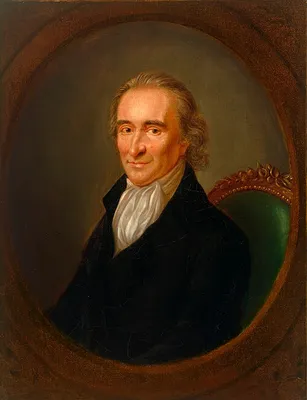
Thomas Paine, an English-born political philosopher, authored influential pamphlets advocating for American independence and republicanism.
Born in England, Thomas Paine became a pivotal figure in the American Revolution through his powerfully written pamphlets. He immigrated to the American colonies in 1774, and his 47-page work, 'Common Sense,' published in 1776, was instrumental in galvanizing support for independence from Great Britain. Paine's writings articulated arguments for human rights that resonated across the Atlantic, influencing revolutionary discourse in both America and France.
After the American Revolution, Paine returned to Britain, where his defense of the French Revolution in 'Rights of Man' led to charges of seditious libel and a conviction in absentia. He fled to France, despite not speaking the language, and was elected to the National Convention. During his time in France, he was imprisoned and completed the first part of 'The Age of Reason.' This work, along with others, advocated for Deism, promoted reason and freethought, and critiqued organized religion, particularly Christian doctrine. He also introduced concepts like guaranteed minimum income in 'Agrarian Justice.' Paine returned to the U.S. in 1802, dying in relative obscurity due to his controversial views.
Political Philosophy and Revolutionary Influence
Thomas Paine's enduring legacy stems from his role as a prolific writer whose ideas profoundly impacted the political landscapes of America and France. His pamphlet 'Common Sense' served as a crucial catalyst for the American Revolution, articulating the case for independence in clear, accessible language that resonated with a broad audience. Beyond advocating for political separation, Paine advanced Enlightenment ideals concerning human rights and the principles of republican governance. His work provided intellectual ammunition for revolutionaries and shaped the discourse surrounding self-determination and popular sovereignty on both sides of the Atlantic. He challenged established monarchical systems and promoted the idea of government by the consent of the governed, making him a central figure in the Age of Revolutions.
Critique of Religion and Advocacy for Reason
In his later writings, most notably 'The Age of Reason,' Thomas Paine developed a significant critique of established religion, particularly Christian dogma. He was a proponent of Deism, a philosophical stance that posits a creator God who does not intervene in the universe and emphasizes reason as the primary source of moral and spiritual knowledge. Paine argued for the importance of freethought and encouraged individuals to rely on their own reason rather than accepting religious doctrines on faith. His writings often attacked the perceived contradictions and injustices within religious texts and institutions, leading to considerable controversy and personal ostracism. This aspect of his work highlights his commitment to rational inquiry and his belief in the power of human intellect to discern truth.
Agrarian Justice and Social Ideas
Thomas Paine also delved into economic and social theory, particularly in his pamphlet 'Agrarian Justice.' In this work, he addressed the origins of property and proposed a system to mitigate social inequality. Paine argued that the earth's resources should be considered common inheritance. To address the disparity created by private land ownership, he introduced the concept of a guaranteed minimum income, to be funded through a one-time inheritance tax levied on landowners. This early articulation of a social welfare concept and a form of universal basic income demonstrates Paine's forward-thinking approach to societal organization and his concern for the economic well-being of all citizens, moving beyond purely political reform.
Key Ideas
- Advocacy for republicanism and independence
- Promotion of human rights and Enlightenment ideals
- Critique of monarchy and organized religion
- Advocacy for Deism, reason, and freethought
- Concept of guaranteed minimum income through inheritance tax
Books by Thomas Paine
2 free public domain books · Read online or download