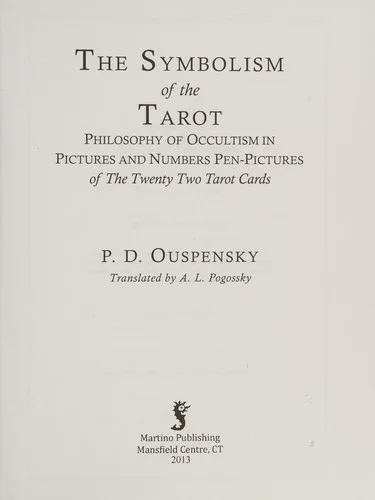
Tarot Masters
 62
62

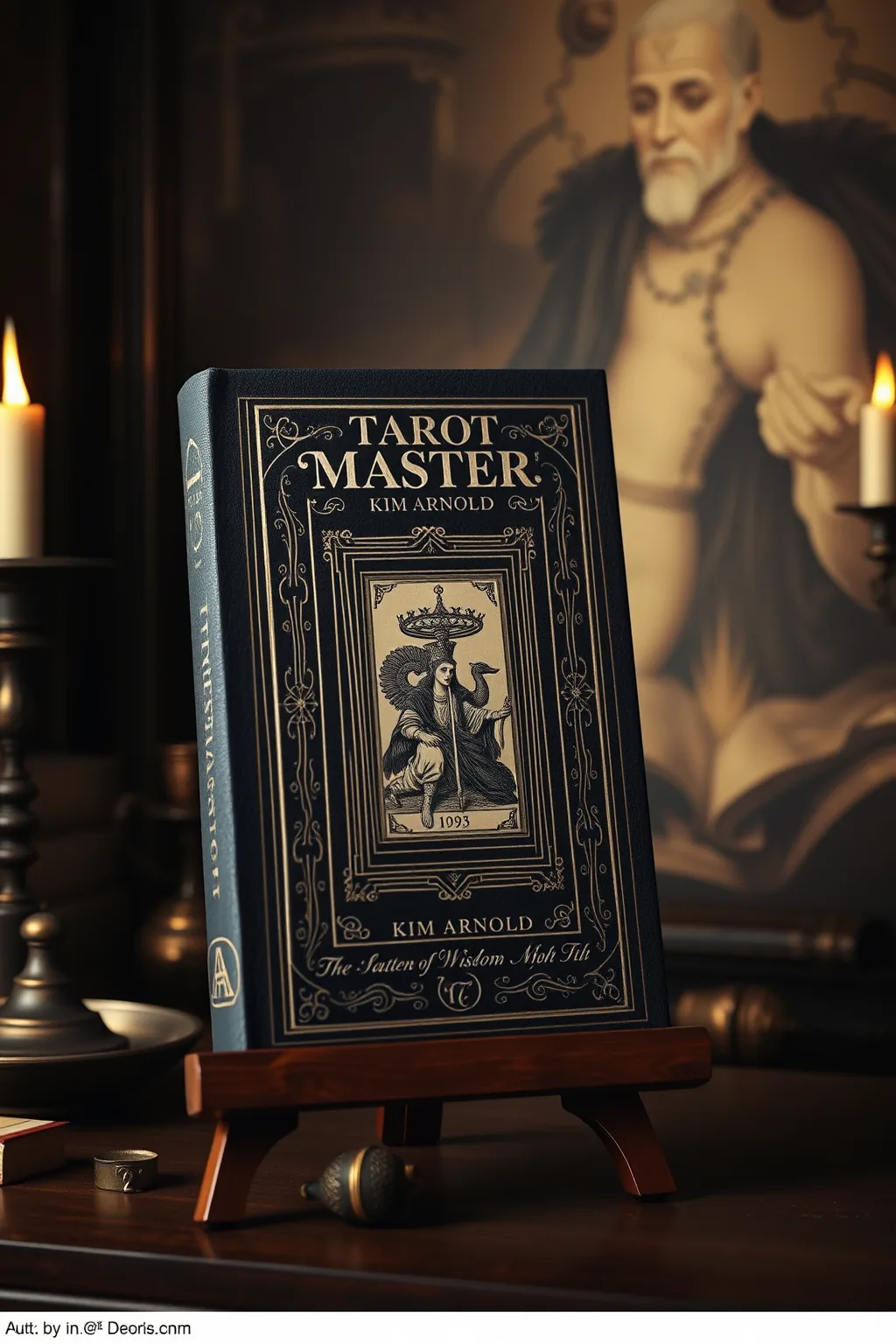
Tarot Masters



Sophia Crane (Associate Editor) — Kim Arnold's "Tarot Masters" is a luminous addition to any serious occult library. Arnold masterfully dissects the layered symbolism of the Tarot, revealing its profound connection to Western Esotericism and Hermetic principles. The book eschews superficial interpretations, instead offering a deeply insightful and spiritually resonant exploration of the cards' archetypal power. It is a valuable resource for practitioners seeking to elevate their readings from simple prognostication to profound soul-work. The clarity of Arnold's prose, coupled with her evident mastery of the subject, makes this an essential read for anyone committed to understanding the Tarot's mystical dimensions.
📝 Description
62
Kim Arnold's 'Tarot Masters' (2005) goes beyond fortune-telling to examine Tarot's philosophical roots.
Kim Arnold's 'Tarot Masters,' published in 2005, examines the Tarot not as a tool for prediction but as a symbolic system. The book investigates the deep currents of esoteric knowledge and ancient philosophies embedded within the cards. Arnold guides readers through the archetypes and cosmic correspondences associated with each Tarot card. It presents the Tarot as a map for understanding the soul and the universe. The author aims to illuminate the philosophical foundations that have informed human inquiry for centuries. The book is written for those seeking a deeper connection to the Tarot, whether they are new to its study or have practiced for years. It offers a path to self-discovery through the language of the Tarot.
This work is structured to deepen a practitioner's understanding of the philosophical underpinnings of Tarot. It moves past simple divinatory interpretations to engage with the archetypal and cosmological dimensions of the cards. Arnold's approach emphasizes the Tarot's role in spiritual development and self-awareness. The book aims to provide a more comprehensive perspective on this ancient oracle for serious students.
This book sits within the Western esoteric tradition, which often views Tarot as a repository of ancient wisdom and a key to understanding cosmic principles. It aligns with hermetic, kabbalistic, and alchemical thought that has historically influenced Tarot interpretation. Rather than focusing solely on divination, 'Tarot Masters' engages with Tarot as a symbolic language reflecting universal laws and stages of spiritual development, a common approach in esoteric studies.
💡 Why Read This Book?
Unlock the profound, hidden meanings of the Tarot beyond simple fortune-telling. "Tarot Masters" offers a gateway to understanding the spiritual and philosophical depths of the cards, connecting them to ancient wisdom traditions. Ideal for seekers, students of esotericism, and practitioners who wish to imbue their readings with deeper insight and transformative power.
⭐ Reader Reviews
Honest opinions from readers who have explored this book.
❓ Frequently Asked Questions
What is the primary focus of "Tarot Masters"?
The book focuses on the esoteric and mystical dimensions of the Tarot, exploring its deep symbolism, philosophical underpinnings, and its role as a tool for spiritual growth and self-discovery, rather than solely as a predictive device.
Is this book suitable for beginners?
While it delves into complex esoteric concepts, Kim Arnold's accessible writing style makes "Tarot Masters" valuable for dedicated beginners eager to grasp the deeper spiritual aspects of the Tarot from the outset.
What esoteric traditions are explored in relation to the Tarot?
The book draws connections to Hermeticism, Kabbalah, Gnosticism, and other Western Esoteric traditions, illustrating how these philosophies have shaped Tarot's symbolic language and interpretive frameworks.
Does the book offer practical advice for reading the Tarot?
Yes, while emphasizing the spiritual context, it provides insights into interpreting card meanings within a broader esoteric framework, enhancing practical reading skills for those who seek deeper understanding.
What makes "Tarot Masters" unique among Tarot books?
Its unique strength lies in its synthesis of historical esoteric teachings with the Tarot, presenting a holistic view that empowers readers to engage with the cards on a profound, soul-level.
🔮 Key Themes & Symbolism
Archetypal Symbolism and the Collective Unconscious
Explore the profound archetypal imagery within the Tarot, revealing how each card speaks to universal human experiences and patterns residing in the collective unconscious. Arnold elucidates how these potent symbols serve as a mirror to the soul, offering insights into our inner world and our connection to the vast cosmic consciousness. Understanding these archetypes transforms the Tarot from a simple deck into a powerful gateway for self-awareness and spiritual evolution, connecting the microcosm of the individual to the macrocosm of existence.
The Tarot as a Map of the Spiritual Journey
This theme positions the Tarot as a sacred cartography of the soul's evolutionary path. From the Fool's innocent leap into the unknown to the World's ultimate integration, the Major Arcana charts a profound journey of spiritual awakening. Arnold guides readers to perceive the sequence and symbolism of the cards as stages of inner transformation, offering wisdom for navigating life's challenges and celebrating its triumphs. It's an invitation to see one's own life mirrored in this timeless narrative of growth and enlightenment.
Hermeticism and Esoteric Correspondences
"Tarot Masters" meticulously combines in the principles of Hermeticism, Kabbalah, and other Western Esoteric traditions, revealing the intricate web of correspondences that imbue the Tarot with its depth. Arnold demonstrates how astrological, alchemical, and numerological elements are interwoven into the fabric of the cards. This exploration offers a richer, more profound understanding of the Tarot's language, allowing practitioners to access a deeper layer of meaning and connect with the universal laws that govern reality.
💬 Memorable Quotes
Direct passages from the work, attributed to the author.
“Each card is a gateway to a forgotten wisdom.”
— This highlights the esoteric nature of the Tarot as presented in the book, suggesting that the cards hold ancient, often overlooked, knowledge waiting to be rediscovered by the earnest seeker.
“Symbolism is the silent language of the universe.”
— This underscores the book's approach to the Tarot, viewing its imagery as a profound form of communication that transcends literal meaning and speaks directly to the subconscious.
“To read the Tarot is to read the self.”
— This reinforces the idea that the Tarot's primary function is self-reflection and self-discovery, enabling individuals to gain clarity about their own motivations, strengths, and challenges.
💡 Key Ideas
Editorial paraphrase of the work's core concepts — not direct quotes.
The Tarot is not a crystal ball, but a mirror to the soul.
This quote emphasizes the book's focus on introspection and self-understanding over mere prediction. It suggests the Tarot's power lies in revealing inner truths and guiding personal growth.
The Fool's leap is the beginning of all true knowing.
This quote points to the importance of courage, faith, and embracing the unknown as the foundational steps in any genuine journey of spiritual or intellectual discovery.
🌙 Esoteric Significance
Tradition
This work is deeply rooted in the Western Esoteric tradition, drawing heavily from Hermeticism, Kabbalah, and Gnosticism. It views the Tarot not merely as a divinatory tool but as a living embodiment of cosmic laws, spiritual principles, and archetypal energies that govern both the inner and outer worlds. The book explores how these ancient wisdom systems are encoded within the Tarot's imagery, offering a path to gnosis and spiritual transformation.
Symbolism
The symbolism within "Tarot Masters" is approached with reverence for its multi-layered meanings. Each card is explored as a complex sigil, a microcosm of universal truths. The book explores the correspondences between the Tarot and elements, planets, astrological signs, and Hebrew letters, revealing an intricate system of interconnected symbols that form a sacred language for understanding existence and the human psyche.
Modern Relevance
In a world often characterized by superficiality and disconnection, "Tarot Masters" offers a vital connection to timeless wisdom. Its emphasis on introspection, archetypal understanding, and spiritual growth provides a powerful framework for navigating modern challenges with greater insight and resilience. The book empowers individuals to tap into their inner guidance, fostering self-awareness and a deeper sense of purpose in their contemporary lives.
👥 Who Should Read This Book
This book is indispensable for the dedicated Tarot practitioner seeking to transcend superficial readings and engage with the cards on a profound, spiritual level. It is equally valuable for students of Western Esotericism, occult philosophy, and comparative religion, offering a unique lens through which to understand ancient wisdom traditions. Beginners drawn to the deeper, mystical aspects of the Tarot will find a comprehensive and inspiring guide, while seasoned scholars will appreciate Arnold's insightful synthesis of historical and philosophical currents.
📜 Historical Context
The creation of the Tarot, particularly its integration into esoteric thought, spans centuries, with significant developments emerging during the Renaissance and flourishing in the 18th and 19th centuries with figures like Antoine Court de Gébelin and Eliphas Lévi. These periods saw a deliberate attempt to imbue the Tarot with occult meanings, linking it to Kabbalah, Hermeticism, and ancient Egyptian mysteries. The late 19th and early 20th centuries, the era of the Golden Dawn and its successors, further cemented the Tarot's status as a central tool in Western Esotericism, used for divination, spiritual initiation, and psychological exploration. "Tarot Masters" situates itself within this rich lineage, drawing upon and contributing to the ongoing dialogue about the Tarot's profound symbolic and spiritual significance.
📔 Journal Prompts
Reflect on the archetype of The Fool in your own life. Where have you taken a leap of faith, and what was the outcome?
Choose a Minor Arcana suit and contemplate its elemental and psychological associations. How do these energies manifest in your daily experiences?
Consider the concept of 'as above, so below' as it relates to a specific Tarot card. How does the macrocosm reflected in the card influence your personal reality?
Explore the concept of the 'shadow self' as represented by a challenging Tarot card. What insights can you gain from confronting these aspects of yourself?
If you were to create your own Tarot spread based on the principles discussed, what questions would you aim to answer and what card positions would you include?
🗂️ Glossary
Archetype
A universal, archaic symbol or motif that derives its meaning from the collective unconscious and appears in art, literature, and mythology. In Tarot, archetypes represent fundamental human experiences and patterns.
Esotericism
A broad category of mystical and occult traditions that focus on hidden knowledge, spiritual realization, and the attainment of higher consciousness, often through symbolic interpretation and ritual practice.
Hermeticism
A religious, philosophical, and esoteric tradition based primarily upon the writings attributed to Hermes Trismegistus. It emphasizes principles such as 'as above, so below' and the interconnectedness of all things.
Kabbalah
A system of Jewish mysticism and esoteric philosophy that deals with the nature of God and the universe, often represented visually through the Tree of Life, which has correspondences with Tarot symbolism.
Gnosis
Spiritual knowledge or insight, particularly the kind that leads to salvation. In esoteric traditions, gnosis is often seen as a direct, intuitive understanding of spiritual truths, often achieved through inner revelation.
This book appears in 3 collections
🔮 Readers Also Liked
Browse all →
More by Kim Arnold
All books →
From the “Tarot” Collection
View all →
More Free Divination & Tarot Books
View all →