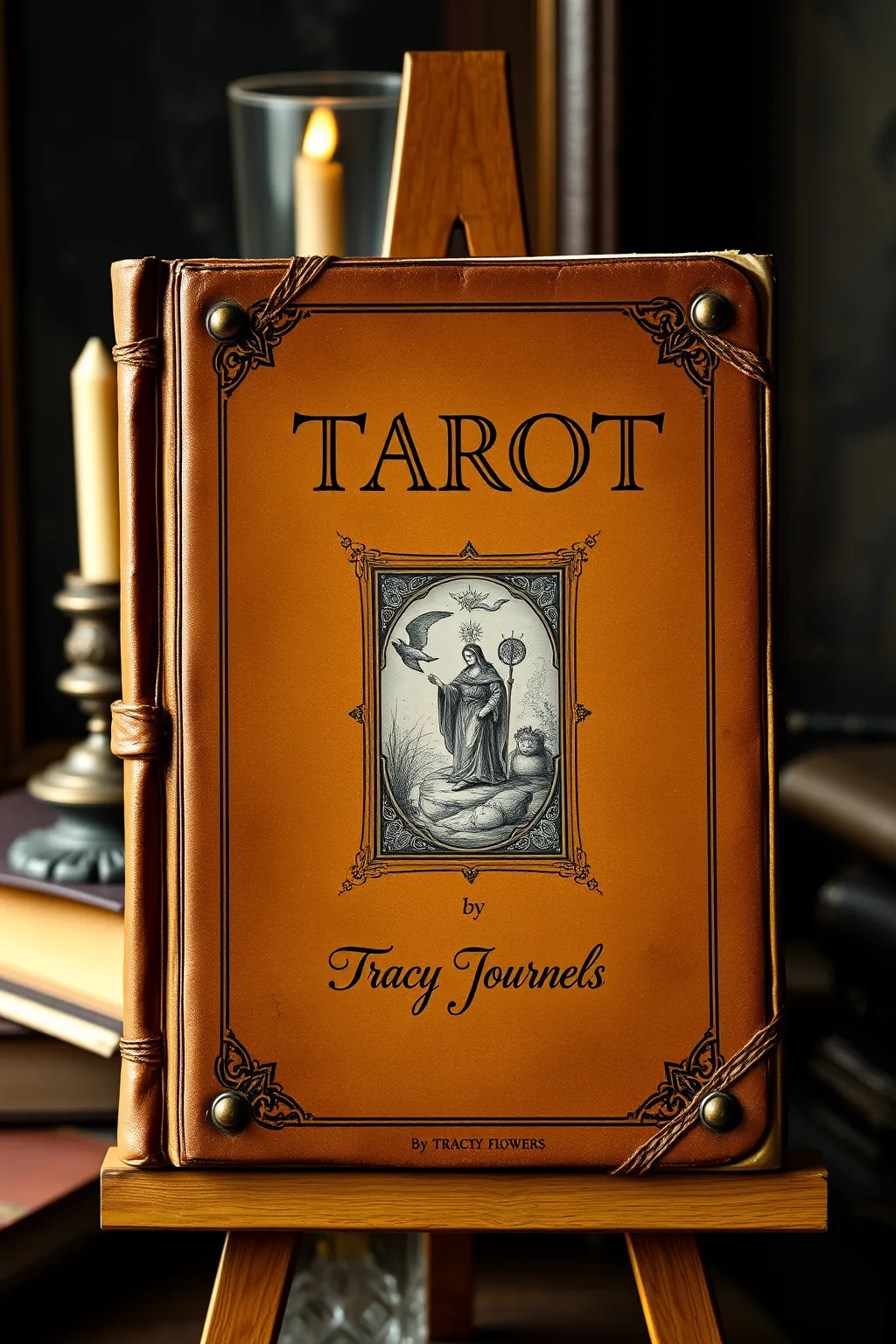
Tarot Journal
 62
62

Tarot Journal



Lorelei Sage, Contemplative Literature Editor — Tracy Flowers' 'Tarot Journal' transcends the ordinary to become an indispensable companion for anyone serious about engaging with the Tarot's profound depths. This journal is not merely a record-keeping tool; it is an interactive grimoire, designed to facilitate genuine esoteric insight. Flowers expertly guides the reader to move beyond rote memorization, encouraging a deep, intuitive connection with the archetypes. Its structured yet flexible layout honors the personal nature of divination, making it ideal for both neophyte practitioners and seasoned mystics seeking to deepen their practice and document their spiritual evolution. A truly invaluable addition to any occult library.
📝 Description
62
Tracy Flowers' Tarot Journal, published in 2023, provides dedicated space for recording readings and reflections.
This journal is designed for individuals who work with the seventy-eight cards of the Tarot. It offers pages for noting down readings and personal interpretations. The book aims to help users understand the symbolism within the cards and track their personal growth as reflected in their readings. It encourages users to record their thoughts and observations after each card pull or spread. This practice is intended to deepen one's connection to the Tarot's messages and aid in self-reflection. The journal is structured to support a regular practice of Tarot study and personal inquiry. It acts as a personal archive of a user's engagement with the cards. The layout is intended to be straightforward for consistent use. It facilitates a methodical approach to learning and experiencing the Tarot. Users can document their experiences and insights over time. The journal supports a personal dialogue with the archetypes presented in the cards. It is a tool for those who wish to systematically engage with Tarot divination.
The Tarot, originating in the mid-15th century, has evolved from a card game to a significant tool in Western esoteric traditions. Its seventy-eight cards are seen as a symbolic language representing archetypal forces and stages of human experience. Practices often involve using the cards for divination, self-exploration, and meditation. This journal aligns with the practice of keeping a record of readings, a method employed by many students and practitioners to track patterns, gain insights, and deepen their understanding of the cards' messages within a personal context. It supports the esoteric view of the Tarot as a mirror to the psyche and a guide for personal transformation.
💡 Why Read This Book?
For the devoted seeker yearning to unlock the Tarot's ancient secrets, 'Tarot Journal' offers a sacred space for profound introspection. Its pages are an invitation to move beyond surface-level readings, encouraging a deep dive into symbolism and archetypal wisdom. Ideal for practitioners, students of esotericism, and anyone on a path of self-discovery, this journal cultivates intuitive understanding and personal transformation through dedicated practice.
⭐ Reader Reviews
Honest opinions from readers who have explored this book.
❓ Frequently Asked Questions
What is the primary purpose of the 'Tarot Journal'?
The 'Tarot Journal' is designed to be a personal, interactive guide for individuals exploring the Tarot. It provides structured space for recording readings, noting interpretations, tracking recurring themes, and documenting personal insights gained from the cards, fostering a deeper, more intuitive connection with the Tarot's wisdom.
Who is the intended audience for this journal?
This journal is perfect for anyone interested in Tarot, from absolute beginners seeking to understand the basics to experienced practitioners looking to deepen their practice, record their progress, and explore the esoteric and spiritual dimensions of divination.
Can this journal be used with any Tarot deck?
Absolutely. The 'Tarot Journal' is designed to be universally applicable. Its focus is on the practice of journaling and interpretation, making it compatible with any traditional or modern Tarot deck you choose to work with.
What kind of prompts or guidance does the journal offer?
While primarily a space for personal reflection, the journal includes prompts and sections designed to encourage thoughtful engagement with each reading, such as space for intuitive impressions, questions for further contemplation, and tracking of emotional or psychological shifts.
Is this journal suitable for academic study of Tarot?
Yes, the 'Tarot Journal' can be a valuable tool for academic study. It allows for detailed documentation of readings, personal interpretations, and the observation of patterns over time, which can be useful for research and analysis of Tarot symbolism and its application.
🔮 Key Themes & Symbolism
The Alchemy of Self-Discovery
This journal serves as a crucible for personal transformation, mirroring the alchemical processes of breaking down, purifying, and synthesizing. Each recorded reading becomes a step in the transmutation of mundane experience into profound self-awareness. By meticulously documenting the interplay between the querent's question and the symbolic language of the Tarot, users engage in a process of inner alchemy, transforming raw intuition and nascent understanding into solidified wisdom and spiritual insight. The act of journaling itself becomes a ritual, fostering a sacred dialogue with the subconscious and the collective unconscious, thereby facilitating the emergence of the authentic self.
Elements of Ancient Archetypes
Within the Tarot lies a vibrant collection woven from the threads of universal human experience, the archetypes that have echoed through civilizations since time immemorial. This journal provides a dedicated space to trace these potent symbols—the Hero's Journey, the Divine Feminine, the Shadow Self—as they manifest in your personal readings. By consistently engaging with the Major and Minor Arcana, you begin to recognize these timeless patterns within your own life, gaining a profound understanding of the forces that shape destiny. It's an invitation to connect with a lineage of wisdom, to see how these ancient narratives continue to unfold and offer guidance in the modern world.
The Cartographer of Destiny
The Tarot, in its intricate symbolism, acts as a celestial map, charting the potentials and probabilities of the unfolding path. 'Tarot Journal' empowers you to become the cartographer of your own destiny. Each entry is an opportunity to meticulously record the lay of the land, noting the currents of energy, the crossroads encountered, and the potential destinations revealed by the cards. This systematic approach transforms abstract divinatory insights into tangible knowledge, allowing for a more conscious navigation of life's journey. You learn to read the signs, understand the terrain, and make informed choices, thereby actively co-creating your future rather than passively accepting it.
💬 Memorable Quotes
Direct passages from the work, attributed to the author.
“Silence the clamor, and listen to the whispers of the Arcana.”
— It highlights the importance of stillness and focused attention when working with Tarot, urging the reader to quiet external distractions to better perceive the subtle, intuitive messages conveyed by the cards.
“Each reading is a sacred dialogue with the soul.”
— This phrase underscores the profound, personal, and spiritual significance of engaging with the Tarot, framing it as a deeply intimate conversation between the individual and their innermost being.
“Trace the patterns, and the path will reveal itself.”
— It encourages a systematic and observant approach to Tarot study and practice, implying that by consistently analyzing the recurring symbols and their connections, one can gain clarity and understanding of their life's trajectory.
💡 Key Ideas
Editorial paraphrase of the work's core concepts — not direct quotes.
The cards are but mirrors, reflecting the universe within.
This quote emphasizes the introspective nature of Tarot, suggesting that the images and symbols on the cards are not external pronouncements but rather reflections of the querent's own inner world, consciousness, and subconscious.
The future is not written in stone, but sketched in possibility.
This quote speaks to the fluid nature of destiny as perceived through Tarot, suggesting that the cards reveal potential pathways and influences rather than a fixed, unchangeable future, empowering agency.
🌙 Esoteric Significance
Tradition
This journal deeply aligns with the Western Esoteric Tradition, particularly drawing from Hermeticism, Kabbalah, and Renaissance occultism, which heavily influenced the development and interpretation of Tarot decks like the Rider-Waite-Smith. It serves as a practical tool for engaging with the archetypal symbolism and psychospiritual allegory inherent in these traditions, encouraging the user to integrate esoteric principles into their personal journey of spiritual development and self-understanding.
Symbolism
The Tarot's seventy-eight cards are a potent lexicon of esoteric symbolism, representing cosmic principles, psychological states, and archetypal energies. From the Fool's journey of initiation to the World's completion, each card is imbued with layers of meaning drawn from astrology, numerology, mythology, and alchemical processes. This journal facilitates the deciphering of these complex symbols, encouraging users to explore their personal resonance with images like the Hierophant's spiritual authority, the Lovers' choice, or the Hermit's inward quest.
Modern Relevance
In an era often characterized by information overload and spiritual seeking, 'Tarot Journal' offers a grounding practice for intuitive development and self-reflection. It provides a structured yet personal method for working through the complexities of modern life, connecting with universal archetypes, and uncovering inner wisdom. Its relevance lies in its ability to foster mindfulness, enhance self-awareness, and empower individuals to actively participate in their own spiritual evolution, making esoteric knowledge accessible and applicable to daily existence.
👥 Who Should Read This Book
This 'Tarot Journal' is an essential companion for a diverse array of seekers. Beginners starting their Tarot journey will find it an invaluable guide for structuring their initial explorations and building foundational understanding. Scholars and students of occultism will appreciate its capacity for detailed recording and pattern analysis, aiding in deeper research and thematic study. Dedicated practitioners will discover it to be a powerful tool for tracking spiritual progress, deepening intuitive connections, and refining their divinatory craft. Ultimately, anyone on a path of self-discovery, seeking greater insight into themselves and the universe, will find this journal to be an indispensable ally.
📜 Historical Context
The practice of journaling and the exploration of divinatory arts have deep roots in human history, flourishing particularly during periods of intellectual and spiritual ferment. The late 19th and early 20th centuries, often termed the 'occult revival,' saw a resurgence of interest in esoteric traditions, including Tarot, alongside advancements in psychology and a growing fascination with symbolism. Authors and practitioners sought to systematize their understanding of these ancient practices, creating tools that could aid in personal exploration and spiritual growth. 'Tarot Journal' emerges from this lineage, offering a modern iteration of a time-honored method for engaging with the Tarot's rich symbolic language, bridging the gap between historical esoteric knowledge and contemporary spiritual seeking.
📔 Journal Prompts
What initial impression do I have of this card spread, before interpretation?
How does the central theme of this reading connect to a recent personal challenge or triumph?
Which archetypal energy (e.g., the Warrior, the Nurturer, the Sage) is most prominent in this reading, and how does it manifest in my life?
If I could ask one follow-up question based on this reading, what would it be?
What is one concrete action I can take this week inspired by the guidance of this Tarot spread?
🗂️ Glossary
Arcana
Referring to the two divisions of the Tarot deck: the Major Arcana (22 cards representing significant life lessons and spiritual journeys) and the Minor Arcana (56 cards representing daily events and more mundane concerns).
Querent
The individual for whom a Tarot reading is performed. The journal is designed to capture the querent's questions and the interpretations of the cards drawn in response.
Divination
The practice of seeking knowledge of the future or the unknown by supernatural means. In the context of Tarot, it involves interpreting the symbolic language of the cards to gain insight.
Archetype
A universal, archaic pattern or image that derives from the collective unconscious and is communicated through art, literature, and mythology. The Tarot is rich with archetypal figures and scenarios.
Intuition
The ability to understand something immediately, without the need for conscious reasoning. Tarot practice encourages the development and application of intuition in interpreting card meanings.
This book appears in 3 collections
🔮 Readers Also Liked
Browse all →








More by Tracy Flowers
All books →
From the “Tarot” Collection
View all →








More Free Divination & Tarot Books
View all →