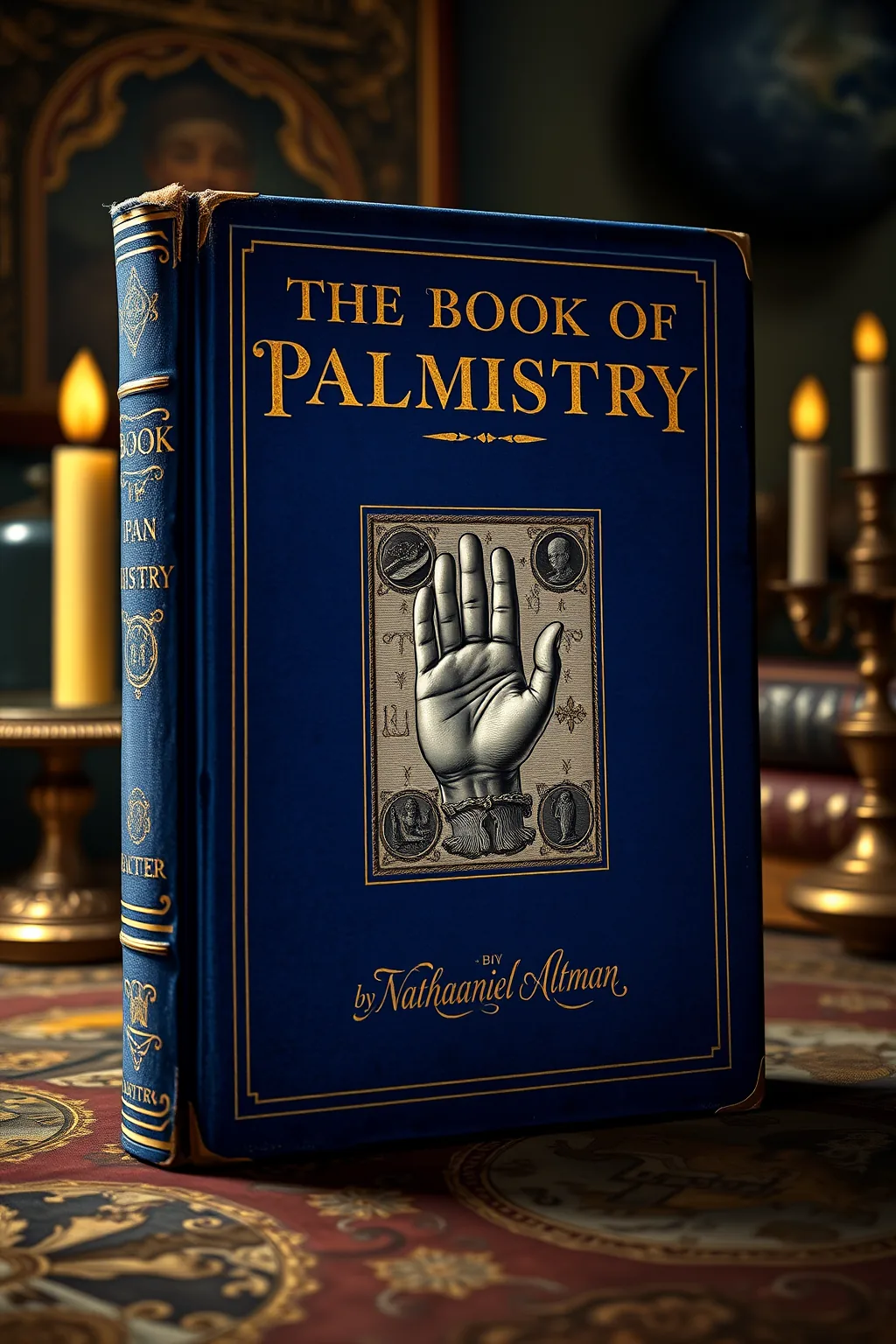
The Book of Palmistry
 84
84

The Book of Palmistry
Nathaniel Altman's 'The Book of Palmistry' avoids the common pitfall of reducing hand-reading to mere predictive parlor tricks. Instead, it presents a sober, almost academic, dissection of chiromancy, grounding its interpretations in observable traits and historical frameworks. The strength lies in its systematic approach; the detailed explanations of the mounts and major lines, particularly the Fate line's variability, offer substantial material for contemplation. However, the sheer volume of detail, while thorough, can occasionally feel overwhelming for the novice, bordering on encyclopedic rather than intuitively guiding. A particular passage detailing the intersection of the Head and Life lines offers a nuanced view of psychological integration, a high point of the work's analytical depth. This book serves as a robust reference, demanding careful study rather than casual perusal.
📝 Description
84
Nathaniel Altman's 2004 book presents palmistry as a system for understanding character, not just fortune-telling.
Published in 2004, The Book of Palmistry by Nathaniel Altman examines hand analysis beyond simple prediction. Altman presents palmistry as a method for understanding personality, potential, and life's unfolding patterns. The book details the meanings of mounts, lines, fingers, and various hand shapes. Its interpretations draw on historical traditions and psychological insights, viewing the hand as a personal map reflecting an individual's inner state. This volume suits those interested in divination, self-discovery, and esoteric studies. It offers a structured approach for beginners and a resource for experienced practitioners seeking to refine their skills. Readers familiar with physiognomy, astrology, or other character analysis methods will find connections and points of comparison.
Altman's work addresses the long history of palmistry, which has roots in ancient India, Greece, and Rome. Throughout centuries, thinkers from Aristotle to scholars in medieval Europe studied chiromancy, often connecting it to humoral theory and astrological influences. The early 20th century saw a revival of palmistry, tied to spiritualism and Theosophy. Altman's 2004 text appears in a time of increased access to esoteric knowledge. It aims to distinguish palmistry as a thoughtful interpretative art, placing it within the wider field of hermetic thought.
Palmistry, or chiromancy, has a history stretching back millennia, with significant development in ancient India, Greece, and Rome. It was discussed by figures like Aristotle and integrated into European scholarship during the Middle Ages, often alongside astrology and humoral theory. The practice saw renewed interest in the late 19th and early 20th centuries, linked to movements like spiritualism and Theosophy. Altman's book situates itself within this lineage, seeking to provide a more structured and insightful approach to hand reading, connecting it to broader hermetic and psychological frameworks.
💡 Why Read This Book?
• Gain a structured framework for interpreting the hand's geography, learning the specific significations of the seven planetary mounts (e.g., Mount of Jupiter) as detailed in Altman's methodical approach. • Understand the nuanced language of the major hand lines, including variations like chains and islands on the Heart Line, offering insights beyond simple predictions. • Explore the elemental hand shapes (Earth, Air, Fire, Water) presented by Altman, providing a foundational typology for character assessment rooted in classical elements.
⭐ Reader Reviews
Honest opinions from readers who have explored this book.
❓ Frequently Asked Questions
When was 'The Book of Palmistry' by Nathaniel Altman first published?
Nathaniel Altman's 'The Book of Palmistry' was first published in 2004, offering a contemporary yet historically grounded perspective on the ancient art of hand analysis.
What are the main components of palmistry discussed in the book?
The book systematically covers hand shapes, the seven planetary mounts (like Venus and Saturn), major and minor lines (Life, Head, Heart, Fate), finger characteristics, and nail formations.
Does the book focus solely on fortune-telling?
No, Altman presents palmistry as a system for understanding character, potential, and life patterns, integrating psychological observation with historical precedent, moving beyond simple prediction.
Is 'The Book of Palmistry' suitable for absolute beginners?
Yes, while comprehensive, the book's structured approach and clear explanations of fundamental concepts like hand shapes and mounts make it accessible to beginners interested in serious study.
What is the significance of the planetary mounts in Altman's book?
Altman details how each of the seven planetary mounts (e.g., Mount of Apollo, Mount of Mercury) corresponds to specific personality traits, energies, and potential life expressions of the individual.
Does the book reference historical figures in palmistry?
While not explicitly detailing every historical figure, the work is framed within the long lineage of palmistry, referencing its presence in ancient cultures and its evolution through various eras.
🔮 Key Themes & Symbolism
The Hand as a Microcosm
Altman posits the hand as a detailed map reflecting the individual's entire being. Each line, mount, and feature is not arbitrary but interconnected, forming a complex symbolic language. This perspective aligns with hermetic principles where the microcosm mirrors the macrocosm. The book meticulously details how variations in the Life Line, for instance, can indicate vitality and life experiences, while the Head Line speaks to cognitive processes and intellectual inclinations, demonstrating the hand's profound capacity to express inner states.
Planetary Influences on Character
A core concept is the association of specific areas of the palm, known as mounts, with the seven classical planets: Sun, Moon, Mercury, Venus, Mars, Jupiter, and Saturn. The development and prominence of these mounts are interpreted as indicators of the individual's strengths and challenges related to the planet's archetypal energies. For example, a well-developed Mount of Jupiter suggests ambition, leadership, and optimism, while a prominent Mount of Saturn might point towards seriousness, introspection, and discipline.
Elemental Hand Typology
The book employs an elemental classification system—Earth, Air, Fire, and Water—to categorize hand shapes, providing a foundational layer of interpretation. An Earth hand, typically broad and square, suggests practicality and groundedness, whereas an Air hand, often long-fingered with a rectangular palm, indicates intellectuality and communication. These elemental associations offer a quick yet insightful initial assessment of a person's core disposition and approach to life, integrating a classical esoteric framework.
Lines as Life's Trajectory
The major lines—Life, Head, Heart, and Fate—are presented not as fixed predictions but as indicators of potential pathways and significant life experiences. Altman examines the nuances of these lines, including their depth, clarity, breaks, and intersections, interpreting them as dynamic reflections of an individual's journey. The Fate line, for example, is explored for its potential to indicate career, purpose, and external influences throughout life, offering a narrative of personal evolution.
💬 Memorable Quotes
Direct passages from the work, attributed to the author.
“The hand offers a unique and personal cartography of the self.”
— This highlights the book's central thesis: the hand is not merely a physical appendage but a complex symbolic representation of an individual's inner world, potential, and life path.
“Each line and mound on the palm corresponds to specific psychological traits and life potentials.”
— This emphasizes the systematic nature of palmistry as presented by Altman, suggesting a direct correlation between physical hand features and an individual's character and destiny.
“Hand shapes provide a foundational understanding of temperament.”
— This points to the elemental typology (Earth, Air, Fire, Water) used in the book, framing it as an accessible entry point for grasping a person's core disposition.
“The Fate Line reveals the influence of external forces and one's chosen path.”
— This interpretation focuses on the dynamic aspect of the Fate Line, suggesting it's not a rigid destiny but a reflection of how external circumstances and personal choices shape one's life trajectory.
“Understanding the Mount of Venus offers insight into love, sensuality, and emotional expression.”
— This illustrates the planetary mount system, linking the Mount of Venus specifically to themes of affection, desire, and the capacity for emotional connection and pleasure.
🌙 Esoteric Significance
Tradition
Altman's work draws heavily from the Western Esoteric Tradition, particularly its Hermetic and Neoplatonic underpinnings, which view the physical world as a reflection of deeper, often celestial, influences. Palmistry, in this context, is seen not as magic but as a divinatory science—a method of reading the subtle energies and inherent patterns imprinted upon the human form. It aligns with the principle of correspondence, where the hand (microcosm) mirrors the greater order (macrocosm), offering insights into the individual's soul and destiny.
Symbolism
Key symbols include the seven planetary mounts, each representing archetypal forces (e.g., Jupiter for authority, Saturn for wisdom) that shape personality. The major lines—Life, Head, Heart, and Fate—function as symbolic rivers of experience, charting the course of vitality, intellect, emotion, and destiny. Hand shapes, categorized by elements (Earth, Air, Fire, Water), further symbolize fundamental temperaments and modes of interaction with the world, creating a rich symbolic lexicon for interpretation.
Modern Relevance
Contemporary practitioners of Western Esotericism, particularly those in psychological astrology and humanistic divination, find Altman's systematic approach valuable. His work informs modern characterology and self-awareness practices that utilize symbolic systems. It provides a tangible, hands-on method for exploring archetypal energies and personal potentials, resonating with modern therapeutic and self-discovery movements seeking embodied wisdom and non-verbal communication systems.
👥 Who Should Read This Book
• Aspiring practitioners of divination seeking a comprehensive, grounded introduction to chiromancy that emphasizes character analysis over simple prediction. • Students of Western Esotericism interested in exploring the symbolic language of the human body and its connection to cosmic influences. • Individuals undergoing self-discovery and personal development who wish to gain deeper insights into their inherent traits, strengths, and life patterns through a symbolic lens.
📜 Historical Context
Published in 2004, Nathaniel Altman's 'The Book of Palmistry' emerges within a contemporary landscape where interest in esoteric practices has broadened significantly. While historical palmistry, or chiromancy, dates back to ancient civilizations and saw notable scholarly engagement from figures like Johannes Indagine in the 16th century, its popular perception often veered towards fortune-telling. By the early 20th century, it was often associated with spiritualist movements and popular occultism. Altman's work, appearing decades after figures like Cheiro had popularized simplified versions, seeks to restore a more nuanced, character-analytic approach. It engages with a long tradition but frames it within modern psychological understanding, differentiating itself from purely predictive or sensationalist methodologies prevalent in some circles.
📔 Journal Prompts
The Mount of Venus: Reflect on its prominence in your palm and its potential influence on your emotional expression.
Life Line variations: How do observed breaks or chains on your Life Line correspond to significant periods of change or challenge in your experience?
The Elemental Hand Shape: Considering your hand's characteristics, how does the corresponding element (Earth, Air, Fire, Water) manifest in your daily life?
Head Line and Heart Line intersection: Explore the interplay between your logical thinking and emotional responses as indicated by these lines.
The Fate Line's journey: Analyze the clarity and trajectory of your Fate Line and its relationship to your perceived life purpose or career path.
🗂️ Glossary
Mounts
Fleshy, raised areas on the palm corresponding to the seven classical planets (Sun, Moon, Mercury, Venus, Mars, Jupiter, Saturn), each believed to influence personality traits and life potentials.
Lines (Major)
The primary creases on the palm: Life Line (vitality, physical health), Head Line (intellect, mentality), Heart Line (emotions, relationships), and Fate Line (destiny, career, purpose).
Elemental Hand Shapes
Classification of hands into four types—Earth, Air, Fire, Water—based on palm and finger proportions, indicating fundamental temperaments and modes of being.
Chirognomy
The study of hand shapes, finger length, and general hand characteristics, considered a foundational aspect of palmistry providing broad personality insights.
Chiromancy
The art of interpreting the lines, mounts, and markings on the palm to understand character, predict future tendencies, and gain insights into life experiences.
Islands
An oval-shaped break or series of breaks appearing on a palm line, often interpreted as indicating a period of weakness, difficulty, or specific challenges related to that line's meaning.
Chains
A series of small, linked marks appearing on a palm line, typically suggesting a fragmented or complicated expression of the energy or life aspect represented by that line.
🔮 Readers Also Liked
Browse all →









More by Nathaniel Altman
All books →





More Free Occult Philosophy Books
View all →