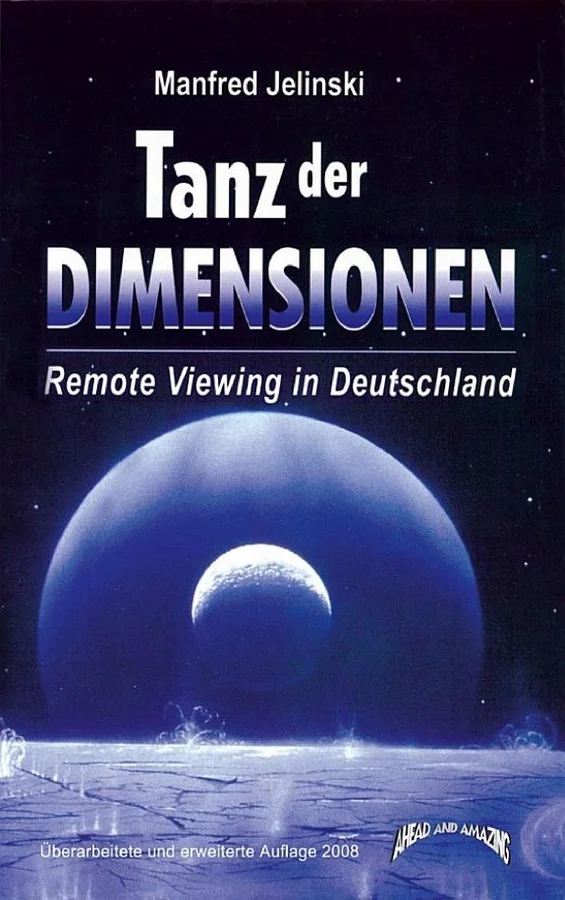
Tanz der Dimensionen
 81
81

Tanz der Dimensionen
Manfred Jelinski’s "Tanz der Dimensionen" doesn't shy away from the more speculative aspects of Remote Viewing. He presents his theories and techniques with a directness that is refreshing, particularly his attempt to offer concrete explanations for precognitive phenomena. The book excels in its detailed descriptions of RV sessions and the author's own experiences, grounding the abstract in tangible examples. A limitation, however, lies in the inherent difficulty of empirically validating the claims made; readers must approach the material with an open mind, willing to accept subjective evidence. Jelinski’s exploration of how prophets might perceive future events, despite the apparent paradoxes, is a particularly compelling section. Ultimately, it’s a dedicated study for those who accept the premise of psychic perception and wish to explore its practical dimensions.
📝 Description
81
Manfred Jelinski's Tanz der Dimensionen, published in 2012, details practical methods for remote viewing.
This 2012 book by Manfred Jelinski moves beyond theory to detail practical methods for remote viewing (RV). Jelinski aims to demystify the mechanisms of precognitive and extrasensory perception, allowing for their application. He shares personal accounts alongside his explanations. The work is intended for anyone interested in the mind's capabilities beyond ordinary senses, including those drawn to parapsychology and consciousness studies. Readers curious about remote viewing techniques, the nature of time, or precognition will find value here. Jelinski's approach focuses on the principles and personal practice of RV, engaging with the ongoing discussions surrounding anecdotal evidence and scientific skepticism in parapsychology.
Jelinski's work is situated within the lineage of psi research that gained momentum in the mid-20th century. This tradition includes experiments at institutions like the Rhine Research Center and, during the Cold War, governmental interest in phenomena like remote viewing under projects such as STAR GATE. Jelinski, however, centers his writing on the fundamental principles and personal application of these abilities, rather than solely on institutional or military contexts. His writing engages with the persistent debate between anecdotal accounts and scientific scrutiny within parapsychology.
💡 Why Read This Book?
• Gain practical techniques for Remote Viewing, as detailed in Jelinski's methodical approach, allowing you to explore consciousness beyond ordinary sensory limits. • Understand Jelinski's framework for the non-linear perception of time, offering a new perspective on precognition and prophetic experiences, as discussed in his 2012 publication. • Explore the author's personal accounts and interpretations of remote viewing sessions, providing concrete, real-world examples that illustrate the book's core concepts.
⭐ Reader Reviews
Honest opinions from readers who have explored this book.
❓ Frequently Asked Questions
What is Remote Viewing according to Manfred Jelinski?
Manfred Jelinski defines Remote Viewing in "Tanz der Dimensionen" as a mental skill allowing individuals to perceive information about distant or future targets solely through focused consciousness, bypassing conventional sensory channels.
When was 'Tanz der Dimensionen' first published?
The original German edition of "Tanz der Dimensionen" by Manfred Jelinski was first published on November 2, 2012.
Does the book explain how to practice Remote Viewing?
Yes, "Tanz der Dimensionen" focuses on practical application, offering methods and guidance for readers interested in actively working with remote viewing techniques.
What is the book's stance on the nature of time?
Jelinski explores the idea that time may not be strictly linear, suggesting that precognition is possible because consciousness can access information across temporal barriers.
Who is Manfred Jelinski in the field of Remote Viewing?
Manfred Jelinski is presented as a leading German chronicler and practitioner of Remote Viewing, known for his ability to explain the phenomenon and guide others in its practice.
What kind of experiences does the book describe?
The book details numerous incredible yet presented as real experiences related to remote viewing, including perceptions of future events and distant locations.
🔮 Key Themes & Symbolism
Practical Remote Viewing Application
Jelinski moves beyond theory to offer actionable methods for engaging in Remote Viewing. The book details specific protocols and exercises designed to train the user's psychic perception. It emphasizes the repeatable nature of these experiences, presenting RV not as an arcane gift but as a trainable skill accessible to many, grounded in the work first published in 2012.
The Nature of Precognition
A central theme is the exploration of how humans can perceive future events. Jelinski tackles the apparent paradox of prophetic accuracy, suggesting a non-linear model of time. The work posits that consciousness can interact with information across temporal divides, offering a framework for understanding how prophets might receive their visions.
Consciousness and Information
The book explores the profound relationship between consciousness and information, proposing that the former can access the latter independent of physical proximity or temporal sequence. Jelinski attempts to provide explanations for this phenomenon, positioning it as a fundamental aspect of reality rather than an anomaly.
Personal Experience and Validation
Jelinski shares numerous personal accounts and observations from his extensive work with Remote Viewing. These narratives serve to illustrate the concepts discussed and provide a form of anecdotal validation for the phenomena, encouraging readers to consider the reality of these extraordinary experiences.
💬 Memorable Quotes
Direct passages from the work, attributed to the author.
“The dance of dimensions is not a metaphor, but a description of how consciousness interacts with reality.”
— This statement expresses the book's core thesis: that our perception of reality is fluid and multi-dimensional, and that consciousness can actively participate in this 'dance'.
“Prophets are not predicting a fixed future, but perceiving probabilities and potentials.”
— This interpretation reframes the concept of prophecy, suggesting that seers engage with a dynamic future rather than a predetermined one, aligning with a non-linear temporal model.
“Remote Viewing is a bridge between the known and the unknown, built with focused intent.”
— This highlights the active and intentional nature of Remote Viewing, portraying it as a deliberate process of extending consciousness to gather information beyond ordinary means.
“The explanation for remote perception lies not in external signals, but in the inherent informational field of existence.”
— This points to an internal or field-based explanation for RV, suggesting information is accessible within a universal consciousness or informational matrix, rather than transmitted physically.
“Understanding the mechanisms of precognition requires questioning the linear flow of time.”
— This emphasizes the foundational shift in perspective needed to grasp precognitive abilities, directly challenging our conventional, sequential understanding of temporal progression.
🌙 Esoteric Significance
Tradition
While not strictly adhering to a single esoteric lineage, "Tanz der Dimensionen" draws from the broader tradition of consciousness exploration that intersects with Hermeticism and Theosophy. It shares the Hermetic principle of "As Above, So Below" by suggesting macrocosmic information is accessible microcosmic consciousness. It aligns with Theosophical ideas about the potential for expanded human perception beyond the physical senses, focusing on practical application rather than solely metaphysical doctrine.
Symbolism
The 'dance' in the title, "Tanz der Dimensionen," symbolizes the fluid, non-linear interaction of consciousness with reality. Dimensions are not static planes but fluid states accessible through focused mental states. The concept of 'viewing' itself acts as a symbol for transcending physical limitations, representing the mind's ability to perceive information across space and time, akin to scrying or astral projection in other traditions.
Modern Relevance
Jelinski's work remains relevant for contemporary practitioners of Remote Viewing and those interested in the practical applications of consciousness research. Thinkers and groups exploring non-local consciousness, quantum entanglement's potential role in psychic phenomena, and alternative models of time continue to find value in his structured approach and experiential accounts. The book serves as a foundational text for understanding RV's potential beyond its historical military applications.
👥 Who Should Read This Book
• Aspiring Remote Viewers: Individuals seeking structured methods and practical guidance to develop their own precognitive and extrasensory perception abilities. • Parapsychology Enthusiasts: Those curious about the scientific and experiential evidence for phenomena beyond conventional sensory input, looking for detailed case studies. • Consciousness Researchers: Students and practitioners interested in alternative models of reality, time, and the capabilities of the human mind, particularly those who value empirical observation.
📜 Historical Context
Manfred Jelinski's "Tanz der Dimensionen" (2012) enters a landscape long occupied by researchers exploring psi phenomena, such as J.B. Rhine and his contemporaries at the Rhine Research Center in the mid-20th century. The book’s focus on practical Remote Viewing (RV) reflects the interest generated during the Cold War, notably by U.S. government-sponsored programs like STAR GATE, which ran until 1995. Jelinski’s work, however, shifts from the geopolitical applications to a more personal and explanatory approach, seeking to clarify RV for a broader audience. It engages with the ongoing debate within parapsychology, where empirical validation remains a challenge, contrasting with more materialist explanations of consciousness prevalent in mainstream science. While not directly engaging with specific contemporary figures, Jelinski’s text contributes to the continued exploration of consciousness initiated by thinkers like Theosophists and later expanded by New Age movements.
📔 Journal Prompts
The concept of the 'informational field of existence' in Remote Viewing.
Jelinski's explanation for prophetic accuracy and non-linear time.
Personal experiences of perceiving information beyond physical senses.
The practical methods for engaging in Remote Viewing sessions.
The author's interpretations of 'incredible, but real' experiences.
🗂️ Glossary
Remote Viewing (RV)
A psi discipline where individuals attempt to perceive information about a target (person, place, object, or event) through mental means, independent of normal sensory input or prior knowledge.
Precognition
The ability to perceive future events or information before they occur through means other than conventional sensory perception or logical deduction.
Non-linear Time
A theoretical concept suggesting that time does not necessarily flow in a strict, sequential, one-directional manner, allowing for the perception of past, present, and future events simultaneously or out of order.
Perceptual Filters
Mental mechanisms or biases that shape how an individual perceives and interprets information, which Jelinski suggests can be managed or bypassed in Remote Viewing.
Target
In the context of Remote Viewing, the specific person, place, object, or event that the viewer attempts to perceive information about.
Dimensional Interaction
The book's concept describing how consciousness can engage with different levels or aspects of reality, perceived as 'dimensions', beyond the standard three spatial and one temporal.
Informational Field
A proposed underlying matrix or field of consciousness/information from which data can be accessed by a remote viewer, rather than being transmitted physically.
This book appears in 1 collection
🔮 Readers Also Liked
Browse all →









From the “Remote Viewing” Collection
View all →






More Free Occult Philosophy Books
View all →