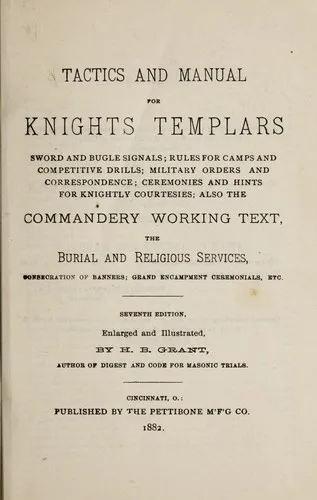
Tactics and manual for Knights Templars ...
 82
82

Tactics and manual for Knights Templars ...
H. B. Grant's 'Tactics and Manual for Knights Templars' offers a peculiar glimpse into the late Victorian imagination of medieval military orders. The strength lies in its earnest attempt to systematize the Templar ethos, presenting a coherent, albeit speculative, organizational and tactical framework. However, the work falters in its historical detachment; it often reads as a projection of 19th-century ideals onto a 12th-century institution, blurring the lines between historical reconstruction and imaginative interpretation. A notable passage discusses the supposed 'rules of engagement' for Templar knights, which, while illustrative of Grant's intent, lacks definitive historical grounding. The manual serves as an interesting artifact of historical romanticism rather than a definitive historical account.
📝 Description
82
H. B. Grant's 1882 manual attempts to codify Templar martial and spiritual disciplines.
Published in 1882, H. B. Grant's 'Tactics and Manual for Knights Templars' structures an examination of the martial and spiritual practices attributed to the medieval order. The book works to establish operational strategies and internal regulations, using historical accounts and symbolic readings to build a framework for Templar activities. It moves past simple historical accounts, aiming for a manual format to explain the Templar ethos. This work is directed toward students of military history, fraternal organizations, and early Christian chivalry. Researchers interested in the development of monastic military orders, the symbolic language of medieval groups, and the use of historical texts to understand group behavior will find it valuable. It will appeal to those who reconstruct primary source material and individuals drawn to the Templar legacy.
Grant's manual reflects a late 19th century fascination with chivalric orders and esoteric history. The Victorian era saw many publications that sought to define or redefine historical and mystical traditions, often shaped by occult societies and a desire to connect with a perceived older, more ordered past. This period also included significant academic study of medieval military orders, sometimes resulting in differing theories.
This manual emerged during the late Victorian era's revival of interest in chivalric orders and esoteric history. Grant's work aligns with a broader cultural trend of defining or redefining historical and mystical traditions, influenced by burgeoning occult societies and a search for connection to a perceived ordered past. It stands within a tradition of reconstructing historical or mystical orders, attempting to codify their practices and philosophies for a contemporary audience.
💡 Why Read This Book?
• Gain insight into late 19th-century interpretations of chivalric orders, specifically understanding the codified 'tactics and manual' approach Grant applies to the Knights Templar, reflecting Victorian scholarly interests. • Explore the symbolic framework Grant attributes to the Templars, such as the integration of spiritual devotion with martial readiness, offering a unique lens on monastic military ideals. • Understand the historical context of the 1882 publication, placing it within the era's burgeoning interest in esoteric history and fraternal organizations, distinct from purely academic historical accounts.
⭐ Reader Reviews
Honest opinions from readers who have explored this book.
❓ Frequently Asked Questions
When was H. B. Grant's 'Tactics and Manual for Knights Templars' first published?
H. B. Grant's 'Tactics and Manual for Knights Templars' was first published in 1882, reflecting a late 19th-century interest in historical and esoteric interpretations of medieval orders.
What kind of content can be found in 'Tactics and Manual for Knights Templars'?
The book explores purported martial and spiritual disciplines of the Knights Templar, attempting to codify their operational strategies and internal regulations based on historical accounts and symbolic interpretations.
Is this book a primary historical source for the Knights Templar?
No, it is not a primary source from the medieval period. Published in 1882, it represents a late Victorian interpretation and reconstruction of Templar practices, rather than a contemporary account.
Who would be interested in reading 'Tactics and Manual for Knights Templars'?
Students of military history, fraternal orders, esoteric traditions, and late 19th-century historical writing would find this book particularly engaging.
Does the book provide verifiable historical facts about the Knights Templar?
While it draws on historical accounts, the book's primary focus is on interpretation and systematization from a late Victorian perspective, making it more of a historical artifact of interpretation than a direct factual record.
What is the significance of the 1882 publication date?
The 1882 date places the work within a period of significant public and scholarly fascination with medievalism, chivalry, and esoteric interpretations of history, common in the late Victorian era.
🔮 Key Themes & Symbolism
Templar Order Codification
Grant's work attempts to present a structured manual for the Knights Templar, moving beyond narrative to codify their supposed operational strategies and internal regulations. This reflects a late 19th-century desire to systematize historical and esoteric knowledge, applying a methodical approach to understanding the order's perceived disciplines and framework for action during the Crusades. The focus is on defining a clear set of rules and tactics.
Spiritual-Martial Integration
A central theme is the proposed fusion of spiritual devotion with martial readiness within the Templar order. The manual explores how religious vows and practices were intended to inform and direct military conduct. This integration represents an idealization of monastic military orders, highlighting the perceived balance between earthly conflict and heavenly aspiration that characterized such institutions in the era's imagination.
Symbolic Framework
The text examines the symbolic language attributed to the Knights Templar, interpreting their actions, vows, and organizational structure through an esoteric lens. Grant seeks to reconstruct a symbolic meaning for the order's practices, suggesting a deeper layer of communication and spiritual intent beyond their historical military functions. This symbolic interpretation is characteristic of late Victorian occult and historical reconstruction movements.
Victorian Esoteric History
Published in 1882, the manual is a product of its time, reflecting the late Victorian era's heightened interest in chivalric traditions, fraternal organizations, and esoteric interpretations of historical subjects. It showcases a particular approach to historical study that blends factual inquiry with imaginative reconstruction, aiming to uncover hidden meanings and lost wisdom from the past.
💬 Memorable Quotes
Direct passages from the work, attributed to the author.
“Grant explores the integration of spiritual discipline with battlefield conduct.”
— This interpretation points to a core theme: the imagined fusion of religious devotion and military action within the Templar order, as presented in the manual from a late 19th-century perspective.
“The manual reflects a late 19th-century reconstruction of Templar practices.”
— This statement emphasizes the book's nature as a product of its publication era, suggesting it offers a Victorian lens on medieval history rather than a direct contemporary account.
“Understanding Templar symbolism is presented as key to their ethos.”
— This interpretation underscores the importance Grant places on symbolic meaning within the Templar order, suggesting that deciphering their symbols reveals deeper aspects of their spiritual and operational identity.
💡 Key Ideas
Editorial paraphrase of the work's core concepts — not direct quotes.
The work attempts to systematically outline Templar tactics and regulations.
This paraphrase captures the essence of Grant's manual, highlighting its deliberate effort to create a structured guide to the Knights Templar's military and internal affairs, rather than simply recounting their history.
The text codifies the perceived operational strategies of the Knights Templar.
This paraphrase focuses on the manual's function as a systemizer of Templar actions, aiming to define their strategic approach and organizational rules based on the author's research and interpretation.
🌙 Esoteric Significance
Tradition
The work engages with a tradition of reconstructing chivalric orders through an esoteric lens, prevalent in the late 19th century. While not strictly Hermetic or Kabbalistic in its stated aim, it draws upon a general Western esoteric interest in hidden knowledge and symbolic systems applied to historical groups. It fits within a lineage of texts that seek to uncover the 'true' or 'inner' nature of organizations like the Templars, often imbuing them with mystical purpose beyond their documented historical functions.
Symbolism
The manual likely explores symbols associated with Templarism, such as the Cross, the Temple of Solomon motif, and potentially regalia. These symbols would be interpreted not merely as historical markers but as keys to understanding the order's spiritual hierarchy and their perceived connection to ancient wisdom. The integration of martial imagery with religious iconography would be examined to reveal a paradigm of divine warfare or spiritual conquest.
Modern Relevance
Contemporary neo-Templar groups and practitioners of Western esoteric traditions continue to draw on such historical interpretations, even if critically. While Grant's specific 1882 framework might be seen as dated, the impulse to find deeper symbolic and spiritual meaning in the Templar narrative persists in modern occultism, speculative history, and certain fraternal organizations seeking historical lineage.
👥 Who Should Read This Book
• Students of esoteric history and late 19th-century occultism, seeking to understand how historical groups like the Knights Templar were interpreted and systematized during the Victorian era. • Researchers interested in the evolution of fraternal orders and chivalric traditions, particularly those examining the blend of historical speculation and symbolic analysis common in the period. • Individuals fascinated by the Templar legend who wish to explore a manual-like approach to their purported structure and disciplines, distinct from purely narrative accounts.
📜 Historical Context
H. B. Grant's 'Tactics and Manual for Knights Templars,' appearing in 1882, is firmly rooted in the late Victorian fascination with medievalism and esoteric interpretations of history. This era witnessed a surge of interest in chivalric orders, Freemasonry, and occult societies, many of which sought to connect with perceived ancient traditions. Grant's work aligns with a broader movement that aimed to reconstruct or define the spiritual and operational frameworks of historical groups like the Knights Templar. Contemporaries such as Helena Blavatsky were exploring ancient wisdom traditions through the Theosophical Society, while other scholars engaged in rigorous historical analysis of medieval institutions. Grant's manual, however, leans more towards a systematized, almost ritualistic, reconstruction, reflecting the era's penchant for finding hidden orders and profound symbolic meanings in the past. Its reception was likely within circles interested in fraternal lore and speculative history, rather than mainstream academic historiography, which was beginning to emphasize critical source analysis.
📔 Journal Prompts
The concept of integrating spiritual discipline with martial conduct in Templar tactics.
Grant's systematization of Templar regulations and its implications.
The historical context of 1882 and its influence on interpreting the Knights Templar.
The symbolic meaning attributed to Templar practices within the manual.
Reflections on how late 19th-century authors reconstructed esoteric orders.
🗂️ Glossary
Knights Templar
A medieval Catholic military order, founded around 1119, known for its role in the Crusades and its unique monastic rule that combined military service with religious vows.
Chivalry
The medieval knightly system of conduct, which included moral, social, and religious duties, often emphasizing bravery, courtesy, and honor.
Monastic Military Order
A religious order whose members are both monks (taking vows of poverty, chastity, and obedience) and warriors, typically formed to defend religious sites or pilgrims.
Esoteric Interpretation
An interpretation that seeks hidden, inner, or symbolic meanings, often related to spiritual or mystical knowledge, as opposed to literal or exoteric meanings.
Codification
The process of arranging rules, laws, or practices into a systematic code or set of principles.
Victorian Era
The period of Queen Victoria's reign in the United Kingdom (1837–1901), characterized by significant industrial, cultural, political, scientific, and military changes and by strict social mores.
Holy Land
The region of the Middle East historically associated with the biblical narratives of Judaism and Christianity, particularly the area encompassing Jerusalem and Galilee, a primary theater for the Crusades.
🔮 Readers Also Liked
Browse all →









More Free Occult Philosophy Books
View all →