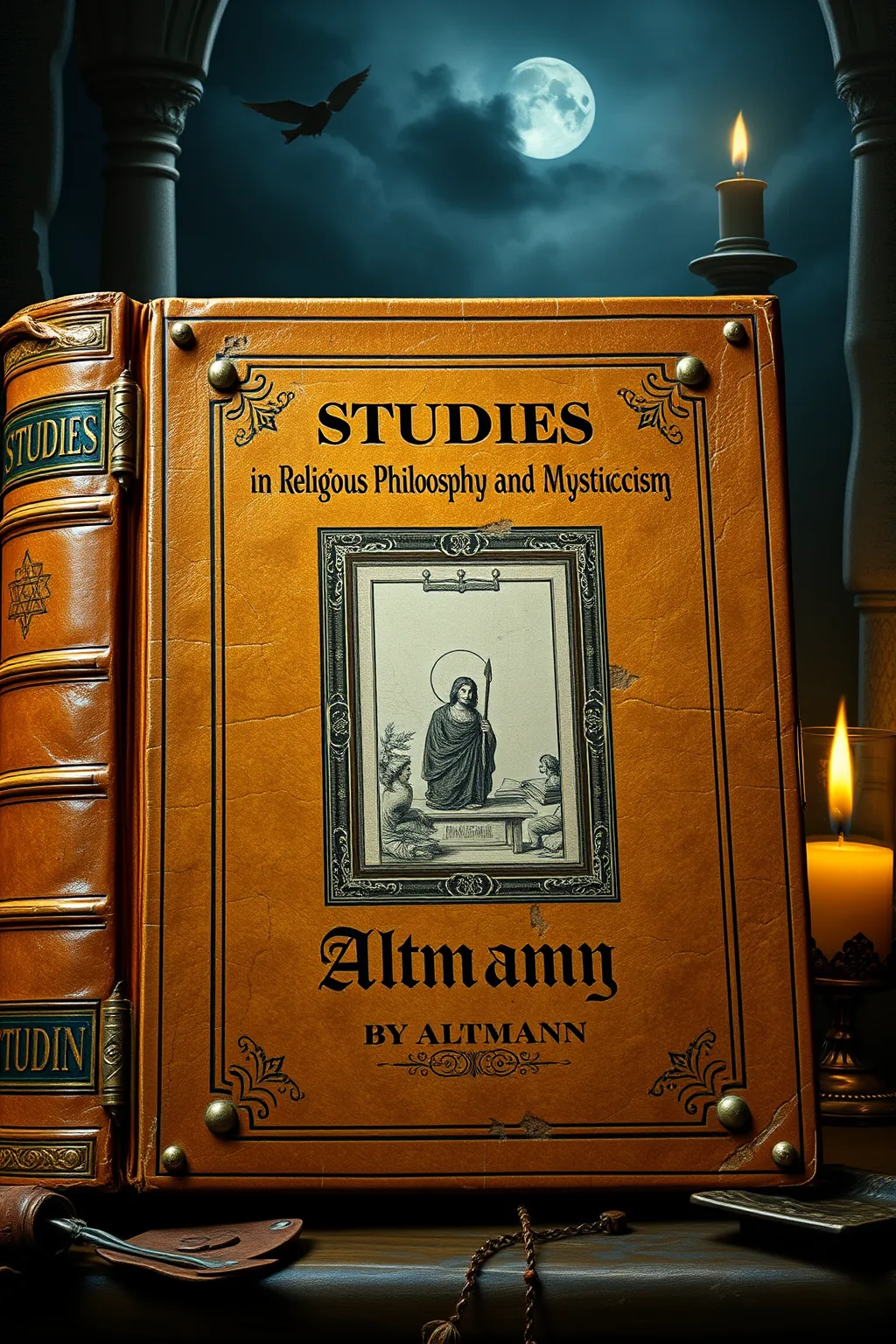
Studies in religious philosophy and mysticism

 74
74

Studies in religious philosophy and mysticism
Alexander Altmann’s Studies in Religious Philosophy and Mysticism presents a formidable intellectual landscape, particularly its detailed analysis of medieval Jewish thought and its philosophical entanglements. The strength lies in its rigorous scholarship and the meticulous way Altmann unpacks dense theological arguments, such as the philosophical underpinnings of Kabbalistic concepts. However, the book’s academic density, while a strength for specialists, can also be a barrier for readers less accustomed to the specific terminology and argumentative styles of historical philosophy. A passage discussing the Neoplatonic influences on Maimonides, for instance, showcases Altmann’s ability to connect disparate intellectual traditions, but requires significant concentration. Ultimately, this is a work of serious scholarship, best suited for those dedicated to the deep study of religious philosophy and historical mysticism.
📝 Description
74
Alexander Altmann's 1969 book examines the intersection of religious philosophy and mystical thought.
Originally published in 1969, Alexander Altmann's Studies in Religious Philosophy and Mysticism offers a rigorous academic analysis of theological and mystical ideas. This is not an introductory text; rather, it delves into intellectual history, concentrating on how philosophical reasoning and esoteric spiritual experiences interacted. Altmann's work traces complex theological discussions and the unfolding of mystical traditions across different historical periods. The book is suited for scholars, graduate students in religious studies, philosophy, and history, and for serious practitioners of mysticism who are already familiar with theological concepts. Those wishing to comprehend the intellectual foundations of various spiritual movements, particularly within Abrahamic traditions and their philosophical dialogues, will find considerable depth here. It demands a patient and analytical engagement with challenging arguments. Altmann's study emerged during a time of revived academic interest in medieval philosophy and mysticism, a period that saw scholars re-evaluating these traditions beyond simplistic categorizations. The book engages with intellectual currents that sought to connect faith and reason, often questioning earlier positivistic or purely historical views of religious phenomena. It contributes to the ongoing scholarly conversation about the development of religious thought.
Altmann's work situates itself within the scholarly re-evaluation of medieval mysticism that gained traction in the mid-20th century. It investigates how thinkers reconciled esoteric spiritual experiences with established philosophical and theological frameworks. The book focuses on the conceptual tools and philosophical lineages that enabled the expression of mystical states and divine encounters within the context of traditions like Judaism and Christianity. It examines the intellectual architecture required to speak of prophecy, revelation, and direct knowledge of God, moving beyond purely historical or devotional accounts.
💡 Why Read This Book?
• Gain a nuanced understanding of the philosophical dialogues within medieval Jewish mysticism, specifically concerning the concept of 'Ein Sof' as explored in the 1969 publication. • Learn to analyze the historical intersections between philosophical systems (like Aristotelianism) and mystical experiences, as Altmann demonstrates with thinkers from the period. • Appreciate the academic rigor required to study esoteric traditions, understanding how scholars in 1969 approached the complex relationship between revelation and reason.
⭐ Reader Reviews
Honest opinions from readers who have explored this book.
❓ Frequently Asked Questions
What is the primary focus of Alexander Altmann's 'Studies in Religious Philosophy and Mysticism'?
The book primarily focuses on the intellectual history of religious philosophy and mysticism, examining how theological concepts and mystical experiences were articulated and debated within various traditions, particularly in the medieval period.
Is 'Studies in Religious Philosophy and Mysticism' suitable for a general audience interested in spirituality?
While it touches on spirituality, the book is highly academic and dense, geared towards scholars and students of religious studies and philosophy rather than a general audience seeking introductory spiritual texts.
What historical period does Altmann most frequently explore in his studies?
Altmann frequently explores the medieval period, investigating the philosophical and theological developments that shaped religious thought and mystical traditions during that era.
Does the book cover non-Abrahamic mystical traditions?
The primary focus tends to be on Abrahamic traditions, particularly Jewish philosophy and mysticism, and their engagement with broader philosophical currents of their time.
When was 'Studies in Religious Philosophy and Mysticism' first published?
The work was first published in 1969, placing it within a period of significant academic re-evaluation of medieval thought and religious history.
What kind of reader would benefit most from Altmann's 1969 publication?
Advanced students and scholars in religious studies, philosophy, and history who are interested in the detailed intellectual history and theological underpinnings of mysticism would benefit most.
🔮 Key Themes & Symbolism
Philosophical Theology
This theme examines the intricate relationship between philosophical reasoning and theological doctrine. Altmann analyzes how thinkers, particularly in the medieval period, employed philosophical frameworks—such as Aristotelianism or Neoplatonism—to articulate, defend, or even critique religious beliefs and mystical experiences. The work highlights the intellectual tools used to grapple with concepts like God's nature, creation, and the possibility of divine knowledge, showing how philosophy served as a crucial language for religious discourse.
Medieval Mystical Traditions
The book offers deep dives into various medieval mystical movements, with a significant focus on Jewish mysticism. It explores the conceptual landscape that birthed and sustained these traditions, looking at how mystics interpreted scripture, sought direct spiritual experience, and developed distinct cosmologies and practices. Altmann traces the development of these ideas, often connecting them to broader philosophical currents, demonstrating that mysticism was not separate from intellectual life but deeply embedded within it.
The Nature of Revelation
A recurring concern is the concept of revelation and its reception. Altmann investigates how different philosophical and mystical schools understood divine communication. This includes examining debates on prophecy, the interpretation of sacred texts, and the role of immediate spiritual insight. The work questions how revealed truths were understood and integrated into existing philosophical systems, often revealing tensions between received wisdom and rational inquiry.
Intellectual History of Esotericism
Altmann’s study contributes to understanding esotericism not as a fringe phenomenon but as an integral part of intellectual history. By tracing the lineage of ideas and the philosophical dialogues surrounding mystical thought, the book demonstrates the scholarly engagement with esoteric traditions. It shows how thinkers in periods like the 12th century were actively wrestling with concepts that would later be categorized as mystical or esoteric, often within mainstream academic and religious discourse.
💬 Memorable Quotes
Direct passages from the work, attributed to the author.
“The work explores how philosophical systems provided a framework for articulating mystical insights.”
— This concept underscores Altmann's central thesis: mystical experiences and beliefs were not solely emotional or intuitive but were often expressed and understood through the rigorous language and logic of philosophy available at the time.
“The book examines the integration of Neoplatonic ideas into medieval Jewish theological discourse.”
— This highlights Altmann's focus on intellectual cross-pollination, showing how philosophical schools originating elsewhere, like Neoplatonism, were adapted and applied by thinkers within a different religious tradition to solve theological or mystical problems.
“Altmann analyzes the conceptual evolution of divine immanence in religious thought.”
— This points to the book's exploration of how the idea of God's presence within creation, or immanence, was understood and debated across different eras and philosophical systems, revealing shifts in theological perspectives.
“The study addresses the role of reason in understanding religious phenomena.”
— This suggests an investigation into the boundaries and interplay between rational inquiry and faith, exploring how thinkers attempted to reconcile spiritual experiences or doctrines with logical analysis, a key tension in religious philosophy.
“The scholarship studies the philosophical underpinnings of Kabbalistic concepts.”
— This signifies a scholarly approach to esoteric Jewish mysticism, indicating that Altmann sought to uncover the rational and philosophical structures that informed complex mystical ideas, rather than viewing them as purely irrational.
🌙 Esoteric Significance
Tradition
Altmann's work primarily engages with the Abrahamic esoteric traditions, with a pronounced focus on medieval Jewish mysticism (Kabbalah) and its philosophical dialogues. It situates these traditions within the broader intellectual field of medieval philosophy, particularly its engagement with Neoplatonism and Aristotelianism. The book demonstrates how esoteric concepts were not isolated but were part of sophisticated philosophical systems, contributing to the intellectual lineage of Western esotericism.
Symbolism
While the book is highly philosophical, it implicitly engages with symbolic representation through its exploration of theological concepts. For instance, the concept of 'Ein Sof' (the Infinite) in Kabbalah, though abstract, functions symbolically to represent the unknowable divine essence. Similarly, discussions on divine attributes or emanations can be seen as symbolic language used to bridge the gap between the transcendent and the immanent, or the unmanifested and the manifested.
Modern Relevance
Contemporary scholars of religion and philosophy continue to draw upon Altmann's rigorous approach to analyzing the philosophical underpinnings of mystical traditions. His work remains relevant for those exploring the historical connections between philosophy and esoteric thought, particularly in understanding how intellectual frameworks shaped spiritual expression in the medieval period and beyond. Thinkers interested in comparative mysticism and the history of ideas find his detailed analyses invaluable.
👥 Who Should Read This Book
• Advanced students and scholars of religious studies, comparative religion, and medieval philosophy, seeking a detailed analysis of theological discourse and mystical thought. • Researchers interested in the intellectual history of Abrahamic traditions, particularly medieval Jewish philosophy and Kabbalah, who require in-depth textual and conceptual exploration. • Philosophers and theologians examining the historical interplay between rationalism and mysticism, who wish to understand how these forces shaped spiritual and intellectual traditions prior to the modern era.
📜 Historical Context
Published in 1969, Alexander Altmann's Studies in Religious Philosophy and Mysticism emerged during a fertile period for academic research into medieval intellectual history and comparative religion. The mid-20th century saw a significant re-evaluation of previously marginalized or misunderstood traditions, including medieval Jewish philosophy and Kabbalah, moving beyond purely theological or hagiographical accounts. Altmann's work engaged with scholars like Gershom Scholem, who had revolutionized the study of Kabbalah, and contributed to a broader scholarly conversation that sought to integrate mystical thought into the mainstream history of philosophy. This era was also marked by critical engagement with existentialism and phenomenology, influencing approaches to religious experience. While not facing overt censorship, the academic rigor of the book positioned it within scholarly debates rather than popular esoteric circles, distinguishing it from more accessible, contemporary spiritual literature.
📔 Journal Prompts
The integration of Neoplatonic concepts within medieval Jewish philosophy.
Reflect on the philosophical frameworks used to articulate mystical experiences.
Analyze the scholarly approach to Kabbalistic concepts presented by Altmann.
Consider the historical context of religious thought in 1969.
The relationship between divine immanence and philosophical theology.
🗂️ Glossary
Ein Sof
A Kabbalistic term referring to God in God's absolute, unknowable essence, beyond all conception or description. It represents the Infinite or the Limitless, the ultimate divine reality before divine manifestation.
Neoplatonism
A philosophical system originating with Plotinus, heavily influenced by Plato, emphasizing emanation from a supreme, transcendent 'One' through a hierarchy of being, influencing much of medieval philosophy and mysticism.
Aristotelianism
The philosophical system based on the teachings of Aristotle, emphasizing logic, empirical observation, and metaphysics, which significantly impacted medieval Christian, Jewish, and Islamic thought.
Immanence
In theology, the belief that God is present within the universe and human experience, as opposed to transcendence, which posits God as existing wholly outside and beyond the material world.
Mysticism
A range of spiritual or philosophical traditions that claim direct experience of the divine or ultimate reality, often through contemplative practices, intuition, or ecstatic states.
Theology
The systematic study of the nature of the divine and of religious belief, often involving philosophical reasoning to understand God, creation, and religious doctrines.
Kabbalah
A system of Jewish mysticism and esoteric interpretation of the Torah, concerned with the nature of God, creation, and the relationship between the divine and the human world.
🔮 Readers Also Liked
Browse all →







More by Altmann, Alexander
All books →



More Free Mysticism & Contemplation Books
View all →