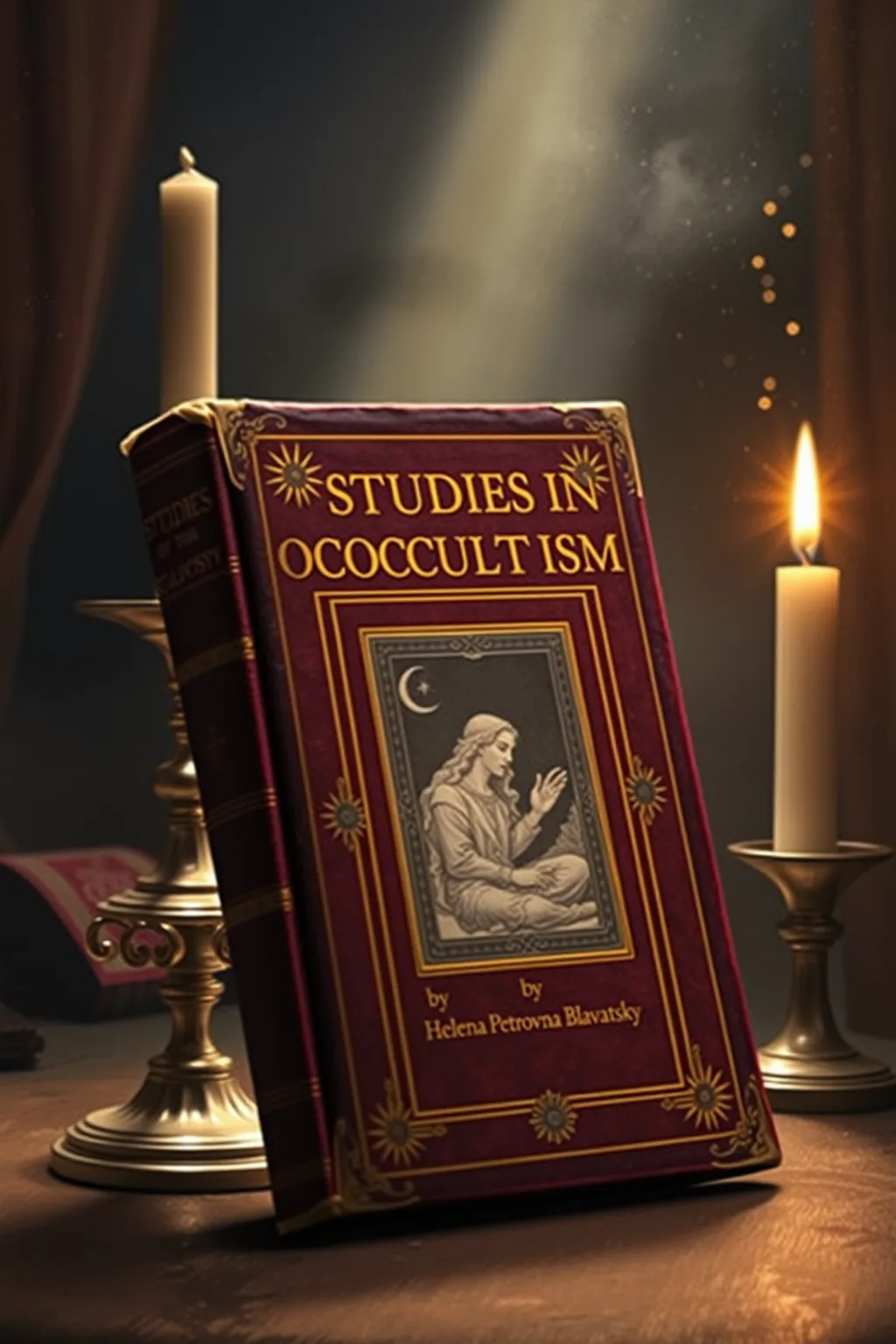
Studies in Occultism
 80
80

Studies in Occultism
Blavatsky's "Studies in Occultism" offers an unvarnished look at the foundational architecture of Theosophy. The strength lies in its directness; Blavatsky doesn't shy away from asserting the existence of planes of being beyond the physical or the intricate workings of karma. Her explanation of the "Seven Principles" of man, for instance, provides a detailed, albeit dense, model for understanding human constitution that is central to her system. However, the work's challenge for the modern reader is its sheer density and reliance on a specific, often archaic, vocabulary. Understanding the nuanced interplay between the 'Kama-Manas' and 'Buddhi-Manas' requires significant prior exposure or dedicated study. A passage discussing the "Great Teachers" and their role in human evolution, while central to Theosophical belief, can feel abstract without the broader context of her voluminous correspondence and other works. Despite its demanding nature, the book remains a vital primary source for anyone serious about the history of esoteric thought. It is a foundational text, demanding but rewarding for the dedicated student.
📝 Description
80
Helena Petrovna Blavatsky's 1897 collection, Studies in Occultism, gathers her early writings on spiritual science.
Studies in Occultism is a compilation of essays and articles by Helena Petrovna Blavatsky, a central figure in modern Theosophy. These pieces offer direct engagement with her core ideas about spiritual science, consciousness, and the hidden principles of the cosmos. Blavatsky constructs a distinct worldview by detailing complex metaphysical concepts, drawing from a wide array of philosophical and religious traditions. The book emerged in the late 19th century during a period of heightened interest in spiritualism and occult revivalism. Blavatsky's work directly addressed and often questioned prevailing scientific and religious ideas of the time.
This collection is particularly useful for understanding the origins of Theosophy and its subsequent impact on other esoteric movements. It is relevant for students of comparative religion, philosophy of mind, and those interested in the historical development of occult doctrines. Readers seeking Blavatsky's unique synthesis of Eastern and Western mysticism will find original material here, bypassing later interpretations to confront her primary statements.
Published in 1897, Studies in Occultism reflects the late 19th-century occult revival in Europe and North America. This period saw a resurgence of interest in spiritualism, mesmerism, and Eastern philosophies, often blended into new esoteric systems. Blavatsky, a key architect of Theosophy, contributed significantly to this milieu. Her writings sought to reconcile ancient wisdom traditions with contemporary scientific and philosophical inquiry, aiming to reveal a hidden spiritual dimension to reality and human existence.
💡 Why Read This Book?
• Gain direct insight into Blavatsky's original formulation of the "Seven Principles" of human constitution, a core Theosophical doctrine, allowing you to grasp the intricate layers of consciousness she described. • Understand the Theosophical perspective on karma and reincarnation, as presented by Blavatsky herself, providing a historical lens on these concepts' modern interpretations. • Explore Blavatsky's synthesis of Eastern philosophies (like Vedanta and Buddhism) with Western occult traditions, offering a unique framework for understanding spiritual evolution and universal laws as articulated in the late 19th century.
⭐ Reader Reviews
Honest opinions from readers who have explored this book.
❓ Frequently Asked Questions
When was Helena Petrovna Blavatsky's 'Studies in Occultism' first compiled and published?
While the individual essays may have appeared earlier, 'Studies in Occultism' as a compilation is generally associated with publications around the late 19th century, following the initial surge of Blavatsky's major works like 'Isis Unveiled' (1877) and 'The Secret Doctrine' (1888).
What is the primary philosophical tradition behind 'Studies in Occultism'?
The primary tradition is Theosophy, a spiritual philosophy founded by Helena Blavatsky, which synthesizes elements from Eastern (Hinduism, Buddhism) and Western esoteric traditions (Hermeticism, Kabbalah, Neoplatonism).
Is 'Studies in Occultism' considered a primary source for Theosophy?
Yes, it is a crucial primary source. It offers direct exposition of Blavatsky's views on key Theosophical tenets, including karma, reincarnation, and the nature of spiritual evolution, providing foundational material for understanding the movement.
What role do Eastern philosophies play in Blavatsky's 'Studies in Occultism'?
Eastern philosophies, particularly concepts from Hinduism and Buddhism such as karma, reincarnation, and the idea of spiritual hierarchies, are integral. Blavatsky sought to demonstrate the universality of these ancient wisdom traditions.
Does 'Studies in Occultism' discuss the concept of 'planes of existence'?
Yes, the work extensively discusses various planes of existence, including the physical, astral, and mental realms, detailing how consciousness operates and evolves across these different levels.
Is this book suitable for beginners in esoteric studies?
While foundational, the book's dense prose and specific terminology make it challenging for absolute beginners. It is more suitable for those with some familiarity with esoteric concepts or a strong academic interest in Theosophy's historical development.
🔮 Key Themes & Symbolism
The Seven Principles
Blavatsky's framework for understanding the human constitution is presented as a series of seven principles, extending from the physical body (Sthula Sharira) to the ultimate spiritual essence (Atma). This intricate model, often drawing parallels with Hindu philosophy's Panchakosha, posits layers of consciousness and energetic bodies (like the Linga Sharira or astral body and Kama Rupa or desire body) that interact. Understanding these principles is crucial for grasping Blavatsky's esoteric psychology and her views on spiritual evolution and disintegration.
Karma and Reincarnation
Central to Blavatsky's teachings are the immutable laws of Karma and Reincarnation. Karma is presented not merely as retribution but as the universal principle of cause and effect, governing the moral and spiritual consequences of actions across lifetimes. Reincarnation is the mechanism through which the spiritual ego progresses, learning lessons and working out karmic debts through successive embodiments. This doctrine underpins her vision of cosmic justice and the gradual perfectibility of humanity.
Esoteric Science and Universal Laws
Blavatsky frames her teachings as a form of 'esoteric science,' distinct from materialistic science but equally governed by precise, discoverable laws. She posits hidden forces and intelligences operating within the cosmos, and a spiritual hierarchy that guides the evolutionary process. This perspective challenges conventional understandings of reality, suggesting a deeper, underlying order that can be perceived through spiritual insight and dedicated study of ancient wisdom.
The Great Teachers
The concept of 'Great Teachers' or Masters, enlightened beings who have attained a high stage of spiritual evolution, is a recurring motif. These Masters, according to Blavatsky, guide humanity's spiritual progress and transmit esoteric knowledge. Their existence is presented as a vital aspect of the spiritual hierarchy and a source of the wisdom traditions that Blavatsky aimed to reintroduce to the modern world.
💬 Memorable Quotes
Direct passages from the work, attributed to the author.
“The human being is composed of seven principles.”
— This statement expresses Blavatsky's complex model of human constitution, outlining the distinct physical, psychic, and spiritual elements that constitute an individual and their journey through various planes of existence.
“Karma is the unerring law which guides the destinies of men.”
— This highlights Karma as a fundamental, impersonal force of cause and effect that shapes individual lives and collective destinies, emphasizing its role in spiritual accountability and evolution.
“Reincarnation is the necessary process through which the spiritual ego learns and evolves.”
— This interpretation underscores reincarnation as the vehicle for the soul's progression, providing the experiential framework for karmic lessons and the gradual attainment of spiritual wisdom across multiple lifetimes.
“Occultism is the science of the unseen.”
— This concise definition frames occult studies as a systematic investigation into the hidden forces, laws, and realities that lie beyond the scope of ordinary sensory perception and conventional scientific inquiry.
“The Masters are the custodians of the ancient wisdom.”
— This refers to the enlightened beings within the Theosophical tradition who are believed to preserve and transmit profound spiritual knowledge, acting as guides for humanity's evolution.
🌙 Esoteric Significance
Tradition
This work is a core part of the Theosophical tradition, which Blavatsky co-founded. Theosophy itself is a syncretic system, drawing heavily from Hermeticism, Neoplatonism, Kabbalah, and particularly from Hinduism and Buddhism. "Studies in Occultism" presents Blavatsky's unique synthesis, aiming to reveal an underlying 'Ancient Wisdom' common to all world religions and esoteric systems, positioning Theosophy as a modern articulation of this perennial philosophy.
Symbolism
Key symbols include the Seven Principles, representing the layered constitution of the human being and the cosmos. The concept of the 'Great Wheel' of reincarnation and karma symbolizes the cyclical nature of existence and spiritual progression. Blavatsky also frequently employs the 'Seven Rays' and the 'Seven Heavens,' motifs common in both Eastern cosmology and Hermetic traditions, to delineate cosmic order and spiritual hierarchies.
Modern Relevance
Contemporary esoteric movements, including various forms of New Age spirituality, modern Wicca, and Neo-Theosophical societies, continue to draw upon Blavatsky's foundational concepts. Thinkers in consciousness studies and comparative religion often engage with her work as a significant historical influence on Western esotericism and alternative spiritual paradigms that emerged in the 20th century.
👥 Who Should Read This Book
• Students of Helena Blavatsky and the origins of Theosophy seeking direct engagement with her foundational ideas on consciousness, karma, and spiritual evolution. • Researchers of 19th-century occultism and spiritualism interested in a primary source that shaped esoteric thought and influenced subsequent movements. • Practitioners of esoteric disciplines looking to understand the historical and philosophical underpinnings of concepts such as reincarnation, planes of existence, and esoteric science.
📜 Historical Context
Helena Petrovna Blavatsky's "Studies in Occultism" emerged from the vibrant intellectual milieu of the late 19th century, a period marked by widespread interest in spiritualism, psychic phenomena, and Eastern religions. As a contemporary of figures like Madame d'Espérance and Arthur Conan Doyle, Blavatsky was part of a broader wave of occult revivalism. Her work, particularly "The Secret Doctrine" (1888), directly challenged both established scientific materialism and orthodox religious doctrines, proposing a complex spiritual cosmology. This period also saw the rise of comparative mythology and religious studies, providing a fertile ground for Blavatsky's attempts to synthesize diverse traditions. While lauded by followers, her teachings faced significant criticism and skepticism from mainstream academia and religious authorities, contributing to her often controversial reception.
📔 Journal Prompts
The Seven Principles of man as outlined by Blavatsky require careful examination.
Reflect on the law of Karma and its implications for personal responsibility.
How does Blavatsky's concept of the 'Great Teachers' influence your understanding of spiritual guidance?
Consider the esoteric interpretation of cycles and the 'Great Wheel' of existence.
Analyze the relationship between the physical and subtle bodies as described in these studies.
🗂️ Glossary
Sthula Sharira
Sanskrit term for the physical body, considered the densest manifestation of the human being in Blavatsky's Seven Principles model.
Linga Sharira
The astral or 'double' body, a subtle energetic counterpart to the physical body, essential for life functions and a vehicle for psychic phenomena.
Kama Rupa
The 'desire body,' associated with emotions and lower passions, believed to persist after physical death and influence lower psychic states.
Manas
The principle of mind or intellect, which Blavatsky often divides into lower (animalistic) and higher (spiritual) aspects.
Buddhi
The spiritual discernment or intuitive wisdom principle, often linked with the Atma to form the higher spiritual triad.
Atma
The supreme spiritual self or divine spark, the highest principle in Blavatsky's Seven Principles, considered immortal and ultimately one with the Absolute.
Esoteric Science
Blavatsky's term for a system of knowledge concerning hidden natural laws and spiritual forces, distinct from but complementary to physical science.