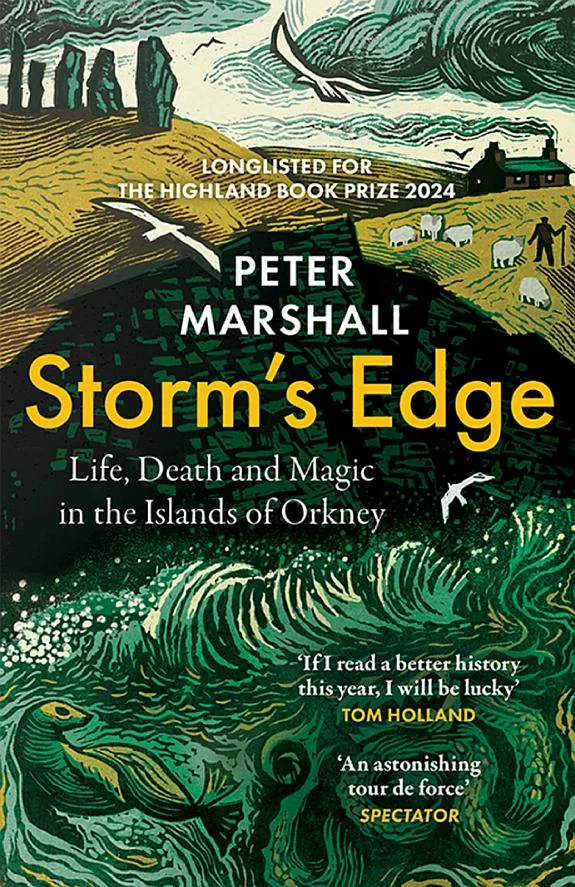
Storm’s Edge: Life, Death and Magic in the Islands of Orkney
 83
83

Storm’s Edge: Life, Death and Magic in the Islands of Orkney
Peter Marshall’s *Storm’s Edge* avoids the easy pitfalls of romanticizing Orkney, instead presenting a grounded yet deeply resonant account of its spiritual and cultural currents. The book excels in its meticulous detail, particularly when tracing the lineage of belief systems from Neolithic times through to the era of Viking sagas. Marshall’s capacity to connect the physical landscape – the dramatic cliffs, the ever-present sea – to the inner lives of its inhabitants is a significant achievement. One passage that lingers is the description of how ancient burial mounds, such as Maeshowe, became sites for later Viking inscriptions, demonstrating a layered interaction with the sacred. A limitation, however, might be that for readers specifically seeking purely occult or grimoire-based magic, the focus here is more on folk belief and the felt presence of the numinous rather than structured magical systems. Nevertheless, for its rich historical synthesis and evocative portrayal of a landscape imbued with meaning, *Storm’s Edge* offers a compelling study of enduring human spirituality.
📝 Description
83
Peter Marshall's 2007 book investigates life, death, and magic in Orkney.
Storm's Edge examines the Orkney archipelago not just as a place, but as a crucible for human experience and belief. The book follows a historical arc from early settlers to contemporary times, showing how the unique environment and isolation of these northern islands shaped the inhabitants' connection to both the visible and invisible worlds. It is a study of Orkney's enduring spirit, its folklore, and the subtle energies perceived and enacted there over millennia.
This work is for readers interested in cultural history, folklore, and the persistence of the numinous in human societies. It appeals to those fascinated by island cultures, their mythologies, and how landscape influences consciousness. Scholars of comparative religion, mythology enthusiasts, and anyone curious about the relationship between place, belief, and human identity will find substantial material. It is suited for those seeking to understand how ancient practices and beliefs persist and transform in modern contexts.
The book situates Orkney's magical and spiritual currents within broader historical movements. It addresses the persistence of pre-Christian beliefs beneath later religious overlays and the impact of isolation on developing unique cultural expressions. Marshall implicitly engages with the long tradition of interpreting island myths and landscapes, a practice seen in earlier writings on Scottish folklore, though often with less focus on the magical or esoteric dimensions.
💡 Why Read This Book?
• Gain insight into the concept of 'thin places' as explored through Orkney's unique geography and history, understanding how specific locations become focal points for perceived spiritual energy, as detailed in chapters discussing sites like Skara Brae. • Discover the enduring influence of pre-Christian animistic beliefs on Orkney folklore and rituals, particularly how these ancient sensibilities manifest in local legends and practices described in the book. • Understand the complex interplay between life, death, and cyclical time as perceived by island communities, drawing connections between agricultural rhythms, marine cycles, and funerary traditions presented in the text.
⭐ Reader Reviews
Honest opinions from readers who have explored this book.
❓ Frequently Asked Questions
What historical periods does Peter Marshall cover in Storm's Edge?
Peter Marshall's *Storm's Edge* spans from the Neolithic era, with references to sites like Skara Brae (c. 3180 BC), through the Viking Age and Christianization, extending into the modern period, examining the evolution of beliefs and culture on the islands.
What is the significance of 'thin places' in Orkney according to the book?
The book interprets 'thin places' in Orkney as locations where the boundary between the physical and spiritual realms is perceived as more permeable, influencing local folklore and the sense of numinous presence across different historical periods.
Does Storm's Edge focus on specific magical practices or folk traditions?
While it explores the felt presence of the numinous and folk beliefs, *Storm's Edge* primarily focuses on the broader cultural and spiritual currents shaped by landscape and history, rather than detailing specific occult magical systems.
Who were some key groups that influenced Orkney's culture as discussed in the book?
The book highlights the influence of early settlers, the Vikings who left significant inscriptions, and the gradual Christianization of the islands, all of which contributed to the complex layering of beliefs and traditions.
What makes Orkney a unique setting for exploring life, death, and magic?
Orkney's unique setting, characterized by its isolation, dramatic natural environment, and rich archaeological heritage, has fostered a distinct cultural landscape where perceptions of life, death, and magic have evolved uniquely over millennia.
Is Storm's Edge a historical account or a mystical exploration?
*Storm's Edge* blends historical inquiry with an exploration of the mystical and esoteric dimensions of Orkney life. It uses historical context to illuminate the persistent spiritual and magical currents within the islands' culture.
🔮 Key Themes & Symbolism
The Numinous Landscape
The work posits Orkney not merely as land but as a conscious presence, a 'thin place' where the veil between worlds is porous. Marshall details how geological features and the relentless sea contribute to a pervasive sense of the numinous. From Neolithic standing stones to Viking runic inscriptions in ancient tombs like Maeshowe, the landscape itself acts as a repository of memory and spiritual energy, shaping the inhabitants' perception of reality and their connection to ancestral forces. This theme explores how geographical isolation fosters unique spiritual sensitivities.
Cycles of Life and Death
Central to the book's exploration is the cyclical understanding of existence, deeply influenced by Orkney's environment. The rhythm of seasons, agricultural necessity, and the ever-present threat and bounty of the sea dictate a perspective where life and death are not endpoints but transitions. Marshall examines how ancient burial practices, fertility rites, and folk beliefs surrounding mortality reflect this interconnectedness, suggesting that the islands' inhabitants historically perceived a continuous flow between the living and the dead, often mediated by local lore and ancestral reverence.
Persistence of Ancient Beliefs
Marshall investigates the remarkable tenacity of pre-Christian animistic and nature-venerating beliefs within Orkney's cultural fabric. Despite the imposition of Christianity and the advent of modernity, these older sensibilities continue to surface in folklore, local legends, and the subtle magic attributed to the islands. The book traces how elements of these ancient worldviews have been reinterpreted or subsumed rather than eradicated, demonstrating a cultural resilience that allows ancient patterns of thought and practice to coexist with later historical developments.
💬 Memorable Quotes
Direct passages from the work, attributed to the author.
“Maeshowe became a target for Viking graffiti, layering new narratives onto ancient sacred spaces.”
— This highlights the book's theme of historical layering, where successive cultures interact with and re-appropriate sites of power, demonstrating how sacred places accrue meaning over time through human engagement.
“The islands foster a unique relationship with the sea, a source of both life and profound mystery.”
— This suggests the central role of the marine environment in shaping Orkney's spiritual landscape, emphasizing its dual nature as provider and a powerful force that evokes awe and a sense of the unknown.
“Skara Brae represents a deep, ancient connection to the land, predating written records.”
— This points to the book's exploration of Neolithic heritage and the idea of a primal, land-based spirituality that forms the bedrock of Orkney's enduring mystical character.
“Isolation has preserved a distinct Orkney consciousness, attuned to subtle energies.”
— This interpretation underscores the book's argument that the islands' geographical separation has allowed for the cultivation and retention of unique beliefs and a heightened awareness of the non-material world.
🌙 Esoteric Significance
Tradition
While not strictly adhering to a single esoteric lineage like Hermeticism or Kabbalah, *Storm's Edge* taps into the broad Western esoteric tradition's interest in landscape as a locus of spiritual power and the persistence of folk magic. It aligns with traditions that emphasize animism, nature spirituality, and the concept of 'thin places' – ideas found in various contemporary pagan and earth-centered spiritualities, as well as older forms of shamanism and folk belief systems.
Symbolism
Key symbols explored include the standing stones, representing ancient connections to celestial cycles and earth energies, and the sea, symbolizing the subconscious, the unknown, and the transformative power of nature. The persistent presence of burial mounds, such as Maeshowe, symbolizes the continuity of ancestral connection and the layered nature of spiritual history, where older beliefs are often overlaid but not erased by new ones.
Modern Relevance
Contemporary practitioners of earth-based spiritualities and neo-paganism draw on the kind of landscape-focused spirituality detailed in *Storm's Edge*. Thinkers and writers interested in ecopsychology and the psychological impact of place also find resonance here. The book speaks to modern desires for connection with nature and a sense of the sacred in the physical world, influencing contemporary approaches to sacred geography and place-based spirituality.
👥 Who Should Read This Book
• Students of comparative folklore and mythology: Gain a deeper understanding of how landscape and isolation shape unique belief systems, drawing on specific Orkney examples like the persistence of animism. • Practitioners of earth-centered spiritualities: Discover concrete examples of 'thin places' and nature veneration, providing inspiration for connecting with the numinous in your own environment. • Cultural historians and geographers: Find a detailed case study on how geographical factors and historical layers (Neolithic, Viking, Christian) influence a region's spiritual and magical consciousness.
📜 Historical Context
Peter Marshall's *Storm's Edge* emerges from a long tradition of scholarship on Scottish islands and their cultural specificities, yet it distinguishes itself by focusing on the esoteric and magical dimensions often marginalized in more secular historical accounts. Written in 2024, it engages with the deep past, from the Neolithic settlements around 3180 BC to the cultural shifts during the Viking Age and subsequent Christianization. The book implicitly addresses the intellectual currents of folklore studies and comparative mythology, but specifically foregrounds the persistent threads of animism and what might be termed 'folk magic'. Unlike earlier works that might categorize such beliefs as superstition, Marshall treats them as integral to the Orkney experience. His work can be seen as a contemporary counterpart to the broader historical narratives of Scotland, offering a more nuanced perspective on belief systems that have historically competed with or coexisted alongside dominant religious and rationalist paradigms.
📔 Journal Prompts
The concept of 'thin places' as manifested in Orkney's specific geography.
Reflect on the cyclical understanding of life and death presented in the book.
Analyze the persistence of animistic beliefs across historical periods in Orkney.
Consider the symbolism of the sea in relation to life and the unknown.
Explore the historical layering of beliefs evident in sites like Maeshowe.
🗂️ Glossary
Thin Places
Locations, often natural or ancient sites, where the boundary between the physical and spiritual realms is perceived to be more permeable, allowing for heightened spiritual experience or connection.
Animism
The belief that natural objects, phenomena, and the universe itself possess souls or consciousness, and that spirits inhabit natural elements like rocks, plants, and rivers.
Numinous
The quality of evoking a sense of the divine, awe, or spiritual dread; relating to a powerful, often mysterious, spiritual presence or force.
Skara Brae
A remarkably preserved Neolithic settlement on the Orkney mainland, offering insights into prehistoric life and spiritual practices on the islands, dating back to around 3180 BC.
Maeshowe
A significant Neolithic chambered tomb on Orkney, notable for its architectural sophistication and later Viking inscriptions, illustrating the layering of history and belief.
Viking Age
The period of Norse history roughly spanning from the late 8th to the mid-11th centuries, during which Norse explorers, traders, and warriors, including those who settled Orkney, made extensive voyages.
Folk Magic
Magical practices and beliefs traditionally passed down through oral tradition within communities, often tied to agricultural cycles, healing, or protection, distinct from formal magical systems.
This book appears in 1 collection
🔮 Readers Also Liked
Browse all →








From the “Folklore Magic” Collection
View all →




More Free Magic & Ritual Books
View all →