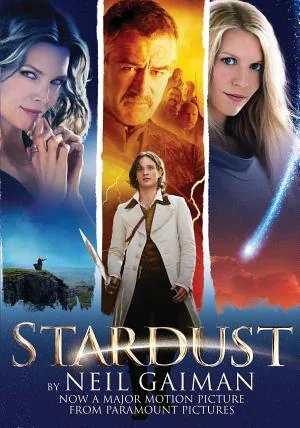
Stardust Movie Tie-in Teen Edition
 71
71

Stardust Movie Tie-in Teen Edition
Neil Gaiman’s Stardust, particularly in this teen-focused, movie tie-in edition, remains a charmingly peculiar fairytale. The premise—a quest into a magical land for a fallen star—is classic, but Gaiman injects it with his signature blend of wry humor and unexpected darkness. His prose, even when simplified for a younger audience, retains a lyrical quality. The character of Yvaine, the star, is a particular triumph, offering a compelling counterpoint to Tristan’s naive quest. However, the narrative occasionally feels a little too episodic, with plot developments sometimes serving the whimsy rather than propelling a consistently tight story forward. The film tie-in aspect, while broadening accessibility, does little to enhance the text itself. Despite this, Stardust offers a delightful escape into a world where the mundane and the magical collide with often surprising results. It’s a fairy tale that understands the sting of reality as much as the allure of dreams.
📝 Description
71
Neil Gaiman's 2007 novel Stardust follows Tristan Thorn's journey into Faerie for a fallen star.
Originally published in 2007, Neil Gaiman's Stardust tells the story of Tristan Thorn, a young man from the village of Wall. He crosses into the magical land of Faerie to retrieve a fallen star for the woman he loves. This edition, released alongside a film adaptation, introduces Gaiman's characteristic blend of whimsy and darkness to a younger audience.
This book is suitable for readers aged 12-14, who will appreciate its mix of adventure, romance, and mild peril. It acts as an accessible introduction to Gaiman's unique storytelling, which often reinterprets traditional fairytale elements with a sense of wonder. The narrative skillfully balances moments of genuine danger with humor and an optimistic outlook. The film tie-in edition was specifically created to coincide with the 2007 movie release, aiming to expand its readership.
Stardust draws from British folklore and fairy tales, traditions that have long explored the porous boundary between the human world and the supernatural. Gaiman's narrative echoes the archetypal quest motif found in many mythologies, where a protagonist ventures into an otherworldly realm to retrieve a magical object or prove their worth. The personification of the fallen star, Yvaine, aligns with animistic beliefs where natural phenomena possess sentient qualities. The story also touches upon themes of fate and the power of spoken words, common in folkloric accounts of magical pacts and prophecies.
💡 Why Read This Book?
• You will experience a modern fairytale that subverts classic tropes, learning how Neil Gaiman reimagines the 'quest for a princess' narrative with a fallen star named Yvaine, challenging traditional gender roles. • You will encounter the concept of liminal spaces, understanding how the village of Wall acts as a literal and metaphorical boundary between the human world and the magical realm of Faerie. • You will discover how promises and their fulfillment, a core element of Arthurian legend and folklore, are explored through Tristan's journey and the magic inherent in spoken words.
⭐ Reader Reviews
Honest opinions from readers who have explored this book.
❓ Frequently Asked Questions
What is the main difference between the original Stardust and the teen edition?
The teen edition is often released alongside a film adaptation, potentially featuring new cover art related to the movie. The core narrative by Neil Gaiman remains the same, though some editions might have minor edits for a younger readership.
When was Neil Gaiman's Stardust first published?
Neil Gaiman's original novel Stardust was first published on June 26, 2007, preceding the movie tie-in editions.
What age group is the Stardust Teen Edition recommended for?
This edition is specifically recommended for readers aged 12-14, offering a gateway into Neil Gaiman's fantastical storytelling.
What is the central premise of Stardust?
The story follows Tristan Thorn, who ventures into the magical land of Faerie to retrieve a fallen star for his beloved, only to discover the star is a living woman named Yvaine.
Does Stardust contain mature themes suitable for its target audience?
While aimed at teens, Stardust contains elements of peril, complex relationships, and dark fairytale undertones that are handled with Gaiman's characteristic nuance, suitable for the recommended age.
Who wrote the novel Stardust?
The novel Stardust was written by the acclaimed author Neil Gaiman, first published in 2007.
🔮 Key Themes & Symbolism
The Nature of Stars
In Stardust, the 'fallen star' is not merely an astronomical event but a sentient being, Yvaine. This transforms the quest from a simple retrieval into an interaction with a personified celestial body. The work explores the idea that what we often perceive as inanimate or distant can possess consciousness and agency, challenging human-centric views. This personification aligns with ancient mythologies where celestial bodies were often deified or imbued with spirit, reflecting a worldview where the cosmos is alive and interconnected.
Boundaries and Thresholds
The village of Wall serves as a potent symbol of separation between the mundane human world and the enchanted field of Faerie. The wall itself represents a tangible barrier, but the narrative consistently probes the permeability of such divisions. Tristan's journey across this threshold initiates his transformation, highlighting how stepping beyond familiar boundaries is essential for growth and discovery. This concept echoes Gnostic ideas of traversing planes of existence to attain knowledge or liberation.
The Weight of Promises
Promises in Stardust carry significant magical weight, often driving the plot's momentum. Tristan's initial vow to retrieve a star for Victoria initiates his adventure, and the consequences of his word shape his destiny. This theme appeals to folkloric traditions where oaths are binding, and their breaking or fulfillment can have dire or wondrous outcomes. It speaks to the power of intent and commitment within a magical framework, where spoken words can manifest reality.
Subverting Fairytale Tropes
Neil Gaiman playfully deconstructs traditional fairytale elements. The damsel in distress is a star who is quite capable of defending herself, and the prince charming figure, Tristan, begins as somewhat self-absorbed. The narrative eschews simple morality, presenting characters with flaws and complex motivations. This approach aligns with a more modern, critical engagement with folklore, similar to how authors like Angela Carter reinterpreted classic tales with feminist and psychological depth.
💬 Memorable Quotes
Direct passages from the work, attributed to the author.
“He had been a boy, and then he was a man, and he had been in love, and he had not been loved.”
— This concise statement captures Tristan's initial motivation and his naive understanding of love before his journey into Faerie. It sets up his quest not just as a physical journey but as an emotional and developmental one.
“Falling stars are not always what they seem.”
— This serves as a crucial piece of foreshadowing and commentary on the nature of Yvaine. It signals that the object of Tristan's quest will be far more complex and alive than he initially anticipates.
“She was a fallen star, and she was going to be murdered.”
— This stark sentence introduces the immediate danger facing Yvaine and shifts the narrative from a romantic quest to a story of protection and peril, highlighting the darker undercurrents of Faerie.
“The wall was the border between the village and the magical world.”
— This directly addresses the symbolic significance of the Wall, emphasizing its role as a literal and metaphorical threshold that Tristan must cross to begin his adventure.
💡 Key Ideas
Editorial paraphrase of the work's core concepts — not direct quotes.
The stars are not important. The important thing is the promise.
This line highlights the narrative's focus on commitment and the power of one's word over the object of desire itself. It suggests that the act of fulfilling a promise holds more value than the reward sought.
🌙 Esoteric Significance
Tradition
Stardust can be loosely connected to the Western Esoteric tradition, particularly its folkloric and fairytale branches, which often overlap with Hermetic and Gnostic themes of hidden worlds and transformative journeys. The concept of Faerie itself taps into ancient beliefs about parallel realms inhabited by powerful, often capricious beings, echoing ideas found in various mystical traditions regarding the unseen forces that influence human affairs. Gaiman's work departs from strictly codified systems, instead drawing on a broad, imaginative interpretation of myth and magic.
Symbolism
The 'Wall' acts as a potent symbol of separation between the mundane and the magical, a liminal space requiring crossing for transformation, akin to initiatory thresholds in esoteric practices. The 'Fallen Star' (Yvaine) represents a celestial essence made manifest, embodying divine or cosmic energy brought into the terrestrial realm, a motif found in alchemy and Gnosticism where divine sparks are trapped or fallen. The concept of 'Faerie' itself symbolizes an archetypal field of enchantment, power, and often, danger, reflecting the 'Otherworld' of Celtic myth.
Modern Relevance
Contemporary authors and storytellers continue to draw inspiration from Gaiman's ability to blend the magical with the mundane, particularly in young adult fiction and urban fantasy. His approach to reimagining folklore and myth appeals to modern explorations of identity and belonging, where characters often navigate complex, 'magical' systems within seemingly ordinary lives. Thinkers interested in the psychological archetypes within fairytales, or the narrative power of myth-making in contemporary society, find Stardust a rich text for analysis.
👥 Who Should Read This Book
• Young readers (12-14) exploring fantasy literature who are ready for stories with a bit more depth and darker undertones than typical children's tales. • Aspiring writers and storytellers interested in how authors like Neil Gaiman subvert traditional fairytale structures and develop unique magical systems. • Fans of folklore and mythology seeking modern interpretations of classic motifs, particularly those concerning the concept of Faerie and celestial beings.
📜 Historical Context
Published in 2007, Neil Gaiman's Stardust arrived in a landscape dominated by epic fantasy series like J.R.R. Tolkien's The Lord of the Rings and the burgeoning Harry Potter phenomenon. While these works often focused on grand conflicts and chosen ones, Gaiman's novel offered a more intimate, whimsical, and often darker take on fairytale archetypes, drawing inspiration from British folklore and earlier works like Lord Dunsany's tales. The 2007 movie tie-in edition specifically aimed to capture a younger audience, leveraging the film's release to introduce Gaiman's distinct voice to a broader demographic. Unlike the high fantasy of his contemporaries, Stardust presented a more personal quest narrative, exploring themes of love, magic, and consequence with a mix of charm and melancholy. Its reception was largely positive, cementing Gaiman's reputation for crafting sophisticated, modern fairytales that appealed across age groups.
📔 Journal Prompts
Tristan's initial desire for Victoria versus his later feelings for Yvaine; the transformation of his quest.
The symbolic meaning of the Wall as a boundary between worlds.
Reflect on the magical properties and consequences of promises within the narrative.
Yvaine's perspective as a living star observing human folly.
The various ways characters in Stardust seek power or immortality.
🗂️ Glossary
Faerie
A magical realm or land, distinct from the human world, inhabited by supernatural beings like fairies, witches, and magical creatures. It represents a place where the rules of nature and logic may not apply.
Wall
The physical and symbolic barrier separating the human village of Wall from the magical land of Faerie. It serves as a threshold for characters and the narrative.
Fallen Star
In this context, not a celestial body, but a personified, sentient being (Yvaine) who has descended from the sky, possessing magical qualities and a consciousness.
Starstone
A magical object sought by various characters, often associated with power or fulfilling desires, representing the tangible form of a fallen star's magic.
Lilith
A powerful witch and antagonist in the story, seeking immortality by consuming the heart of a fallen star. Represents a darker, more ancient form of magic.
Stormhold
The magical kingdom within Faerie where the princes of the realm vie for the throne, representing the political and power structures of the magical world.
The Babylon Candle
A magical artifact used for teleportation, allowing rapid travel between locations, highlighting the practical application of magic within the story's world.
🔮 Readers Also Liked
Browse all →








More Free Occult Philosophy Books
View all →