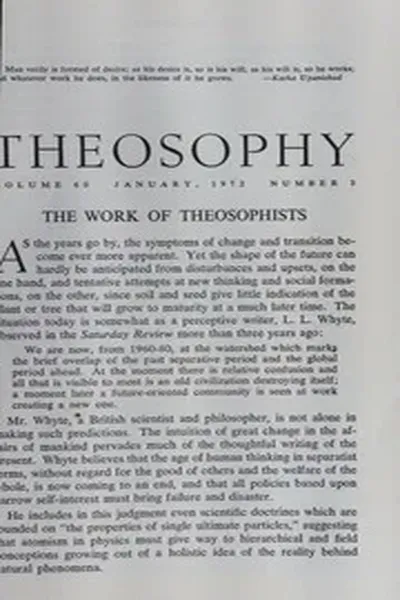
Thinking and destiny

 73
73

Thinking and destiny
Harold Waldwin Percival's Thinking and Destiny is a formidable work, presenting a densely structured argument for the primacy of thought in shaping reality. Its strength lies in its systematic, almost architectural, approach to metaphysics, offering a detailed blueprint for understanding consciousness's creative power. Percival avoids vague pronouncements, instead building a logical edifice that demands careful study. A limitation, however, is the sheer density of the material, which can feel overwhelming without prior grounding in similar philosophies. The chapter detailing the "Law of Cause and Effect" is particularly illustrative of Percival's methodical exposition, demonstrating how every thought acts as a seed with predictable consequences. This book is an essential, albeit challenging, resource for dedicated seekers of metaphysical understanding.
📝 Description
73
Harold Waldwin Percival published Thinking and Destiny in 1971, detailing how thought shapes reality.
Thinking and Destiny examines the connection between consciousness, thought, and the creation of one's circumstances. Percival argues that the quality of our thoughts directly affects personal experience and the fundamental nature of existence. The book presents a method for understanding how mental states, beliefs, and intentions interact with universal principles to shape both internal and external realities.
This work is for those seriously studying occult philosophy, metaphysics, and consciousness. It is suited for readers who want a detailed account of thought as a creative power, rather than simple explanations. Those interested in how manifestation works, the development of the psyche, and the basic rules of existence will find a wealth of information.
Percival's exposition of mental laws is systematic, approaching the subject with a rigor that distinguishes it from more devotional or anecdotal spiritual texts. The book offers a specific framework for understanding these concepts, aiming to give readers a practical approach to self-mastery and achieving their potential.
Published in 1971, Thinking and Destiny appeared during a resurgence of interest in metaphysical ideas, drawing from traditions like Theosophy and New Thought. While authors such as Helena Blavatsky and Neville Goddard addressed similar themes, Percival's contribution is his methodical, almost scientific, presentation of mental principles. His detailed system offers a unique perspective compared to the less structured or more anecdotal styles found in some contemporary spiritual literature.
💡 Why Read This Book?
• Gain a systematic understanding of how thought-forms are constructed and their impact on reality, as detailed in Percival's framework for mental causation. • Explore the principles of desire and its role in manifestation, learning how intentionality interacts with universal laws as presented in the text. • Discover a structured methodology for self-mastery and personal evolution, directly applicable to shaping one's destiny through conscious thought control.
⭐ Reader Reviews
Honest opinions from readers who have explored this book.
❓ Frequently Asked Questions
What is the core philosophy behind Harold Waldwin Percival's Thinking and Destiny?
The core philosophy posits that human thought is a creative force that directly shapes individual destiny and the surrounding reality. Percival meticulously details the mechanics of how thoughts, desires, and beliefs interact with universal laws to produce tangible results.
When was Thinking and Destiny first published?
Thinking and Destiny was first published in 1971, a period marked by significant interest in metaphysical and esoteric subjects.
Is Thinking and Destiny suitable for beginners in esotericism?
While accessible to dedicated beginners, the book is quite dense and systematic. It requires focused study and a willingness to engage with complex concepts, making it more suited for those committed to in-depth metaphysical exploration.
What are some key concepts explored in Thinking and Destiny?
Key concepts include the nature of consciousness, the mechanics of thought-forms, the law of cause and effect as it applies to mental states, and the principles of spiritual evolution driven by conscious thought.
How does Percival's work differ from other New Thought authors?
Percival's approach is notably more systematic and less anecdotal than many New Thought writers. He presents a detailed, almost scientific, framework for understanding mental laws and their operation, rather than focusing primarily on affirmations or testimonials.
Where can I find more information about Harold Waldwin Percival's other works?
Harold Waldwin Percival authored other significant works, including 'Man and His Becoming' and 'The Unified Field Theory'. These texts further elaborate on his philosophical system and can be found in specialized esoteric libraries.
🔮 Key Themes & Symbolism
The Mechanics of Thought
Percival meticulously dissects the nature of thought, presenting it not as an ephemeral process but as a tangible force with creative power. The work explores how thoughts are formed, projected, and how they interact with the universal ether to create specific conditions and experiences. This detailed examination provides a framework for understanding the 'how' behind mental causation, moving beyond simple affirmations to a more intricate understanding of psychic mechanics and the formation of thought-forms.
Destiny as Self-Created
A central theme is that destiny is not a preordained fate but a direct consequence of one's conscious and subconscious thought processes. The book argues that by understanding and mastering the principles of thought, individuals can actively shape their future circumstances. This perspective places immense responsibility and power in the hands of the individual, offering a pathway to self-directed evolution and the realization of one's true potential through diligent mental discipline.
The Unified Field of Consciousness
Percival posits a universal consciousness or 'Unified Field' with which individual minds interact. This field is the source from which all realities manifest, and understanding one's connection to it is key to wielding the power of thought effectively. The work explores how individual consciousness acts as a localized expression of this universal field, capable of influencing and being influenced by it through specific mental states and intentions.
Spiritual Evolution Through Mental Discipline
The ultimate goal presented is spiritual evolution, achieved through rigorous mental discipline and the application of the laws governing thought and reality. Percival outlines a path of self-transformation, emphasizing that true progress lies in understanding one's inner workings and aligning them with higher principles. This process involves overcoming limitations imposed by ignorance and uncontrolled desires, leading to a higher state of being and expanded awareness.
💬 Memorable Quotes
Direct passages from the work, attributed to the author.
“Thought is the seed of destiny.”
— This concise statement expresses Percival's core thesis: that every thought we generate, consciously or unconsciously, acts as a germinating cause that will inevitably manifest as a future experience or circumstance in our lives.
“The Law of Cause and Effect operates relentlessly on the mental plane.”
— This highlights Percival's view that mental actions are as subject to immutable laws as physical ones. Every mental impulse, positive or negative, creates a corresponding effect, emphasizing the need for careful consideration of one's thoughts.
“Desire is the motive power behind the formation of thought-forms.”
— Percival explains that mere thought is insufficient; it is the underlying desire or urge that gives momentum and direction to our mental creations, making them more potent in their manifestation.
“Understanding the nature of consciousness is the key to understanding reality.”
— This suggests that the external world is a reflection or projection of consciousness. By exploring the nature of our own awareness, we unlock the secrets of the universe and our place within it.
“Self-mastery begins with the mastery of thought.”
— Percival argues that true control over one's life and destiny stems from the ability to govern one's own mind, directing thoughts and desires purposefully rather than being passively swept along by them.
🌙 Esoteric Significance
Tradition
Thinking and Destiny fits within the broad tradition of Western Esotericism, particularly drawing from Hermeticism and the philosophy of Mind. It elaborates on the principle of 'As Above, So Below' by detailing the mechanisms through which the mental (or 'Above') directly influences the material ('Below'). Percival's work can be seen as a modern, systematic interpretation of ancient ideas about consciousness as the fundamental reality, providing a detailed map of the inner cosmos and its relationship to the outer world.
Symbolism
The book's symbolism is primarily conceptual rather than overtly pictorial. Key motifs include 'thought-forms' representing visualized or desired outcomes, the 'seed' symbolizing the origin of an idea or destiny, and the 'Unified Field' representing the all-pervading consciousness. These concepts function as symbolic representations of abstract metaphysical principles, guiding the reader to visualize and understand the invisible forces at play in creation.
Modern Relevance
Contemporary thinkers in the fields of consciousness studies, manifestation coaching, and applied metaphysics frequently draw upon Percival's systematic approach. His detailed explanations of thought-forms and mental causation continue to inform modern practices aimed at personal development and the deliberate creation of reality. Schools focusing on Hermetic philosophy and the practical application of mental laws often cite Thinking and Destiny as a foundational text for serious students.
👥 Who Should Read This Book
• Dedicated students of metaphysics and esoteric philosophy seeking a systematic, in-depth exploration of consciousness and its creative powers. • Individuals interested in understanding the mechanics of manifestation and personal destiny, looking for a rigorous framework beyond simple affirmations. • Researchers of historical esoteric movements who wish to examine a distinct, highly structured philosophical system developed in the mid-20th century.
📜 Historical Context
Harold Waldwin Percival's Thinking and Destiny, first published in 1971, arrived during a vibrant period of esoteric revival. Post-war interest in Eastern philosophies, Theosophy, and the burgeoning New Thought movement had created fertile ground for works exploring consciousness and manifestation. While figures like Neville Goddard were popularizing similar ideas of mental creation, Percival's approach stood apart with its rigorous, almost scientific, methodology. His detailed exposition of mental laws offered a more systematic counterpoint to the often devotional or anecdotal styles found elsewhere. The book's philosophical underpinnings can be seen as an extension of earlier Hermetic principles concerning the all-encompassing nature of Mind, but Percival synthesized these with a unique framework that demanded deep intellectual engagement from the reader. Its reception was primarily within dedicated metaphysical circles, appreciated for its depth rather than widespread popular appeal.
📔 Journal Prompts
The seed of destiny: Analyze a current life circumstance by tracing its originating thought-form.
Desire as motive power: Reflect on a significant goal and the underlying desires driving your pursuit.
The Unified Field: Contemplate your connection to universal consciousness during moments of insight.
Mental causation: Identify a recurring thought pattern and its tangible effects in your daily life.
Self-mastery: Document instances where you successfully directed your thoughts toward a specific outcome.
🗂️ Glossary
Thought-Form
A distinct mental construct or idea generated by consciousness, believed to possess its own energy and influence, capable of manifesting in the outer world.
Mental Plane
The realm or dimension of existence where thoughts, ideas, and consciousness reside and operate as causal forces.
Unified Field
Percival's concept for the all-encompassing, fundamental consciousness of the universe from which all individual minds and realities emanate.
Spiritual Evolution
The process of growth and development of consciousness towards higher states of awareness and understanding, driven by knowledge and self-mastery.
Causation
The principle that every effect has a preceding cause; in this context, specifically referring to how thoughts and mental states act as causes.
Desire
The volitional impulse or urge that provides the energy and direction for thoughts, enabling them to form and manifest as realities.
Self-Mastery
The state of having achieved complete control over one's own thoughts, emotions, desires, and actions, leading to conscious direction of one's life.
🔮 Readers Also Liked
Browse all →







More Free Theosophy & Anthroposophy Books
View all →