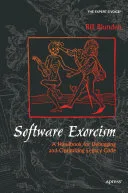
Software Exorcism
 74
74

Software Exorcism
Bill Blunden's "Software Exorcism" cuts through the usual industry platitudes with a refreshingly blunt assessment of why software development often goes sideways. The book’s strength lies in its direct confrontation of the human element, framing persistent coding problems not as isolated technical glitches but as manifestations of deeper, often unacknowledged, social and psychological forces at play within development teams. Blunden’s unflinching analysis of 'legacy code' as something akin to a haunting, infected by the past, is particularly striking. However, the book's very directness might alienate readers seeking purely technical solutions or those uncomfortable with its somewhat adversarial tone. A passage discussing the 'programmer's psyche' and its susceptibility to external pressures offers a compelling, if bleak, perspective on why certain coding 'curses' persist. Ultimately, "Software Exorcism" serves as a potent, albeit uncomfortable, diagnostic tool for the ailments plaguing the software engineering profession.
📝 Description
74
Bill Blunden's 2013 book 'Software Exorcism' examines systemic issues beyond technical debugging.
Published in 2013, 'Software Exorcism' by Bill Blunden looks at the behavioral and social aspects that cause persistent problems in software development. It suggests that many so-called 'bugs' stem from deeper organizational and psychological issues, rather than being purely technical defects. The book is for software engineers, project managers, and anyone who has struggled with difficult-to-fix legacy code and suspects the root cause is not just the code itself.
Blunden's work appeared during a time when Agile and DevOps were gaining traction, and software projects were growing more complex. Instead of focusing solely on workflow optimization, Blunden took a different approach. He examined the human factors and the hidden obstacles that impede progress, a stance that contrasted with the era's general optimism about overcoming technical challenges. The book introduces 'software exorcism' as a metaphor for the significant, often psychological, efforts needed to correct fundamentally flawed systems. It discusses concepts like 'code rot,' 'technical debt,' and the 'programmer's psyche,' proposing their interconnectedness. It also addresses how communication issues and team dynamics can translate into technical problems.
While not a traditional occult text, 'Software Exorcism' employs esoteric thinking by framing software development problems through a lens of hidden forces and psychological undercurrents. The 'ghosts in the machine' concept suggests that systemic failures are not merely logical errors but manifestations of deeper, often unconscious, patterns within individuals and organizations. This approach mirrors esoteric traditions that seek to understand and influence unseen influences, applying a similar investigative and corrective methodology to the often-opaque world of software creation and maintenance.
💡 Why Read This Book?
• You will learn to identify and address the psychological and social 'hauntings' embedded in legacy code, moving beyond superficial debugging techniques, as discussed in the chapter on the 'programmer's psyche.' • You will gain a new framework for understanding persistent software failures, recognizing them as potentially systemic issues rather than isolated errors, a concept central to the 'software exorcism' metaphor. • You will acquire practical strategies for confronting deeply ingrained, difficult-to-fix codebases by understanding the historical and organizational 'curses' they carry, as explored in the book's analysis of 'code rot.'
⭐ Reader Reviews
Honest opinions from readers who have explored this book.
❓ Frequently Asked Questions
What is the core concept of 'Software Exorcism'?
The core concept is that many persistent, difficult-to-resolve software problems are not purely technical but are influenced by social, psychological, and historical factors within development teams, akin to 'hauntings' in legacy code.
Who is Bill Blunden, the author of Software Exorcism?
Bill Blunden is an author and software engineer known for his unconventional and critical perspectives on the software development industry, as demonstrated in his 2013 book.
When was Software Exorcism first published?
Software Exorcism was first published on March 25, 2013, reflecting on the state of software engineering at that time.
What kind of 'debugging' does this book focus on?
It focuses on 'debugging' behavioral and systemic issues within the software engineering industry, rather than solely on technical code errors. It addresses the human and organizational elements.
Does the book offer technical solutions for code problems?
While it discusses code problems, its primary focus is on diagnosing the underlying social and psychological causes. Technical solutions are framed within this broader context.
What is 'legacy code' in the context of this book?
In Software Exorcism, 'legacy code' refers to older, often problematic code that carries historical baggage—technical debt, past decisions, and team dynamics—making it difficult to maintain or improve.
🔮 Key Themes & Symbolism
The Unseen Architectures
This theme explores how social dynamics and psychological states of developers act as unseen architects, shaping the very structure and behavior of software. Blunden suggests that team communication, management styles, and individual anxieties can become embedded in code, creating 'ghosts' that haunt the system long after their originators are gone. This perspective reframes bugs not as isolated incidents but as symptoms of deeper interpersonal or organizational malaise.
Legacy Code as Palimpsest
The book treats legacy code not merely as old code, but as a palimpsest—a text written over and over, with earlier layers still influencing the visible surface. This historical layering includes technical debt, abandoned features, and the residue of past development practices and decisions. Understanding this layered history is crucial for effective intervention, suggesting that true 'debugging' requires a form of archaeological or even historical analysis of the codebase.
The Programmer's Psyche
Central to the 'exorcism' is an examination of the programmer's mental and emotional state. Blunden posits that external pressures, internal frustrations, and cognitive biases can significantly impair a developer's ability to write clear, maintainable code. This section studies how stress, imposter syndrome, and organizational politics can manifest as technical deficiencies, making the programmer's internal world as critical as the external code.
Rituals of Remediation
Beyond diagnosis, the book hints at 'rituals of remediation'—methods for addressing deeply ingrained software ailments. These are not standard coding practices but more akin to psychological or organizational interventions. The concept implies that fixing severely compromised systems requires a systematic, perhaps even ritualistic, approach that confronts the 'curses' embedded within the code and its development environment.
💬 Memorable Quotes
Direct passages from the work, attributed to the author.
“The programmer's psyche is easily infected by external pressures.”
— This highlights the vulnerability of developers to stress and organizational politics, suggesting that their mental state directly impacts code quality and can lead to systemic issues.
“Legacy code is often a manifestation of past decisions, not just technical errors.”
— This interpretation emphasizes that the problems in old code stem from historical context and choices made during development, not solely from bugs in the programming itself.
“We are forced to clean up coworker's bad code.”
— This direct statement captures the frustration of dealing with poorly written code left by others, framing it as a common, albeit unwelcome, aspect of software development.
“Software problems can be like hauntings.”
— This evocative interpretation captures the essence of the 'software exorcism' metaphor, suggesting that persistent, inexplicable code issues are akin to spectral disturbances.
💡 Key Ideas
Editorial paraphrase of the work's core concepts — not direct quotes.
Behavioral problems in software engineering are common.
This paraphrased concept points to the book's core argument that human behavior and social dynamics are significant contributors to issues within the software industry.
🌙 Esoteric Significance
Tradition
While not explicitly tied to a single esoteric tradition, "Software Exorcism" draws parallels with Gnostic ideas of confronting hidden, corrupting forces and with Hermetic principles of correspondence, suggesting that the microcosm of the code reflects the macrocosm of the development environment and human psyche. It employs a form of 'practical magic' by framing technical problem-solving as a ritualistic process of banishing negative influences (bugs, bad practices) from a digital construct.
Symbolism
The central metaphor of 'exorcism' itself is symbolic, representing the ritualistic expulsion of malevolent entities (flawed code, bad practices) from a possessed space (the software system). 'Legacy code' functions as a symbol for the past's persistent influence, akin to ancestral curses or unresolved karmic debts. The 'programmer's psyche' can be seen as a symbolic representation of the human element, prone to 'infection' or 'possession' by external negative forces.
Modern Relevance
Contemporary discussions around developer burnout, the psychological impact of remote work, and the ethical considerations of complex AI systems echo Blunden's concerns. Thinkers exploring the sociology of technology and critical approaches to software development might find his work a foundational text for understanding the persistent human element in digital creation. His ideas resonate with communities focused on mindful coding and the mental well-being of engineers.
👥 Who Should Read This Book
• Developers and engineers grappling with intractable bugs in legacy systems, seeking a framework beyond standard debugging techniques. • Project managers and team leads frustrated by persistent team dysfunction that manifests as technical problems, looking for a new diagnostic lens. • Students and researchers of computer science history and the sociology of technology, interested in critical perspectives on the software industry's evolution.
📜 Historical Context
Published in 2013, Bill Blunden's "Software Exorcism" arrived at a time when the software industry was rapidly embracing Agile methodologies and DevOps, focusing on speed, efficiency, and continuous delivery. While the prevailing discourse often celebrated innovation and streamlined processes, Blunden's work took a sharp turn towards the darker, more persistent issues. He challenged the optimistic narratives by examining the psychological and social underpinnings of software failure, a perspective that stood in contrast to more technically focused analyses common at the time. In an era dominated by books on microservices or functional programming, Blunden's focus on the 'programmer's psyche' and 'code rot' offered a counterpoint. His candid, often blunt, approach eschewed the typical industry jargon, positioning the book as a critical intervention rather than a celebratory endorsement of contemporary practices. The work's reception was likely varied, appealing to those experiencing the frustrations Blunden described while perhaps being overlooked by those focused on the latest technological trends.
📔 Journal Prompts
The programmer's psyche and its infection.
Manifestations of code rot in your projects.
Identifying the 'hauntings' in legacy code.
Rituals for addressing systemic code flaws.
Social engineering within your development team.
🗂️ Glossary
Software Exorcism
A metaphor for the process of diagnosing and resolving deep-seated, persistent software problems that stem from social, psychological, or historical factors rather than purely technical code errors.
Legacy Code
Older software code that is difficult to maintain or update due to its age, complexity, lack of documentation, or the embedded influence of past development practices and decisions.
Code Rot
The perceived degradation of software quality over time, often exacerbated by neglect, changing environments, and the accumulation of technical debt, leading to increased fragility and difficulty in maintenance.
Technical Debt
The implied cost of future rework caused by choosing an easy (limited) solution now instead of using a better approach that would take longer. It accumulates like financial debt.
Programmer's Psyche
Refers to the mental, emotional, and psychological state of a software developer, which the book argues can significantly influence their work and contribute to software problems.
Social Engineering (in development)
The application of social and psychological manipulation within a development team context, leading to communication breakdowns, poor decision-making, or code quality issues.
Haunting (in software)
A metaphor for persistent, seemingly inexplicable bugs or issues in software that are difficult to trace and resolve, suggesting they are remnants of past problems or influences.





![The 70 Best Tales of Edgar Allan Poe [69 stories]](/img/thumb/the-70-best-tales-of-edgar-allan-poe-69-stories-edgar-allan-poe-523054.webp)