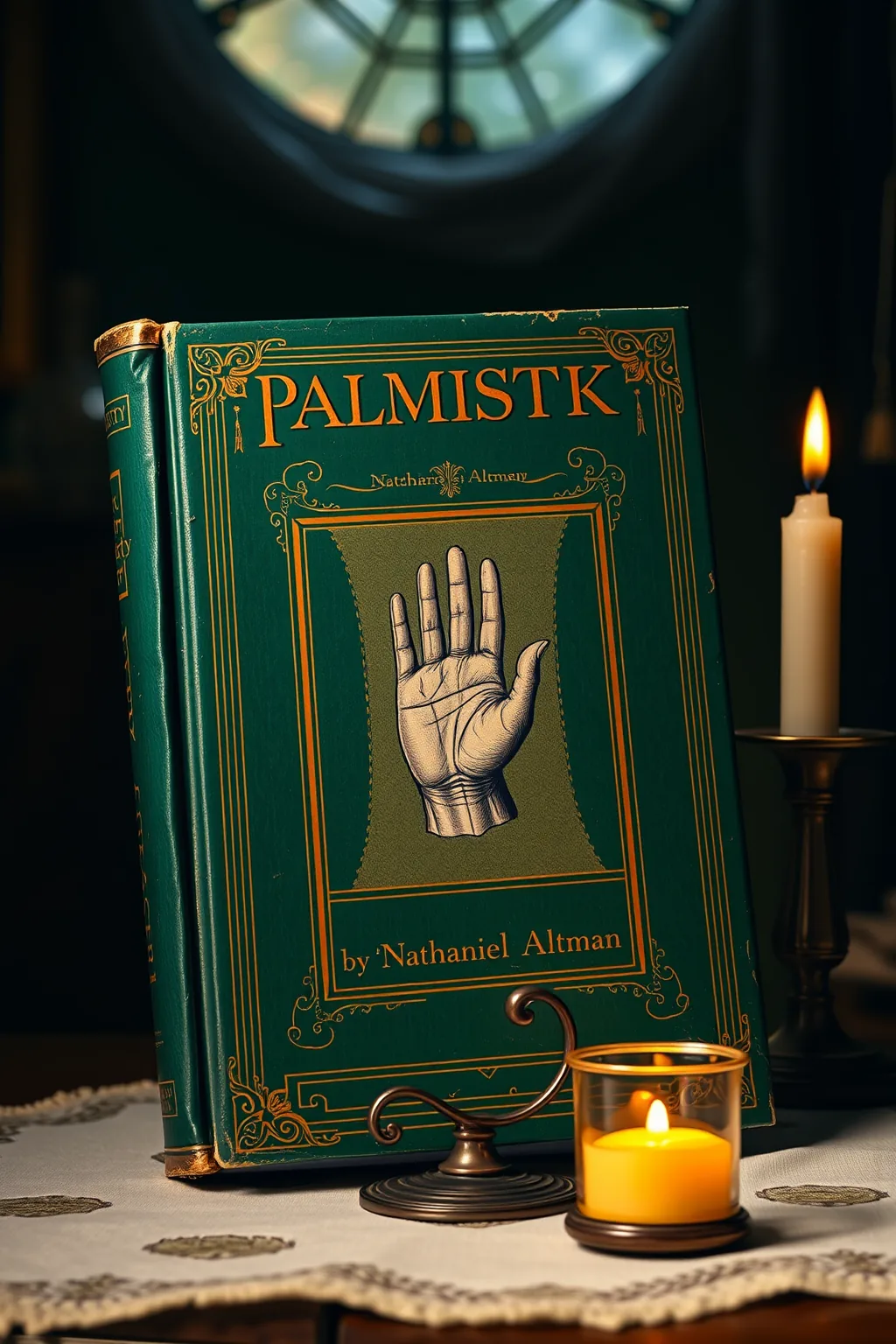
Palmistry
 79
79

Palmistry
Altman's "Palmistry" approaches its subject with a commendable academic rigor, presenting a broad overview that effectively synthesizes Western, Indian, and Chinese palmistry traditions. The inclusion of practical guidance on taking hand prints is a particular strength, moving the reader from theory to tangible application. However, the book's encyclopedic nature, while informative, occasionally feels dense, and some readers might desire more detailed case studies to illustrate the interpretive methods. The section on psychological aspects, while interesting, could benefit from further elaboration to fully connect with modern psychological frameworks. Despite these points, the work stands as a solid, well-researched introduction to the subject for serious students.
📝 Description
79
Nathaniel Altman's 2007 book, "Palmistry," analyzes the hand as a map of personality.
Published in 2007, Nathaniel Altman's "Palmistry" offers a thorough look at chiromancy, moving past simple fortune-telling. The book treats the hand as a detailed chart of an individual's character and potential. It examines both the philosophical roots and the practical methods for interpreting the lines, mounds, and overall shape of the human hand. This volume is suitable for those interested in self-understanding through less common means, students of different divination methods, and practitioners who want a solid reference text. It appeals to readers who prefer a structured approach to subjects often seen as mysterious, giving them instruments for personal examination and insight.
Altman places palmistry within a wide historical view, noting its presence in Western thought from ancient times. The book covers its spread through different cultures, including significant developments in Indian and Chinese traditions. This highlights a practice that has existed for thousands of years across various philosophical systems. The core of the work breaks down the hand's specific features. This includes analyzing the main and secondary lines, the fleshy areas at the base of the fingers, and general hand shape categories. The text also suggests using hand printing for close study and monitoring developments.
Palmistry, or chiromancy, is an ancient divinatory art that seeks to understand human character and future by examining the hand's physical features. Its roots stretch back to antiquity, with evidence of its practice found in Vedic India, China, and classical Greece. Philosophers like Aristotle commented on it, and it has been a consistent thread in Western esoteric traditions throughout the centuries. This book situates palmistry not merely as a method of fortune-telling, but as a system of psychological and physiognomic interpretation, aligning with broader esoteric interests in symbolic languages and the correlation between physical form and inner life.
💡 Why Read This Book?
• Learn to interpret the major and minor lines of the hand, understanding concepts like the Head Line's length and the Heart Line's branching, as detailed in the book's practical guidance sections. • Explore the distinct methodologies of Western, Indian (Vedic), and Chinese hand reading traditions, appreciating their unique historical development and interpretive nuances. • Gain practical skills in hand printing and data organization for self-analysis, as presented in the 'Practical Guidance' chapter, enabling a more systematic approach to reading one's own palm.
⭐ Reader Reviews
Honest opinions from readers who have explored this book.
❓ Frequently Asked Questions
Can palmistry actually predict the future?
Altman's "Palmistry" frames the practice less as fortune-telling and more as a tool for understanding personality, potential, and life patterns. It explores how lines might reflect psychological states or life experiences rather than fixed destinies.
What is the significance of hand shape in palmistry?
Different hand shapes (e.g., square, spatulate, conic) are discussed in relation to corresponding elemental types (Earth, Air, Fire, Water) and associated personality traits, offering a foundational layer of interpretation.
How does Indian palmistry differ from Western palmistry?
The book notes that Indian palmistry, or Hasta Samudrika Shastra, often incorporates astrological elements and has a more codified system of interpretation compared to some Western traditions, which may focus more on psychological mapping.
Is it possible to change the lines on my hands through reading?
Altman discusses the idea that conscious awareness and life choices can influence the development of hand lines over time. The book suggests that understanding one's palm can empower personal growth and potentially alter future patterns.
What are the main lines analyzed in palmistry?
The primary lines examined are typically the Life Line, Head Line, Heart Line, and Fate Line (or Saturn Line), each offering insights into health, intellect, emotions, and life direction, respectively.
When was Nathaniel Altman's "Palmistry" first published?
Nathaniel Altman's "Palmistry" was first published in June 2007, offering a modern, encyclopedic introduction to the subject.
🔮 Key Themes & Symbolism
The Hand as a Microcosm
Altman posits the hand as a detailed map of the individual's being, reflecting not just potential destinies but also psychological makeup and life experiences. This perspective elevates palmistry beyond simple prognostication, framing it as a tool for deep self-understanding. The book meticulously dissects the various components—lines, mounts, finger lengths, and overall shape—each contributing a layer to the holistic interpretation of the individual. The work explores how these physical markers correlate with inner states and life trajectories.
Comparative Divination Systems
A significant aspect of "Palmistry" is its comparative approach, examining the practice across different cultural and historical contexts. It contrasts the Western tradition with the sophisticated systems found in Indian (Vedic) palmistry and Chinese hand reading. This exploration highlights how diverse cultures have independently developed intricate methods for interpreting the hand, revealing universal human interests in self-knowledge and fate, while also showcasing unique philosophical underpinnings.
Psychological Correlation
Moving beyond purely predictive models, Altman integrates psychological interpretations of hand features. The book suggests that the lines and formations on the hand can mirror an individual's mental and emotional landscape, their strengths, weaknesses, and patterns of behavior. This approach aligns palmistry with modern interests in self-awareness and personal development, viewing the hand as a dynamic reflection of the psyche rather than a static blueprint.
Practical Application and Self-Analysis
The work emphasizes the practical utility of palmistry for personal insight. It provides guidance on how to take accurate hand prints and organize data, facilitating systematic analysis. This focus on methodology empowers readers to engage in their own readings, encouraging a hands-on approach to exploring the insights offered by their own hands and fostering a deeper connection with their personal life journey.
💬 Memorable Quotes
Direct passages from the work, attributed to the author.
“The hand is a living document, constantly being written upon by our experiences and choices.”
— This interpretation highlights the dynamic nature of palmistry as presented by Altman, suggesting that the lines on the hand are not fixed but evolve with an individual's life, reflecting ongoing personal development and agency.
“Western palmistry often seeks to map the psyche, while Indian traditions may integrate astrological correspondences.”
— This statement underscores the comparative aspect of Altman's work, differentiating key approaches to palmistry and indicating the diverse methodologies and philosophical frameworks employed across different cultures.
“Hand prints offer a stable reference point for detailed analysis, allowing for comparison over time.”
— This emphasizes the practical, methodical aspect of Altman's teaching, positioning hand printing as a crucial tool for serious students to conduct thorough and consistent readings, moving beyond casual observation.
“The shape of the hand and fingers can provide foundational insights into temperament.”
— This captures the idea that the physical structure of the hand itself, independent of the lines, offers significant clues to a person's inherent character and disposition, forming a base layer of interpretation.
“Understanding the mounts reveals energies and potentials associated with planetary influences.”
— This points to the symbolic language of palmistry, where the fleshy pads on the hand (mounts) are linked to specific celestial bodies and their associated qualities, offering a richer layer of interpretation.
🌙 Esoteric Significance
Tradition
Altman's "Palmistry" engages with the Hermetic tradition through its exploration of correspondence between the microcosm (the hand) and the macrocosm (the universe/psyche). It aligns with Neoplatonic ideas of the soul's journey and the body as a vessel of divine or cosmic influence. While not strictly Kabbalistic or Gnostic, it shares with these traditions an interest in symbolic language and the mapping of hidden realities through tangible forms, viewing the hand as a text to be deciphered.
Symbolism
Key symbols include the major lines (Life, Head, Heart) representing fundamental aspects of existence: vitality, intellect, and emotion. The mounts (e.g., Venus, Jupiter, Mars) are symbolic of planetary influences and inherent potentials—love, ambition, courage. Hand shapes themselves, often correlated with classical elements (Earth, Air, Fire, Water), symbolize fundamental personality archetypes and modes of interaction with the world.
Modern Relevance
This work speaks to contemporary self-help movements and modern esoteric psychology. Thinkers and practitioners interested in embodied cognition, symbolic interpretation, and holistic approaches to well-being find value in Altman's systematic analysis. It informs modern chiromancers and those exploring psychological archetypes through symbolic systems, bridging ancient practices with current quests for self-knowledge and personal empowerment.
👥 Who Should Read This Book
['• Students of comparative divination systems seeking to understand the nuances between Western, Indian, and Chinese palmistry methodologies.', '• Individuals interested in psychological self-analysis who want to explore esoteric frameworks for understanding personality and life patterns.', '• Practitioners of esoteric arts looking for a comprehensive, foundational text that covers both theoretical concepts and practical techniques like hand printing.']
📜 Historical Context
Nathaniel Altman's "Palmistry," published in 2007, emerged during a period of renewed interest in esoteric studies and self-help methodologies. While palmistry itself has ancient roots, dating back to India and Greece, Altman's work situates itself within contemporary scholarship that seeks to integrate traditional practices with modern psychological understanding. The early 2000s saw a proliferation of books aiming to explain occult arts, often drawing from diverse traditions. Unlike earlier, more narrowly focused texts, Altman's volume aimed for an encyclopedic scope, incorporating Western, Indian, and Chinese traditions. This broad approach contrasts with the more specialized focus of earlier figures like William Gurney Benham, whose influential "The Book of Fate" (1912) predominantly explored Western chiromancy. Altman's work contributed to a broader intellectual current that viewed esoteric practices not just as divination tools but as systems for psychological insight and personal growth.
📔 Journal Prompts
Reflect on the characteristics associated with your dominant hand's primary lines, such as the Head Line's length and slope.
Compare the descriptions of the Mount of Jupiter in the book with your perceived levels of ambition and leadership.
Consider how the Indian palmistry perspective on a specific line might differ from its Western interpretation.
Analyze the potential psychological correlations suggested for the shape of your fingers and hand.
Document your own hand print and note any features that align with the concepts of the Fate Line.
🗂️ Glossary
Chiromancy
The practice of divination and character analysis through the study of the hand, particularly the lines, mounts, and shape of the palm and fingers. It is an older term for palmistry.
Lines (Major)
The primary creases on the palm, typically including the Life Line (vitality, physical health), Head Line (intellect, mental faculties), and Heart Line (emotions, relationships).
Lines (Minor)
Secondary creases on the palm, such as the Fate Line (career, life path), Sun Line (success, happiness), and Mercury Line (communication, business), which offer more specific insights.
Mounts
The fleshy, raised pads at the base of the fingers and palm, named after classical planets (e.g., Mount of Venus, Mount of Jupiter), believed to indicate specific character traits and potentials.
Hand Shape
The overall form of the palm and fingers, often classified into elemental types (Earth, Air, Fire, Water) or specific shapes (e.g., Square, Spatulate), providing a foundational understanding of temperament.
Hand Print Analysis
A systematic method of studying the palm by taking impressions (prints) of the hand, allowing for detailed examination and comparison of lines, mounts, and patterns over time.
Hasta Samudrika Shastra
The traditional Indian system of palmistry, which often incorporates astrological principles and possesses a rich, codified interpretive framework.