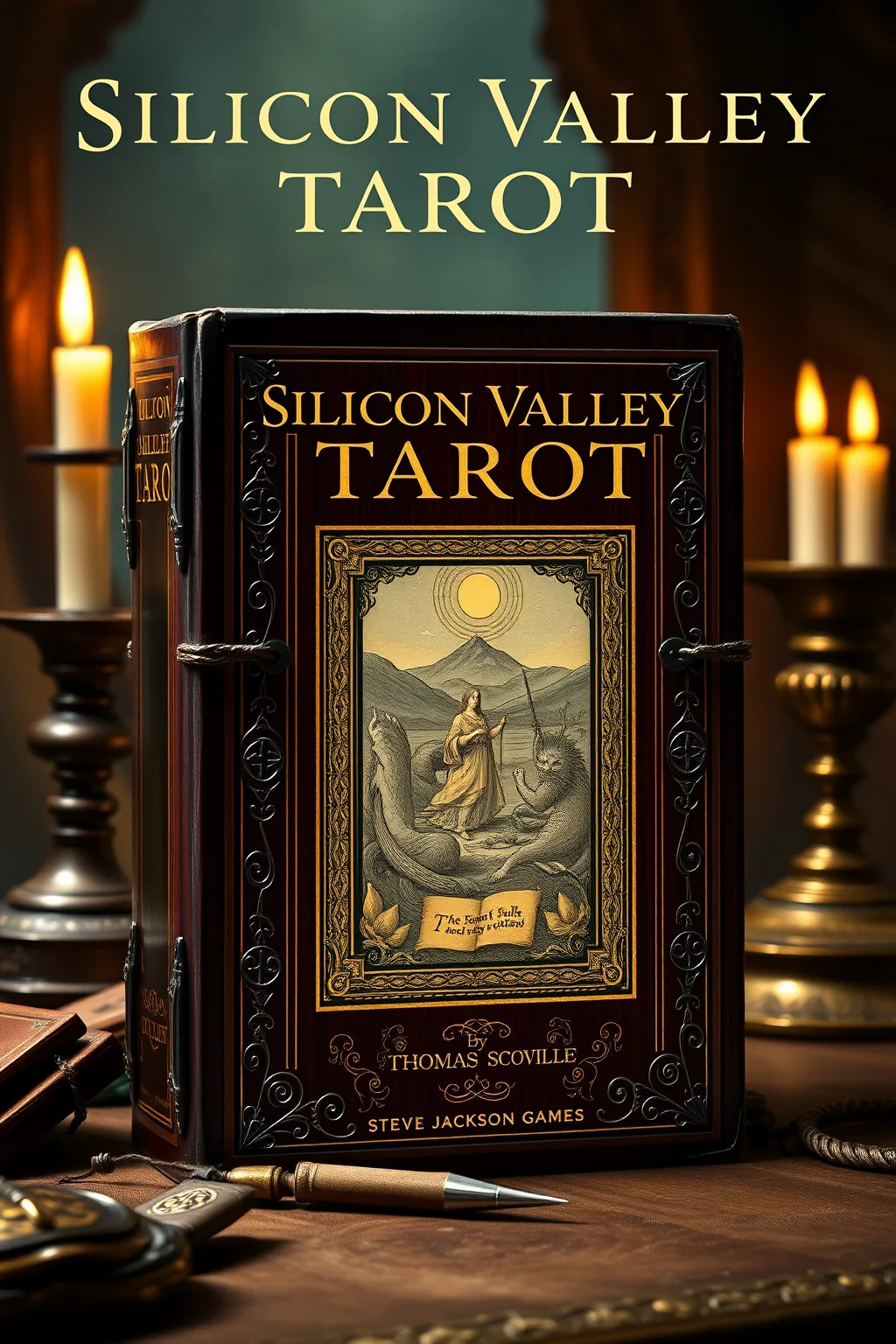
Silicon Valley Tarot (Steve Jackson Games)
 83
83

Silicon Valley Tarot (Steve Jackson Games)
Thomas Scoville's Silicon Valley Tarot, released by Steve Jackson Games in 1998, offers a refreshingly specific and often witty reinterpretation of the tarot structure. Rather than generic archetypes, it grounds the cards in the concrete realities of tech culture, from the relentless drive of 'The Hustler' (likely The Magician) to the often-opaque machinations of 'The Algorithm' (The Chariot). This specificity is its greatest strength, providing a unique lens for understanding modern ambition and its pitfalls. However, the deck occasionally leans so heavily into its specific milieu that it risks becoming dated, or perhaps too niche for broader esoteric study without significant translation. The concept of 'The Server Farm' as a representation of the unconscious, for instance, is a striking image but demands considerable mental gymnastics to connect with traditional interpretations. It's a clever exercise in applied symbolism, though its ultimate utility depends heavily on the reader's familiarity with and interest in the Silicon Valley ethos.
📝 Description
83
Thomas Scoville's Silicon Valley Tarot, published in 1998, maps tarot archetypes onto tech culture.
This 1998 deck from Steve Jackson Games is not a typical tarot set; it functions as a conceptual framework. Author Thomas Scoville applied traditional tarot imagery to the specific environment of Silicon Valley. The deck reimagines the Fool's Journey within the context of startup culture, innovation, and the digital era, providing a distinct viewpoint on contemporary esotericism.
It is designed for individuals interested in the overlap between esoteric symbolism and modern culture. Tarot enthusiasts seeking unconventional uses, students of Jungian archetypes curious about their modern forms, and those fascinated by Silicon Valley's mythology will find it of interest. Game designers and artists looking for inspiration from unusual symbolic systems may also appreciate it.
The deck translates the Major Arcana into symbols pertinent to the technology industry. It recontextualizes ancient archetypes through figures like 'The Innovator' (The Fool), 'The Venture Capitalist' (The Emperor), and 'The Algorithm' (The Chariot). The work considers the recurring patterns of technological booms and downturns, the drive for disruptive concepts, and the human aspect within a mechanized, data-focused world. It examines the 'startup mythos' as a contemporary spiritual pursuit.
Emerging in 1998, Silicon Valley Tarot appeared during a time of significant internet expansion and the dot-com boom. Esoteric thought was starting to manifest in new ways beyond established systems, influenced by figures like Carl Jung and the growing New Age movement. The work's focus on a specific, modern, corporate environment was a departure from more historical or nature-based tarot decks, indicating a rising interest in secularized or culturally specific occult applications.
💡 Why Read This Book?
• Gain a novel perspective on tarot archetypes by examining how concepts like 'The Algorithm' manifest in the context of 1998's burgeoning tech industry, offering insights into modern symbolic language. • Explore the 'startup mythos' as a contemporary spiritual narrative, understanding how the pursuit of innovation mirrors older quests for enlightenment or power. • Appreciate the recontextualization of traditional figures, such as 'The Venture Capitalist' representing The Emperor, providing concrete examples of how esoteric structures can be adapted to specific cultural environments.
⭐ Reader Reviews
Honest opinions from readers who have explored this book.
❓ Frequently Asked Questions
What is the primary esoteric tradition influencing the Silicon Valley Tarot?
While not strictly adhering to one tradition, the Silicon Valley Tarot draws heavily on Jungian psychology and its exploration of archetypes, applying them to a modern, secular context. It also engages with general Hermetic principles of correspondence and symbolic representation.
When was the Silicon Valley Tarot first published and by whom?
The Silicon Valley Tarot was first published in 1998 by Steve Jackson Games, a company known for its innovative and often esoteric game designs.
Does the deck use standard tarot card names or new ones?
The deck reinterprets standard tarot card names and concepts, applying them to Silicon Valley phenomena. For example, 'The Emperor' might be represented by 'The Venture Capitalist,' and 'The Fool' by 'The Innovator'.
Is this a playable card game or a symbolic deck for divination?
It is primarily designed as a symbolic deck for divination and reflection, though its origins with Steve Jackson Games suggest a potential for game-like applications or conceptual frameworks for narrative.
What makes this deck different from traditional tarot decks?
Its uniqueness lies in its specific focus on the culture, language, and archetypes of Silicon Valley, particularly as it existed around the late 1990s dot-com boom, offering a modern, secularized interpretation.
Who is the author of the Silicon Valley Tarot?
The author of the Silicon Valley Tarot is Thomas Scoville, who first published the work in 1998.
🔮 Key Themes & Symbolism
The Startup Mythos
This theme explores the narrative arc of Silicon Valley's entrepreneurial culture as a modern spiritual quest. It examines how the pursuit of disruptive innovation, venture capital funding, and market dominance mirrors ancient quests for enlightenment, power, or the philosopher's stone. Concepts like 'The Innovator' and 'The Venture Capitalist' are analyzed not just as business roles but as archetypal figures engaged in a contemporary 'Great Work'.
Algorithmic Archetypes
Here, the focus shifts to the symbolic representation of technology itself within the tarot framework. The 'Algorithm' is presented as a potent, often inscrutable force, akin to fate or divine will, shaping events and destinies. This theme investigates how the logic and structure of code, data, and networked systems can be understood through esoteric lenses, treating them as new forms of divine or natural law.
Digital Alchemy
This theme treats the creation of software, platforms, and digital economies as a form of modern alchemy. The transformation of raw ideas and code into valuable products and services is examined through the lens of transmutation and the creation of the 'gold' (profit, influence, or societal change). It considers the 'Server Farm' as a symbolic space, perhaps representing the collective unconscious or a new kind of elemental plane.
The Fool's Journey in Tech
This theme reinterprets the classic Fool's Journey of the tarot through the specific challenges and opportunities of the tech world. The initial leap of faith required for a startup, the trials faced in development, the potential for spectacular success or failure, and the eventual wisdom gained (or lost) are mapped onto the archetypal stages of growth and transformation.
💬 Memorable Quotes
Direct passages from the work, attributed to the author.
“The Innovator takes the first leap, often with no clear path forward.”
— This highlights the archetype of The Fool as a symbol of pure potential and the courage required to begin any transformative process, especially within the high-risk environment of technological innovation.
“Funding is the Philosopher's Stone of the digital age.”
— This metaphor equates the acquisition of venture capital with the alchemical pursuit of turning base metals into gold, suggesting that capital is the crucial element for transforming raw ideas into valuable digital realities.
“The Algorithm dictates the flow, unseen but ever-present.”
— This interpretation positions the concept of an algorithm as a modern manifestation of fate or an inscrutable cosmic force, influencing outcomes and shaping destinies within the technological landscape.
“Success is measured in user acquisition and market disruption.”
— This reflects the specific metrics and goals prevalent in the Silicon Valley culture of the late 1990s, reframing traditional notions of achievement through a business and technological lens.
“The Server Farm hums with the collective unconscious.”
— This intriguing concept suggests that vast data centers, housing the digital world's information, can be viewed as a physical manifestation or analogue of the shared, deep psychological structures described by Jung.
🌙 Esoteric Significance
Tradition
While not explicitly aligned with a single esoteric lineage, the Silicon Valley Tarot is deeply influenced by Jungian psychology, particularly Carl Jung's theories on archetypes and the collective unconscious. It also engages with general Hermetic principles of correspondence, viewing the macrocosm of the digital world as reflected in the microcosm of its symbolic representation. The work applies these concepts outside of traditional religious or mystical frameworks, secularizing archetypal exploration within a specific cultural context.
Symbolism
Key symbols include 'The Innovator' (representing The Fool's leap into the unknown), 'The Venture Capitalist' (embodying The Emperor's authority and structure, but with a focus on funding innovation), and 'The Algorithm' (functioning like a modern Fate or a complex Chariot, directing outcomes). The 'Server Farm' is also a potent motif, symbolizing vast repositories of information or perhaps a new manifestation of the collective unconscious.
Modern Relevance
Contemporary thinkers in fields like digital sociology, critical theory of technology, and even speculative design might find resonance with this work. Its approach to mapping archetypes onto technological phenomena anticipates later discussions on the 'mythology' of tech companies and the psychological impact of digital environments. It serves as an early example of how esoteric frameworks can be adapted to analyze and interpret rapidly evolving secular cultures.
👥 Who Should Read This Book
• Students of Jungian psychology interested in modern manifestations of archetypes, particularly within technological and corporate environments. • Tarot enthusiasts seeking unconventional applications and deconstructions of the traditional deck, especially those intrigued by cultural commentary. • Individuals fascinated by the mythology and cultural history of Silicon Valley, looking for symbolic interpretations of its rise and ethos.
📜 Historical Context
The Silicon Valley Tarot emerged in 1998, a period marked by the explosive growth of the internet and the dot-com bubble. Technologically, this was the era of Netscape Navigator, the rise of search engines, and the widespread adoption of personal computers. Intellectually, the work sits at the confluence of late 20th-century esotericism, which saw a revival of interest in Jungian psychology and archetypal symbolism, and the burgeoning cultural mythology surrounding Silicon Valley as a new frontier. While traditional tarot decks often drew from Hermetic, Kabbalistic, or pagan sources, Thomas Scoville’s deck deliberately grounded its symbolism in a specific, contemporary, and secularized domain. Its reception was likely niche, appealing to fans of Steve Jackson Games' often quirky and unconventional products, and perhaps to those seeking to reconcile spiritual or psychological frameworks with the rapidly changing technological landscape. It predated the widespread public discourse on the ethical implications of AI or social media algorithms, focusing instead on the foundational mythos of technological creation.
📔 Journal Prompts
The Innovator's first step: What untested idea are you currently pursuing?
Reflect on 'The Algorithm' as a guiding principle in your life. What are its inputs and expected outputs?
How does the 'Startup Mythos' compare to older narratives of creation or transformation?
Consider the 'Venture Capitalist' archetype: what is the value you are seeking to transform or create?
Analyze the 'Server Farm' concept: where does your personal 'data' reside, and how is it processed?
🗂️ Glossary
The Innovator
Represents The Fool archetype, symbolizing the courage to start new ventures, embrace the unknown, and initiate transformative processes within the tech landscape.
The Venture Capitalist
Corresponds to The Emperor, embodying authority, structure, and resources, specifically focusing on funding and directing innovative projects within the Silicon Valley ecosystem.
The Algorithm
A key concept, akin to fate or a complex directive force, representing the logic and systems that govern operations, data flow, and outcomes in the digital world.
Startup Mythos
The overarching narrative and cultural belief system surrounding the creation and growth of technology startups, often framed as a modern heroic journey or quest.
Server Farm
A symbolic space representing the infrastructure that houses vast amounts of digital information, potentially interpreted as a modern collective unconscious or a new elemental plane.
Digital Alchemy
The process of transforming raw ideas, code, and data into valuable digital products, services, or market influence, analogous to the alchemical transmutation of base metals into gold.
Market Disruption
A core goal in the tech industry, representing the act of fundamentally altering existing markets or industries through innovative products or business models.
🔮 Readers Also Liked
Browse all →









More by Thomas Scoville
All books →
More Free Occult Philosophy Books
View all →