Thomas Scoville
The biblical account of Thomas's doubt and subsequent belief in the resurrected Jesus has been a significant subject in art and theology.
The biblical figure of Thomas, often called "doubting Thomas," is known for his skepticism, refusing to believe in the resurrected Jesus until he could physically examine the crucifixion wounds. This account, found in the Gospel of John, has been a recurring theme in Christian art and theological interpretation since at least the 6th century.
Interpretations vary, with Catholic tradition often emphasizing Jesus's willingness to provide physical evidence to bolster faith, encouraging practices like pilgrimages and relic veneration. Protestant interpretations, conversely, often highlight Jesus's assertion of the superiority of faith without physical proof. The episode has also been viewed through a eucharistic lens, symbolizing the sacrament of the Eucharist.
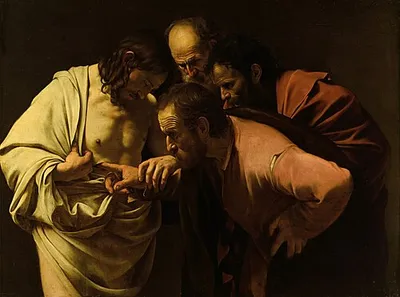
Beyond theological discourse, the "Incredulity of Saint Thomas" has been a popular subject in visual arts, from early mosaics to Renaissance sculptures and Baroque paintings. The narrative has also been adapted into medieval dramas and inspired related legends, such as the "Girdle of Thomas" and the "Incredulity of Jerome," which further explore themes of faith, doubt, and physical evidence.
Theological Interpretations of Thomas's Doubt
The biblical narrative of Thomas's doubt, as recounted in the Gospel of John, has spurred diverse theological interpretations. While the text itself does not definitively state whether Thomas actually touched Jesus's wounds, this ambiguity has fueled centuries of discussion. Catholic tradition, particularly before the Reformation, generally held that Thomas did indeed examine the wounds, seeing it as an affirmation of the Resurrection and a model for using physical experiences—like pilgrimages and relics—to reinforce Christian belief. Jesus's allowance of this physical verification, despite noting the blessing of faith without such evidence, was seen as an encouragement for tangible aids to faith. Protestant interpretations, however, often emphasized Jesus's statement regarding the blessedness of those who believe without seeing, focusing on the concept of "faith alone" (sola fide). Some commentators also viewed Thomas's initial skepticism, and that of the other apostles, as evidence of the Gospels' veracity, arguing that a fabricator would not invent such doubts. Furthermore, the episode has been interpreted allegorically in relation to the Eucharist, with early Church Fathers like John Chrysostom and Cyril of Alexandria seeing it as a symbol of the sacrament.
Artistic Depictions and Symbolism
The "Incredulity of Saint Thomas" has been a prominent subject in Christian art since at least the 6th century, appearing in mosaics, illuminated manuscripts, and paintings. Early depictions, such as those in Ravenna, often show Thomas in the act of probing Jesus's side, emphasizing the importance of physical evidence for believers. The iconography evolved to include Jesus revealing his wounds, sometimes including those on his hands and feet, and occasionally showing Thomas kneeling in acceptance. In the later Middle Ages, the pose of Jesus displaying his wounds, known as the "ostentatio vulnerum," was adopted as a standalone motif, highlighting Christ's suffering and the reality of his Resurrection, appearing in works depicting the Last Judgment and Christ in Majesty. The Renaissance saw notable sculptural interpretations, like Verrocchio's work in Florence, where the theme's connection to justice and courts, due to its placement in a guild church with judicial functions, added another layer of meaning. The Counter-Reformation saw a resurgence of the subject as a defense of Catholic doctrines against Protestant challenges, with artists like Caravaggio producing iconic versions.
Related Legends and Medieval Adaptations
The biblical story of Thomas's doubt also inspired later legends and found expression in medieval drama. One notable legend, the "Girdle of Thomas," recounts how the Virgin Mary, upon her Assumption, dropped her girdle to Thomas as physical proof of her ascension, especially since he had missed the event. This relic, the "Sacra Cintola," became venerated in Prato Cathedral, and the legend influenced Florentine art, particularly depictions of the pregnant Virgin Mary. Another related narrative is the "Incredulity of Jerome," which describes a soldier named Jerome who doubted the stigmata of Saint Francis of Assisi and examined his wounds. This episode is thought to be depicted in Giotto's frescoes. The dramatic nature of the "Incredulity of Thomas" also made it a frequent subject in medieval mystery plays, such as those in the York and Chester cycles, and in Cornish ordinalias, demonstrating the story's enduring appeal across different artistic and performative traditions.
Key Ideas
- Theological interpretation of faith versus physical evidence
- Symbolism of the resurrected Christ's wounds
- Artistic representation of doubt and belief
- Legends associated with the Apostle Thomas
Books by Thomas Scoville
2 free public domain books · Read online or download