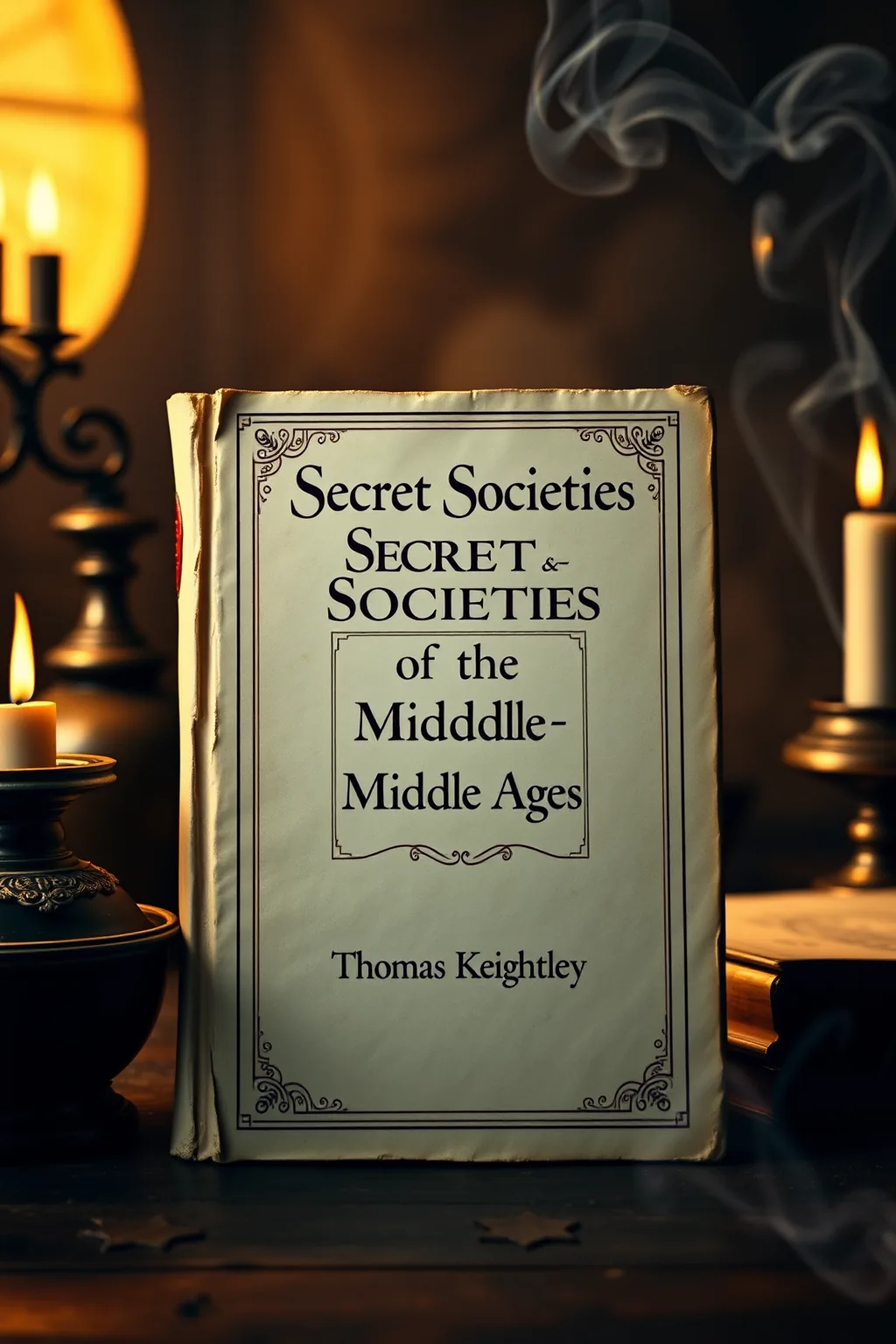
Secret Societies of the Middle Ages
 71
71

Secret Societies of the Middle Ages
Keightley’s "Secret Societies of the Middle Ages" meticulously reconstructs the historical landscape of clandestine organizations, moving beyond sensationalism to offer a grounded analysis. The author’s strength lies in his systematic approach, connecting the formation of these groups to broader socio-economic and intellectual currents of the medieval era. A particularly compelling section details the evolution of guilds, demonstrating how their internal structures and initiation rites mirrored those of more overtly secretive bodies. However, the work occasionally suffers from a dry, academic tone that may deter readers seeking a more narrative-driven account. The limitation lies in its dense presentation of historical fact, which, while accurate, can sometimes obscure the more intriguing aspects of the subject matter. Despite this, the book provides an invaluable baseline for understanding the practical and ideological underpinnings of medieval secret societies, offering a sober counterpoint to more fanciful interpretations.
📝 Description
71
Thomas Keightley's 2014 work examines clandestine organizations flourishing in the Middle Ages.
Thomas Keightley's "Secret Societies of the Middle Ages," first published in its current form in 2014, examines clandestine organizations that were active during the medieval period. Keightley suggests that secret societies often arise when specialized knowledge exceeds general understanding, prompting those who hold this knowledge to protect it within select groups. This viewpoint positions the origin of such societies not as simple conspiracy, but as a natural outcome of intellectual and social division. The book appeals to historians, sociologists, and those interested in esoteric traditions. Readers curious about the historical origins of Freemasonry, the Knights Templar, or other medieval fraternities will find Keightley's careful research useful. It is suited for those who approach the subject from an academic or historically informed standpoint, seeking evidence-based analysis over speculative narratives. The text requires close attention, rewarding readers who value detailed historical examination.
This book is situated within the 19th-century tradition of studying hidden histories and secret orders, a period marked by fascination with such subjects. Keightley's work, though published in the 21st century, connects to this scholarly lineage, seeking to understand the historical impact of clandestine groups. It engages with the historical context of medieval guilds, religious orders, and chivalric brotherhoods, many of which exhibited characteristics of secrecy and shared ritual, forming a backdrop for the analysis of more formally recognized secret societies.
💡 Why Read This Book?
• Understand the historical impetus for knowledge preservation in medieval groups, as detailed in Keightley's examination of guilds and monastic orders, offering a practical perspective on how information was controlled. • Gain insight into the early structures and rituals that influenced later esoteric traditions, specifically referencing the parallels drawn between medieval fraternities and nascent secret societies. • Appreciate the academic rigor applied to the subject of medieval clandestine organizations, providing a factual foundation for further study beyond the 2014 publication date.
⭐ Reader Reviews
Honest opinions from readers who have explored this book.
❓ Frequently Asked Questions
What is the primary argument of Thomas Keightley's "Secret Societies of the Middle Ages"?
Keightley argues that secret societies historically arose from the natural human tendency to hoard knowledge that surpasses common understanding, essentially treating specialized information as a form of exclusive property.
Which historical groups does Keightley examine as potential precursors to modern secret societies?
The work explores medieval guilds, monastic orders, and chivalric brotherhoods, analyzing their internal structures and practices for elements that resemble those of more overtly secret organizations.
When was "Secret Societies of the Middle Ages" originally published?
While this specific edition was published on July 8, 2014, the foundational research and concepts likely stem from earlier scholarship by Thomas Keightley.
Does the book focus on conspiracy theories?
No, Keightley's approach is historical and sociological, aiming to understand the origins and functions of these groups within their medieval context, rather than promoting conspiracy theories.
What kind of reader would benefit most from this book?
Historians, scholars of esoteric traditions, and readers interested in the social history of medieval Europe who seek an evidence-based examination of clandestine groups would find this book beneficial.
What distinguishes Keightley's perspective on secret societies?
Keightley distinguishes himself by framing the emergence of secret societies as a logical outcome of knowledge accumulation and the desire to control its dissemination, rather than solely as instruments of political intrigue.
🔮 Key Themes & Symbolism
Knowledge as Property
The central thesis posits that accumulated knowledge, exceeding the common stock, becomes a valuable commodity. Individuals or groups possessing this specialized knowledge naturally seek to keep it exclusive, leading to the formation of secret societies. This concept is explored through examples of how guilds protected trade secrets and monastic orders preserved theological doctrines, demonstrating a historical pattern of information enclosure predating formal clandestine organizations.
Medieval Fraternal Structures
Keightley examines various medieval organizations, including guilds, religious orders, and chivalric fraternities, as foundations for secret societies. The book analyzes their hierarchical structures, initiation rites, and internal codes of conduct. It highlights how these established forms of communal organization provided blueprints for groups seeking to operate outside mainstream societal oversight, safeguarding their unique practices and beliefs from external scrutiny.
The Evolution of Secrecy
This theme traces the development of secrecy from pragmatic needs, such as protecting trade skills or religious practices, to more elaborate systems designed for esoteric transmission. The work differentiates between societies formed for mutual aid and those dedicated to preserving and propagating specific doctrines or mystical traditions, showing a spectrum of secrecy driven by varying motivations and societal pressures during the Middle Ages.
Social Stratification and Knowledge
The book connects the rise of secret societies to broader patterns of social and intellectual stratification in the medieval period. As certain groups gained access to specialized knowledge—whether in crafts, theology, or philosophy—they created mechanisms to maintain their advantageous position. This theme underscores how secret societies often served to reinforce existing social hierarchies or create new ones based on access to privileged information.
💬 Memorable Quotes
Direct passages from the work, attributed to the author.
“The same thing has happened to knowledge that has happened to all other human possessions,—its actual holders have striven to keep it to themselves.”
— This statement expresses Keightley's core argument: the drive for exclusivity is a fundamental aspect of human behavior, particularly evident when knowledge confers significant advantage or power.
“Secret Societies... began to be formed almost as soon as any knowledge had been accumulated by particular individuals beyond what constituted the common stock.”
— This suggests that the historical impulse toward forming hidden groups is directly proportional to the accumulation of specialized knowledge beyond general societal comprehension.
“If we had the means of investigating historically the origin of Secret Societies, we should probably find that...”
— This framing highlights the author's empirical approach, acknowledging the challenges of historical reconstruction while asserting a probable, evidence-based origin for these organizations.
“The possessor of the advantage does not seem to have the same reason for communicating it as for keeping it.”
— This reinforces the economic analogy of knowledge, suggesting that the benefits of sharing specialized information are often outweighed by the advantages of retaining it exclusively.
“It is true that in this case...”
— This phrase indicates a qualification or nuance to the preceding statement, suggesting that while the general principle holds, specific historical contexts might present exceptions or complexities.
🌙 Esoteric Significance
Tradition
While not explicitly aligned with a single esoteric tradition like Hermeticism or Kabbalah, Keightley's work provides foundational historical context for understanding the origins of Western esoteric practices. It speaks to traditions that emphasize lineage, guarded knowledge, and ritualized transmission of wisdom, common across various occult paths that trace their roots to medieval or ancient antecedents.
Symbolism
The book touches upon the symbolic language inherent in medieval guilds and fraternities, which often employed allegorical figures and coded gestures to signify rank, knowledge, and mutual obligation. While specific symbols are not the primary focus, the underlying principle of using shared, often veiled, imagery to foster group identity and convey complex ideas is explored as a key element of these early organizations.
Modern Relevance
Contemporary scholars and practitioners of Western esotericism, particularly those interested in the historical development of Freemasonry, Rosicrucianism, and other fraternal orders, draw upon Keightley's research. His work helps contextualize the historical emergence of practices and organizational structures that continue to inform modern esoteric groups, providing a basis for understanding their evolution.
👥 Who Should Read This Book
• Historians of medieval Europe seeking to understand the social and intellectual underpinnings of non-mainstream organizations. • Students of comparative religion and sociology interested in the origins and functions of group secrecy and knowledge control. • Enthusiasts of esoteric history looking for a factually grounded examination of the precursors to modern secret societies, moving beyond speculative accounts.
📜 Historical Context
Thomas Keightley's work emerges from the 19th-century intellectual milieu, a period characterized by intense interest in historical origins, folklore, and esoteric traditions. Scholars like Émile Littré and later figures in occultism were simultaneously exploring ancient mysteries and the societal impact of hidden knowledge. The study of medieval guilds, which possessed intricate rituals and hierarchies, provided a fertile ground for hypothesizing about the precursors to organizations like Freemasonry. Keightley's research fits within this trend of seeking empirical roots for contemporary secret societies, situating them within the practical and social realities of the Middle Ages rather than purely mythological frameworks. While the book itself was re-published in 2014, its scholarly foundation addresses the historical reception and academic discourse surrounding secret societies throughout the 19th and 20th centuries.
📔 Journal Prompts
The medieval tendency for knowledge holders to "keep it to themselves"—reflect on contemporary parallels.
Guild structures as proto-secret societies: identify specific elements that fostered exclusivity.
The concept of "knowledge as property"—how does this influence modern information sharing?
Analyze the motivations behind medieval groups forming within "what constituted the common stock" of knowledge.
Medieval fraternities and their coded language: consider the role of symbols in maintaining group cohesion.
🗂️ Glossary
Guilds
Associations of artisans or merchants who oversaw the practice of their craft or trade in a particular area. They controlled training, quality, and prices, often possessing internal hierarchies and initiation rites.
Monastic Orders
Religious communities, typically Christian, living under a rule (e.g., Benedictine, Franciscan). They often preserved knowledge through scriptoria and maintained distinct spiritual and organizational practices.
Chivalric Brotherhoods
Groups of knights or warriors bound by oaths and codes of conduct, often associated with military orders (like the Knights Templar) or courtly ideals, emphasizing loyalty and shared purpose.
Esoteric Knowledge
Knowledge that is intended for or likely to be understood by only a small number of people with a specialized background or interest. Often contrasted with exoteric (publicly accessible) knowledge.
Clandestine Organizations
Groups that operate in secrecy, often to avoid detection or persecution by authorities, or to maintain exclusivity of membership and knowledge. Secret societies fall under this category.
Initiation Rites
Ceremonies or rituals marking a person's transition from one stage or status to another, particularly into a new group or society. In secret societies, these often impart specific knowledge or allegiances.
Common Stock (of knowledge)
Refers to the general body of knowledge, understanding, and information available to the public or average members of a society at a given time.