Secret Societies and Subversive Movements

 71
71

Secret Societies and Subversive Movements
Nesta H. Webster's 1924 study, *Secret Societies and Subversive Movements*, is a formidable if sometimes alarmist, catalog of alleged conspiratorial networks. Webster marshals an impressive array of historical sources to trace the perceived thread of secret societies from antiquity through the French Revolution and into the early 20th century. Her detailed accounts of groups like the Bavarian Illuminati and the Carbonari are particularly strong, offering a historical perspective often lost in modern sensationalism. However, the work suffers from a pervasive assumption of malevolent intent and a tendency to link disparate groups into a monolithic "Great Conspiracy" without always providing definitive proof. While the meticulous research is commendable, the overarching thesis can feel overstated, particularly when discussing the influence of Freemasonry. Ultimately, Webster provides a foundational text for understanding historical anxieties about hidden power, but requires critical engagement.
📝 Description
71
Nesta H. Webster published *Secret Societies and Subversive Movements* in 1924, examining clandestine groups' historical impact.
Published in 1924, Nesta H. Webster's *Secret Societies and Subversive Movements* investigates organizations operating outside public view and their alleged influence on historical developments. The book traces the history of secret societies from ancient mystery cults up to the early 20th century. Webster focuses on their claimed roles in revolutions and major political shifts.
This work is suited for serious students of history, political science, and esoteric thought who value detailed research over fictional accounts. Readers interested in the historical basis for conspiracy theories, the development of revolutionary ideas, and societal concerns about hidden forces will find considerable content. Webster's research appeared during a time of significant global change and growing interest in hidden histories and the occult. The early 20th century, marked by the aftermath of World War I and the emergence of new political ideologies, heightened public fascination with secret groups thought to manipulate world events. The book engages with earlier studies on secret societies by figures like John Robison and Augustin Barruel.
Webster's work is part of a tradition of inquiry into hidden structures of power and influence, often associated with the late 19th and early 20th centuries. This period saw a surge in interest in secret societies, occultism, and alternative historical narratives. Books like John Robison's *Proofs of a Conspiracy* (1797) and Augustin Barruel's *Memoirs Illustrating the History of Jacobinism* (1797) laid groundwork by connecting Enlightenment societies and Freemasonry to revolutionary movements. Webster continued this line of thought, applying it to the turbulent events of her own era and seeking patterns of continuity in clandestine activity.
💡 Why Read This Book?
• Understand the historical anxieties surrounding secret societies as detailed in Webster's analysis of the French Revolution's origins, a period ripe with speculation. • Grasp the alleged organizational structures and aims of groups like the Bavarian Illuminati, as meticulously researched by Webster, offering concrete historical examples. • Explore the concept of a 'Great Conspiracy' as presented by Webster, providing insight into early 20th-century theories about hidden forces shaping global events.
⭐ Reader Reviews
Honest opinions from readers who have explored this book.
❓ Frequently Asked Questions
When was Nesta H. Webster's *Secret Societies and Subversive Movements* first published?
Nesta H. Webster's *Secret Societies and Subversive Movements* was first published in 1924, placing it within a significant period of historical and societal upheaval.
What historical events does Webster link to secret societies?
Webster links secret societies to major historical events such as the French Revolution, the Russian Revolution, and various other political upheavals and reform movements throughout history.
Which specific secret societies are examined in the book?
The book examines several prominent secret societies, including the Illuminati, Freemasons, Carbonari, and the Knights Templar, among others.
What is the central thesis of Webster's work?
The central thesis posits that secret societies have consistently worked towards subverting established governments and social orders, often acting in concert as part of a 'Great Conspiracy'.
Is the book considered an objective historical account?
While meticulously researched, the book is often viewed as presenting a particular, critical perspective on secret societies, reflecting the author's concerns about their influence.
Where can I find Nesta H. Webster's *Secret Societies and Subversive Movements* online?
As a work published in 1924, *Secret Societies and Subversive Movements* is in the public domain and is often available for free online through various digital archives and libraries.
🔮 Key Themes & Symbolism
The Great Conspiracy
Webster elaborates on the concept of a pervasive, long-standing conspiracy orchestrated by secret societies to undermine established institutions and control global events. This theme posits a hidden hand guiding revolutions and societal changes, tracing its supposed roots from ancient mystery cults to modern political movements. The work attempts to demonstrate a continuous thread of subversive intent across centuries, linking disparate groups under a unified, albeit clandestine, agenda. This provides a framework for understanding historical anxieties regarding hidden powers.
Revolutionary Lineages
A significant focus is placed on the transmission of revolutionary ideas and organizational methods across different eras. Webster traces how concepts and structures, allegedly originating in groups like the Illuminati, were adopted and adapted by subsequent movements. The book examines the supposed propagation of these subversive doctrines through secret networks, highlighting their role in instigating major historical upheavals like the French Revolution. It explores the perceived continuity of these revolutionary impulses through various clandestine organizations.
The Role of Freemasonry
Freemasonry is a recurring subject of intense scrutiny within Webster's analysis. The work investigates the degree to which Masonic lodges and principles may have served as conduits for subversive ideas or as organizational hubs for revolutionary activities. Webster explores the overlap and influence between Freemasonry and other secret societies, particularly in the context of 18th and 19th-century political movements. The book questions the public facade of Freemasonry, suggesting deeper, more covert agendas at play.
Ancient Roots of Subversion
Webster extends her investigation into the deep past, seeking the origins of subversive movements in ancient mystery cults and esoteric traditions. The work suggests that the desire to overthrow established religious and political orders, and the methods used to achieve this, have ancient precedents. This historical tracing aims to demonstrate that modern revolutionary activities are not novel but rather continuations of long-standing, hidden conflicts rooted in antiquity, often linked to Gnostic or Orphic traditions.
💬 Memorable Quotes
Direct passages from the work, attributed to the author.
“The French Revolution was only the first act of the Great War which is to end civilization.”
— This statement reflects Webster's overarching thesis that the French Revolution was not an isolated event but a precursor to a larger, ongoing struggle orchestrated by hidden forces against societal order.
“For it is a maxim that revolutions are not made by the masses, but by the classes.”
— This interpretation suggests that Webster believed major societal shifts are not spontaneous uprisings but are instead carefully planned and executed by elite, often clandestine, groups.
“The Illuminati were not merely a secret society, but a secret society of conspirators.”
— This highlights Webster's specific focus on the Illuminati as a prime example of a group whose primary purpose was not just secrecy, but active, organized plotting against existing structures.
“The whole of history is a battle between the forces of order and the forces of disorder.”
— This captures Webster's Manichean view of history, where she sees a perpetual conflict between established societal structures and the clandestine forces seeking to dismantle them.
💡 Key Ideas
Editorial paraphrase of the work's core concepts — not direct quotes.
The Carbonari were the inheritors of the revolutionary spirit of the French Revolution.
This paraphrased concept illustrates Webster's view of the Carbonari as a direct continuation of the subversive aims and methods supposedly employed during the French Revolution.
🌙 Esoteric Significance
Tradition
Webster's work operates within the tradition of anti-Masonic and anti-Illuminati literature, often drawing from a Protestant, conservative, and nationalist perspective. While not strictly an esoteric text itself, it analyzes groups often considered within the broader spectrum of Western esotericism, such as Freemasonry and historical iterations of the Illuminati. It departs from esoteric traditions by framing these groups' activities primarily through a lens of political subversion and societal decay, rather than spiritual or metaphysical development.
Symbolism
The book frequently touches upon symbols associated with the groups it discusses, such as the All-Seeing Eye or the Square and Compasses. Webster often interprets these symbols not as arcane tools for enlightenment but as markers of clandestine allegiance and indicators of a hidden agenda aimed at overthrowing established order. She views the secrecy surrounding these symbols as evidence of their subversive nature, designed to conceal their true, destructive purpose from the uninitiated populace.
Modern Relevance
Contemporary thinkers and writers exploring the history of conspiracy theories, political radicalism, and the societal impact of clandestine organizations often reference Webster's research. Her work remains a foundational text for understanding the historical development of certain narratives about secret societies. Modern researchers in fields like political science and cultural studies may engage with her analysis to understand the evolution of anxieties surrounding hidden power structures and their perceived influence on historical events.
👥 Who Should Read This Book
• Students of early 20th-century political thought and historical conspiracy theories, seeking to understand the origins of modern narratives about secret societies. • Researchers interested in the French Revolution and other major historical upheavals, looking for detailed accounts of alleged conspiratorial involvement. • Readers of Nesta H. Webster's other works, such as *The World at the End of Religion*, who wish to explore her consistent focus on hidden influences shaping history.
📜 Historical Context
Nesta H. Webster's *Secret Societies and Subversive Movements*, published in 1924, emerged from the intellectual milieu of post-World War I Europe, a time marked by widespread political instability, the rise of Bolshevism, and a pervasive public fascination with hidden influences. The era saw a resurgence of interest in earlier conspiracy literature, such as John Robison's *Proofs of a Conspiracy* (1797) and Augustin Barruel's *Memoirs Illustrating the History of Jacobinism* (1797), which had already posited secret societies as drivers of revolution. Webster's work engaged directly with these traditions, seeking to update and expand upon their findings. Her research was contemporary with the burgeoning field of sociology and psychoanalysis, yet she maintained a focus on political history and alleged conspiratorial networks. The book's reception was polarized; while it resonated with those already inclined towards conspiracy theories, more mainstream historians often criticized its lack of empirical rigor and its tendency to connect disparate events into a singular narrative of subversion. Its arguments were notably engaged with by figures such as Winston Churchill, who acknowledged Webster's work in discussions on political instability.
📔 Journal Prompts
The alleged continuity of subversive aims from ancient cults to modern movements.
Webster's interpretation of the symbolism employed by groups like the Illuminati.
The perceived link between the Carbonari and the French Revolution's legacy.
Analyze the societal anxieties that made Webster's 'Great Conspiracy' thesis compelling in 1924.
Compare Webster's portrayal of Freemasonry with contemporary understandings of the fraternity.
🗂️ Glossary
Illuminati
A historical secret society founded in Bavaria in 1776 by Adam Weishaupt. Webster extensively analyzes its alleged aims to overthrow governments and religions, viewing it as a key progenitor of modern revolutionary movements.
Carbonari
A secret revolutionary society founded in Italy in the early 19th century. Webster links them to the propagation of revolutionary ideals following the French Revolution and sees them as an important link in the chain of subversive movements.
The Great Conspiracy
A central concept in Webster's work, referring to a purported unified, long-term plan by various secret societies to destabilize and overthrow established social and political orders throughout history.
Subversive Movements
Refers to organized efforts, often clandestine, aimed at undermining or overthrowing existing political, social, or religious structures. Webster meticulously traces these movements through various historical periods.
Jacobinism
Associated with the radical political movement during the French Revolution. Webster uses it as a reference point for revolutionary fervor and organizational tactics allegedly adopted by subsequent secret societies.
Mystery Cults
Ancient religious or philosophical groups characterized by secret rites and initiations. Webster posits these as early forms of secret societies and potential origins for later subversive ideologies.
Freemasonry
A fraternal organization with a long history, often associated with esoteric symbolism. Webster critically examines its role and influence, suggesting it has been a conduit for subversive activities.
🔮 Readers Also Liked
Browse all →




More by Nesta H. Webster
All books →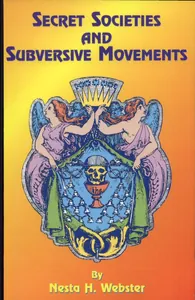


More Free Freemasonry & Secret Societies Books
View all →