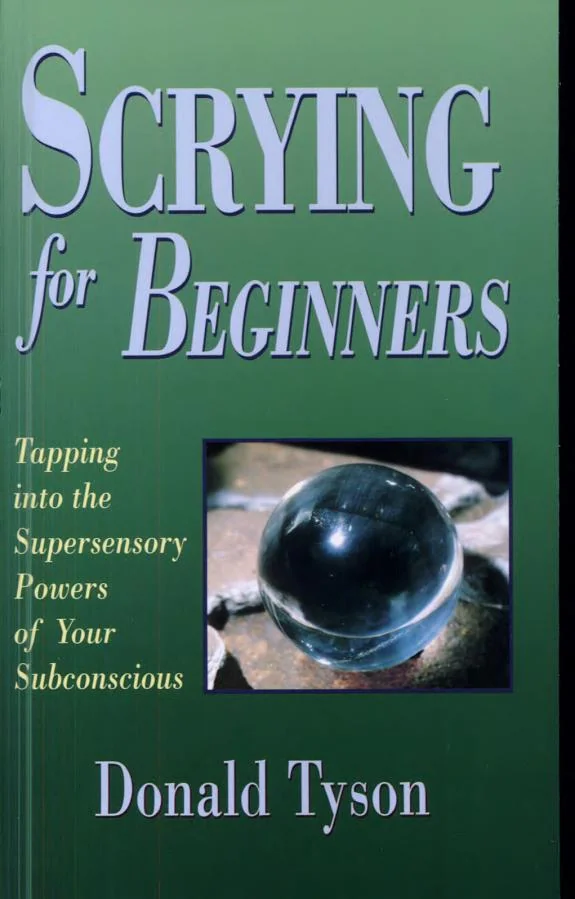
Scrying for Beginners
 84
84

Scrying for Beginners
Donald Tyson's "Scrying for Beginners" approaches visual divination with a refreshing, grounded perspective. Rather than presenting scrying as mere parlor trickery, Tyson frames it as a psychological technique for accessing subconscious or extra-sensory information. The strength lies in its systematic breakdown of various methods, from simple flame gazing to more complex mirror work, offering clear instructions for the neophyte. However, the book's primary limitation is its occasionally dry, academic tone, which may not fully capture the intuitive spark many seek in such practices. A particularly effective section details the importance of environmental setup and mental preparation, stressing that the scryer's state of mind is paramount. Tyson provides a solid foundation, but the true depth of scrying often requires personal exploration beyond the text's direct guidance.
📝 Description
84
Donald Tyson's 1997 book teaches practical methods for visual divination.
Published in 1997, Donald Tyson's "Scrying for Beginners" provides a guide to visual divination, commonly known as scrying. The book presents scrying as a psychological practice connected to extrasensory perception, rather than solely supernatural occurrences. It is aimed at newcomers to scrying or those who wish to refine their intuitive faculties. The text offers a structured method for honing visual precognitive abilities, appealing to readers interested in methods beyond standard information acquisition.
Tyson's work situates scrying within wider esoteric traditions, appearing during a time of renewed interest in parapsychology. It references earlier divinatory practices that use visual or sensory input, serving as an introduction to the subject. The book details various scrying techniques, such as crystal gazing, water scrying, and mirror divination. It also covers the necessary psychological preparation, the analysis of symbolic imagery, and the development of inner focus for accessing visionary information.
Appearing in the late 20th century, a period marked by growing interest in parapsychology and esoteric studies, Donald Tyson's "Scrying for Beginners" places the practice of scrying within broader occult traditions. The book acknowledges historical divinatory systems that rely on visual or sensory perception. It frames scrying as a psychological discipline with roots in extrasensory perception, moving away from purely supernatural explanations. This approach offers an accessible entry into understanding how visual divination fits within a larger framework of esoteric practices.
💡 Why Read This Book?
• Gain practical techniques for developing visual divination skills, directly learning about methods like crystal gazing and mirror scrying as detailed in the book's chapters. • Understand scrying as a psychological tool for extra-sensory perception, moving beyond mystical assumptions to a more grounded, accessible practice as presented by Tyson. • Acquire methods for interpreting symbolic imagery, a crucial element for effective scrying, enabling you to translate visions into meaningful information.
⭐ Reader Reviews
Honest opinions from readers who have explored this book.
❓ Frequently Asked Questions
What is scrying according to Donald Tyson?
Donald Tyson defines scrying as a psychological technique for unearthing information via extra-sensory means, focusing on visual perception and interpretation to access deeper knowledge.
What are some common scrying tools mentioned?
The book examines various tools, including crystal balls, mirrors, water bowls, and even flames, as mediums for visual divination and accessing psychic impressions.
Is scrying presented as a supernatural gift or a developable skill?
Tyson frames scrying primarily as a developable skill rooted in psychological processes and extra-sensory perception, accessible through practice and focused intention.
Who is the author, Donald Tyson?
Donald Tyson is an author known for his works on Western esoteric traditions, magic, and occultism, with "Scrying for Beginners" being an accessible entry point to his teachings.
When was 'Scrying for Beginners' first published?
Donald Tyson's "Scrying for Beginners" was first published in 1997, reflecting a growing interest in esoteric practices during that era.
What distinguishes scrying from other forms of divination?
Scrying specifically focuses on visual impressions and imagery perceived through a medium, differing from methods like tarot or rune casting which rely on symbolic arrangements.
🔮 Key Themes & Symbolism
Visual Divination Techniques
The book meticulously details various methods of scrying, emphasizing the practical application of tools such as crystal spheres, obsidian mirrors, and basins of water. Tyson guides the reader through the process of preparing the scrying medium and oneself, fostering the necessary mental state for clear visions. He distinguishes between passive observation and active seeking of information, illustrating how different techniques can yield varied types of insights, from symbolic messages to precognitive glimpses.
Psychological Basis of Scrying
Tyson posits that scrying is fundamentally a psychological process, leveraging innate extra-sensory perception (ESP) rather than relying solely on external supernatural forces. The work explores how the mind can project and receive information when in a focused, receptive state. This perspective explains scrying, presenting it as a trainable mental faculty that can be honed through dedicated practice, concentration exercises, and understanding the interplay between the conscious and subconscious mind.
Interpretation of Visions
A significant portion of the book is dedicated to the critical aspect of interpreting the images and symbols perceived during scrying sessions. Tyson provides frameworks for understanding the language of the subconscious and the symbolic lexicon that emerges during divination. He stresses the importance of personal symbolism, intuition, and cross-referencing visions with known esoteric or psychological archetypes to derive meaningful guidance from the scrying experience.
Cultivating Inner Focus
Developing the ability to scry effectively requires significant mental discipline. Tyson outlines methods for enhancing concentration, reducing mental chatter, and achieving a state of relaxed awareness. This involves managing external distractions and internal mental noise, allowing the user to maintain focus on the scrying medium and become receptive to subtle impressions. The book emphasizes that consistent practice is key to strengthening this inner focus.
💬 Memorable Quotes
Direct passages from the work, attributed to the author.
“Scrying is the psychological technique of unearthing information by extra-sensory means.”
— This foundational statement frames scrying not as magic, but as a method of accessing hidden knowledge through the mind's latent perceptive abilities, emphasizing its practical, psychological nature.
“The many forms of scrying, such as Ouija boards, dowsing rods and aura reading, are examined.”
— This highlights the breadth of visual and sensory divination techniques covered, showing that scrying encompasses a range of practices beyond simple crystal gazing.
“The work explores techniques for those who want to develop their skills.”
— This underscores the book's purpose: to serve as a practical, instructional guide for aspiring practitioners aiming to cultivate their intuitive and divinatory abilities.
💡 Key Ideas
Editorial paraphrase of the work's core concepts — not direct quotes.
Focus and receptivity are paramount to successful scrying.
This paraphrased concept emphasizes the core requirements for effective scrying: intense concentration combined with an open, non-resistant mental state.
Interpretation of symbols is key to understanding scryed visions.
This paraphrased concept stresses that seeing images is only the first step; the ability to decode their meaning is essential for deriving value from the scrying process.
🌙 Esoteric Significance
Tradition
Tyson's work draws broadly from Western esoteric traditions, particularly those focused on divination and psychic development. While not strictly adhering to a single lineage like Hermeticism or Kabbalah, it synthesizes techniques and concepts relevant to practices like ceremonial magic and general occultism, presenting them in a digestible format for modern seekers. It bridges the gap between popular psychic phenomena and more structured esoteric systems.
Symbolism
Central to scrying is the interpretation of symbolism. The book implicitly engages with universal archetypes that appear in visions, which echo across cultures and traditions. Specific symbols, such as water (representing the subconscious, emotion, and the feminine principle) or mirrors (acting as portals or reflections of inner truth), are explored as common motifs within the scrying experience, requiring personalized understanding.
Modern Relevance
Contemporary practitioners of modern witchcraft, neo-paganism, and even secular mindfulness techniques often incorporate elements of scrying as taught by authors like Tyson. His emphasis on psychological technique and personal development speaks to current trends in self-discovery and alternative wellness practices, making the book a foundational text for many exploring intuitive development outside of rigid traditional frameworks.
👥 Who Should Read This Book
• Aspiring diviners and psychics seeking a practical, step-by-step introduction to visual forms of clairvoyance, learning concrete methods for crystal gazing and mirror work. • Students of Western esoteric traditions interested in understanding the practical application of psychic abilities within occult frameworks, as presented by Donald Tyson. • Individuals curious about developing their intuition and extra-sensory perception through accessible psychological techniques, moving beyond theoretical concepts to hands-on practice.
📜 Historical Context
Published in 1997, "Scrying for Beginners" emerged during a resurgence of interest in esoteric subjects, fueled by the internet and a growing dissatisfaction with purely materialistic worldviews. This period saw many occult authors, like Tyson, making traditional magical practices more accessible. While figures like Aleister Crowley had explored similar territories in the early 20th century, Tyson's approach offered a more modern, psychologically grounded perspective. The book appeared alongside a general trend of New Age and self-help literature that incorporated spiritual or mystical elements. Unlike more academic treatises on divination, Tyson's work aimed directly at the novice practitioner, bypassing the more complex philosophical underpinnings often found in Hermetic or Kabbalistic texts.
📔 Journal Prompts
Reflect on the concept of extra-sensory perception as presented in relation to scrying.
Analyze the role of psychological focus in successful scrying sessions.
Consider the symbolism of water as a scrying medium.
Evaluate the importance of environmental setup for divination.
Explore personal interpretations of common scrying symbols.
🗂️ Glossary
Scrying
A divination practice involving gazing into a reflective surface or medium to receive visions, insights, or information through visual means.
Extra-sensory Perception (ESP)
The supposed ability to acquire information by psychic means, such as through telepathy, clairvoyance, or precognition, distinct from the five senses.
Clairvoyance
The psychic ability to perceive events, persons, or objects removed from the normal range of the senses, particularly through visual impressions.
Divination
The practice of seeking knowledge of the future or the unknown by supernatural means or through the interpretation of omens or symbols.
Psychological Technique
A method or procedure based on principles of psychology, used here to describe how scrying is understood as a mental discipline.
Visual Medium
Any object or substance, such as a crystal, mirror, or water, used as a focal point for scrying to induce visionary states.
Symbolic Imagery
Pictures or representations that stand for something else, often used in dreams or divination to convey deeper meanings or messages.
This book appears in 1 collection
🔮 Readers Also Liked
Browse all →









From the “Scrying” Collection
View all →



More Free Occult Philosophy Books
View all →