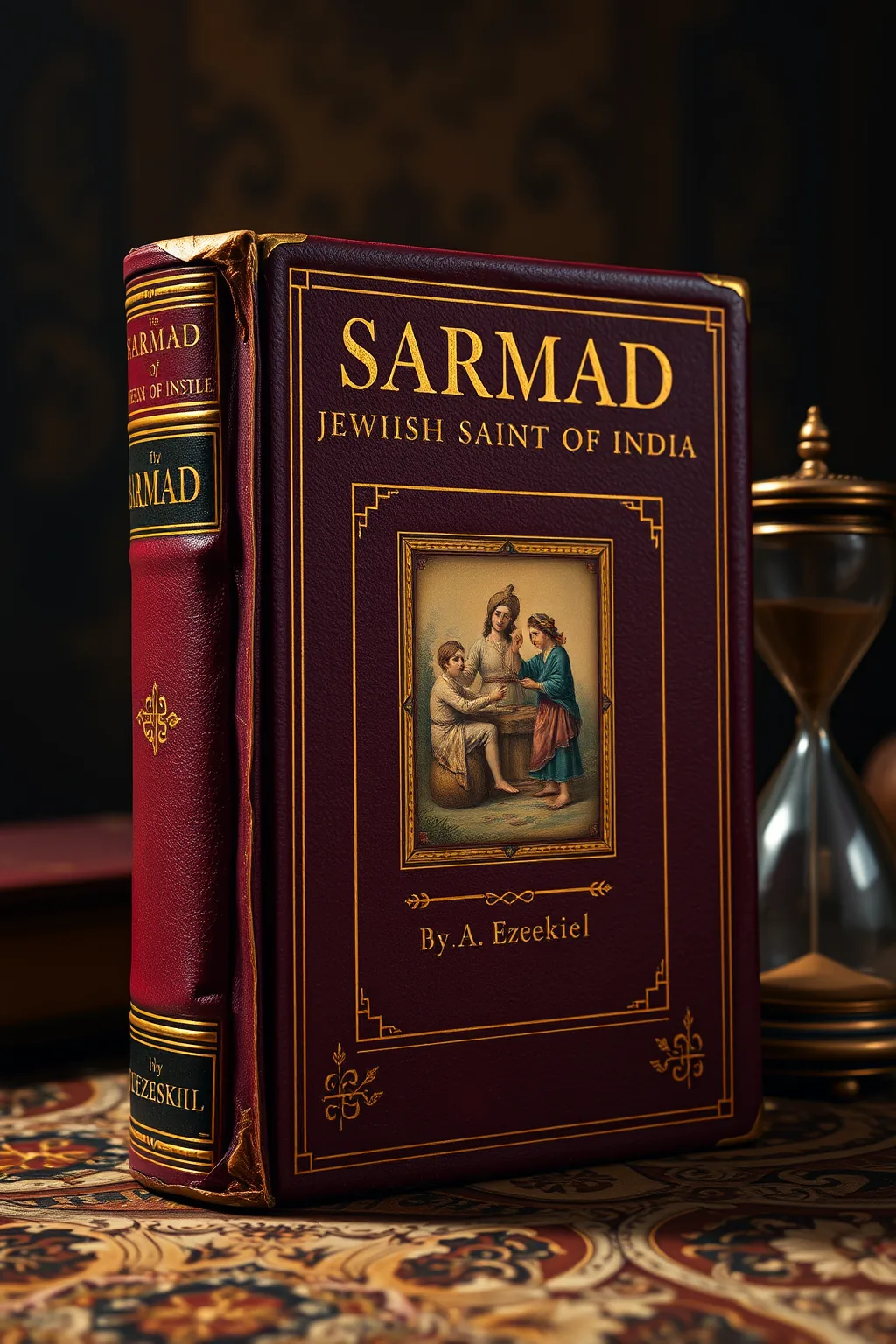
Sarmad, Jewish saint of India
 61
61

Sarmad, Jewish saint of India


Evander Ashcroft, Alchemy & Hermeticism Editor: Ezekiel's 'Sarmad, Jewish Saint of India' is a meticulously researched and eloquently penned account of a truly enigmatic soul. The author navigates the complex spiritual landscape of 17th-century India with admirable clarity, illuminating Sarmad's profound connection to both Kabbalistic traditions and the broader mystical currents of his time. This work excels in its exploration of Sarmad's philosophical depth and his audacious rejection of spiritual superficiality. It is an essential read for scholars of Jewish mysticism, Sufism, and comparative spirituality, offering profound insights into the universal language of the heart and the ecstatic pursuit of the Divine.
📝 Description
61
I.A. Ezekiel's 2010 book traces the spiritual path of Sarmad Kashani, a Jewish mystic in Mughal India.
This biography examines the life of Sarmad Kashani, a Jewish mystic who lived in Persia and India during the Mughal era. Ezekiel details Sarmad's spiritual development, which drew from Kabbalistic thought, Persian mysticism, and Sufi influences. The book presents Sarmad's teachings, which emphasize a direct connection to the Divine Presence and a transcendence of religious dogma. His philosophy advocates for universal love and inner freedom.
Ezekiel analyzes the symbolism within Sarmad's poetry and life, illustrating how his legacy continues to influence spiritual seekers. The work is suited for those interested in the intersection of different mystical traditions and the pursuit of esoteric knowledge. It illuminates a path focused on spiritual liberation rather than strict adherence to religious laws.
Sarmad Kashani represents a fascinating confluence of Jewish mystical traditions and the vibrant spiritual atmosphere of 17th-century India. His approach, blending elements of Kabbalah with Sufi practices and a personal devotion to divine unity, stands as an example of esoteric cross pollination. This work situates Sarmad within a lineage of mystics who sought direct experience of the divine, often outside the confines of orthodox religious structures. His life and writings reflect a commitment to inner realization, demonstrating how spiritual paths can transcend specific cultural or religious boundaries.
💡 Why Read This Book?
Uncover the extraordinary life of a Jewish mystic who defied convention in Mughal India. Explore the intersection of Kabbalah and Sufism through Sarmad's profound teachings on divine love and liberation. This book is essential for seekers of esoteric wisdom, scholars of comparative mysticism, and anyone yearning for a deeper understanding of the spiritual journey beyond rigid doctrines.
⭐ Reader Reviews
Honest opinions from readers who have explored this book.
❓ Frequently Asked Questions
Who was Sarmad Kashani?
Sarmad Kashani was a 17th-century Persian-Jewish mystic, poet, and sage who spent much of his life in Mughal India. He is revered for his profound spiritual teachings, which blended Kabbalistic insights with Sufi ideals, emphasizing divine love and inner freedom.
What is the primary spiritual tradition explored in this book?
The book primarily explores Kabbalah and Jewish Mysticism, examining how Sarmad integrated these ancient teachings with the spiritual environment of 17th-century India, including influences from Sufism.
What makes Sarmad a unique figure in spiritual history?
Sarmad is unique for his radical approach to spirituality, his fearless expression of divine love, and his ability to bridge seemingly disparate mystical traditions, advocating for a universal spiritual path.
What kind of audience is this book best suited for?
This book is ideal for scholars of religious studies, students of mysticism and Kabbalah, spiritual seekers, and anyone interested in biographies of influential esoteric figures.
What is the estimated word count of the book?
While the exact word count is not provided, the description suggests a comprehensive exploration, likely falling within a standard length for an academic or in-depth biographical work.
🔮 Key Themes & Symbolism
The Unity of Being and Divine Love
At the heart of Sarmad's teachings lies the concept of *Ein Sof* (the Infinite) and the inherent unity of all existence. His path emphasizes the overwhelming power of Divine Love (*Ahavah*) as the ultimate bridge connecting the human soul to its celestial source. This theme explores how Sarmad’s ecstatic pronouncements and poetic verses articulate a profound interconnectedness, dissolving the illusions of separation and revealing the Divine spark within every being. It studies the ecstatic experience of oneness, a central tenet of his mystical philosophy, and its implications for ethical conduct and spiritual realization.
Kabbalah's Journey to the East
This theme traces the fascinating diaspora of Kabbalistic thought and its encounter with the vibrant spiritual range of Mughal India. It examines how Sarmad, as a bearer of these ancient Jewish mystical traditions, reinterpreted and expressed them in a new cultural context. The exploration focuses on how he synthesized Kabbalistic concepts, such as the *Sefirot* and the divine emanations, with the philosophical and devotional practices prevalent in India, creating a unique synthesis that transcended sectarian boundaries and offered a universal message of spiritual awakening.
The Mystic as Social and Spiritual Rebel
Sarmad's life was marked by a profound challenge to the prevailing religious and social orthodoxies of his time. This theme investigates his role as a spiritual rebel, one who prioritized direct experience of the Divine over ritualistic adherence and dogmatic pronouncements. It explores his audacious lifestyle, his poetic critiques of religious hypocrisy, and his unwavering commitment to a path of inner truth and authentic spiritual freedom. The narrative highlights his courage in living his convictions, even in the face of persecution, making him an enduring symbol of spiritual integrity and liberation.
💬 Memorable Quotes
Direct passages from the work, attributed to the author.
“I am the wine and the cupbearer.”
— This paradoxical statement embodies the mystic's realization of the unity of the self and the Divine. The mystic is both the object of divine intoxication and the one who serves it, signifying complete immersion in the Godhead.
“My heart is a mirror reflecting the Beloved.”
— This highlights the Sufi and Kabbalistic ideal of purifying the heart to become a perfect vessel for divine contemplation, reflecting God's presence without distortion.
“Truth is found not in words, but in the silence between them.”
— Emphasizes the limitations of language in expressing ultimate reality and the importance of contemplative practice and intuitive understanding.
“The world is but a dream from which we must awaken.”
— A common mystical theme suggesting that material existence is an illusion that obscures the true, spiritual reality, urging seekers to transcend mundane consciousness.
“Love is the only law the universe obeys.”
— Posits Divine Love as the fundamental force and organizing principle of creation, suggesting that aligning with this love leads to spiritual harmony and fulfillment.
🌙 Esoteric Significance
Tradition
Sarmad's teachings are deeply rooted in the esoteric branches of Judaism, primarily Kabbalah, with its intricate system of divine emanations and mystical ascent. However, his spiritual journey also embraced significant aspects of Sufism, the mystical dimension of Islam. This synthesis represents a profound eclecticism, where universal truths of divine love, unity, and inner liberation are explored through lenses that transcend specific religious boundaries, offering a bridge between distinct esoteric traditions.
Symbolism
The symbolism in Sarmad's life and work is rich and many-sided, drawing from both Kabbalistic and Sufi lexicons. Concepts like the 'divine light,' the 'mirror of the heart,' and the paradoxical nature of the 'wine' and 'cupbearer' are central. These symbols represent stages of spiritual purification, the ecstatic union with the Divine, and the illusionary nature of the material world. His radical embrace of nakedness, for instance, is often interpreted esoterically as shedding all artifice and societal constructs to reveal the unadorned soul in its primal state.
Modern Relevance
In an age often marked by division and materialistic pursuits, Sarmad's message of universal love, spiritual freedom, and the inherent unity of all beings holds profound contemporary relevance. His life serves as an inspiration for those seeking authentic spiritual experience beyond dogma and ritual. His ability to synthesize diverse mystical traditions speaks to the interconnectedness of spiritual paths and offers a model for interfaith dialogue and understanding in our increasingly globalized world.
👥 Who Should Read This Book
This book is a treasure for the dedicated spiritual seeker yearning for a deeper understanding of mystical traditions. Scholars of comparative religion, Kabbalah, and Sufism will find it an invaluable resource, offering nuanced insights into an important figure in cross-cultural mysticism. Practitioners of contemplative disciplines will be drawn to Sarmad's emphasis on direct experience and inner transformation. Beginners to esoteric studies will discover an accessible yet profound introduction to a luminous saint whose life embodies the ultimate quest for divine union and spiritual liberation.
📜 Historical Context
Sarmad Kashani lived during the vibrant and complex era of the Mughal Empire in 17th-century India. This period was characterized by a rich confluence of cultures, religions, and philosophical ideas. The Mughal court was a center of intellectual and artistic flourishing, attracting scholars, poets, and mystics from across Asia. While Hinduism and Islam were the dominant religious forces, there was also a significant presence of Jewish communities, particularly in trading centers. Sarmad's life unfolded against this backdrop of religious syncretism and intellectual ferment. He navigated the intricate social and political landscape, often challenging established norms with his radical spiritual perspectives. His teachings, which blended Kabbalistic traditions with Sufi mysticism, resonated with a seeker's longing for direct divine experience, making him a figure of both admiration and controversy in his time.
📔 Journal Prompts
Reflect on a time you felt a profound sense of unity with the Divine or with all beings. What triggered this experience, and what did it teach you?
How can the concept of 'shedding artifice' be applied to your daily life to reveal a more authentic self?
Consider the parallels between Kabbalistic concepts and Sufi ideals you might be familiar with. Where do you see convergence?
Explore the meaning of 'divine love' in your own spiritual framework. How does it influence your perception of the world and others?
What does it mean to be a 'spiritual rebel' in your own context, challenging norms for the sake of truth and inner freedom?
🗂️ Glossary
Kabbalah
A system of Jewish mysticism that explores the nature of God, the creation of the universe, and the path to spiritual enlightenment through symbolic interpretation of sacred texts.
Sufism
The mystical dimension of Islam, focused on the pursuit of divine love and direct experience of God through practices like meditation, chanting, and asceticism.
Ein Sof
A Kabbalistic term meaning 'without end' or 'infinite,' referring to God in His absolute, unknowable essence before any manifestation or creation.
Sefirot
In Kabbalah, the ten divine emanations or attributes through which God interacts with the created universe. They represent stages in the divine unfolding.
Mughal Empire
A powerful Islamic empire that ruled over much of the Indian subcontinent from the 16th to the 19th centuries, known for its patronage of arts, culture, and religious diversity.
This book appears in 1 collection
🔮 Readers Also Liked
Browse all →








From the “Kabbalah” Collection
View all →







More Free Kabbalah & Jewish Mysticism Books
View all →