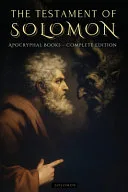
The Testament of Solomon
 84
84

The Testament of Solomon
The Testament of Solomon presents a fascinating, if somewhat fragmented, account of King Solomon's dominion over the spirit world. Its primary strength lies in its historical significance as an early demonological text, offering invaluable insights into ancient conceptions of spiritual entities and their manipulation. The narrative of Solomon receiving a ring from Michael to control demons is particularly striking, providing a vivid image of divinely sanctioned occult power. However, the text can feel disjointed, with its various sections sometimes lacking smooth transitions. The prophetic elements, particularly the foretelling of Christ's arrival, feel like a later addition, attempting to reconcile the text with emerging Christian orthodoxy. Despite these limitations, the passages detailing the specific names and vulnerabilities of demons, such as the demon of the crossroads or the one associated with specific bodily afflictions, offer a compelling, if unsettling, look into the anxieties and beliefs of its time.
📝 Description
84
### What It Is
The Testament of Solomon is an apocryphal text attributed to the biblical King Solomon, detailing his encounters with demons and his supposed ability to command them. This work is significant as one of the earliest known treatises dedicated to demonology, offering a unique glimpse into ancient beliefs about the hierarchy and powers of malevolent spirits. It presents Solomon not just as a wise king, but as an exorcist and prophet, privy to hidden knowledge.
### Who It's For
This text will appeal to scholars of ancient religious texts, particularly those interested in Jewish apocrypha and early Christian traditions. It is also of interest to practitioners and students of demonology, occultism, and comparative religion who seek to understand historical perspectives on spiritual warfare and the nature of evil. Those fascinated by the intersection of myth, scripture, and magical practices will find substantial material here.
### Historical Context
Likely compiled between the 1st and 4th centuries CE, The Testament of Solomon emerged during a period of intense religious and philosophical ferment in the Hellenistic and Roman worlds. It existed alongside Gnostic texts and other apocryphal writings, reflecting a diverse landscape of spiritual inquiry. The text's attribution to Solomon, a figure already associated with wisdom and mystical knowledge in Jewish tradition, lent it considerable authority, despite its eventual exclusion from the biblical canon. Its reception varied, with some later Christian scholars viewing it with suspicion due to its magical elements.
### Key Concepts
The work centers on Solomon's divine empowerment through a ring given by the Archangel Michael, which grants him dominion over all demons. It outlines the names, hierarchies, and specific weaknesses of various demonic entities, along with incantations and rituals for their subjugation. A significant prophetic element is the foretelling of the coming of Christ, often through the mouth of demons themselves or as interpreted by Solomon, suggesting an early Christian redaction or influence on the text.
💡 Why Read This Book?
• Gain an understanding of early demonological frameworks, learning about the specific entities like the demon Asmodeus and the methods, such as the seal of Solomon, used for their control as detailed in ancient texts. • Explore the unique prophetic dimension of the Testament, which includes demons foretelling the birth of Christ, offering a perspective on how apocryphal texts sometimes engaged with burgeoning Christian theology. • Discover the historical context of apocryphal literature, understanding how texts like this, attributed to biblical figures, circulated and were interpreted during the early centuries CE, influencing later esoteric traditions.
⭐ Reader Reviews
Honest opinions from readers who have explored this book.
❓ Frequently Asked Questions
What is the historical period when The Testament of Solomon was likely written?
Scholarly consensus places the likely compilation of The Testament of Solomon between the 1st and 4th centuries CE, a period of significant religious syncretism and the development of early Christian and Gnostic thought.
Who is the Archangel Michael in relation to The Testament of Solomon?
In the text, Archangel Michael is credited with providing King Solomon with a magical ring, a divine gift that bestows upon him the power to command and control all demons.
Does The Testament of Solomon contain prophecies about the future?
Yes, the text includes prophecies, notably concerning the coming of Christ, which are sometimes uttered by the demons themselves under Solomon's command, indicating a complex theological layering.
What is the primary focus of the demons described in The Testament of Solomon?
The demons are described with their specific names, the afflictions they cause (e.g., illness, madness), their hierarchical positions, and their vulnerabilities, forming an early compendium of demonological knowledge.
Is The Testament of Solomon considered part of the standard biblical canon?
No, The Testament of Solomon is an apocryphal text. It was not included in the accepted biblical canon by Jewish or most Christian traditions, despite its historical influence.
What role does the demon Asmodeus play in The Testament of Solomon?
Asmodeus is a prominent demon in the text, depicted as a particularly troublesome entity whom Solomon must subdue. He is often portrayed as a tempter and a source of great mischief and destruction.
🔮 Key Themes & Symbolism
Solomon's Dominion Over Spirits
The central theme revolves around King Solomon's divinely granted authority to command demons. Empowered by a magical ring from Archangel Michael, Solomon interrogates demons, learning their names, functions, and weaknesses. This theme explores the ancient concept of a righteous ruler wielding occult knowledge for cosmic order, contrasting with the chaos represented by the subjugated spirits. The text details specific rituals and incantations used to enforce this dominion, positioning Solomon as an archetypal exorcist.
Early Demonological Compendium
This work stands as one of the earliest systematic treatises on demonology. It meticulously lists and describes various demons, assigning them specific roles in corrupting humanity, causing illness, or tempting individuals. The Testament provides a structured view of the infernal hierarchy and the perceived mechanisms through which malevolent forces operated in the ancient world, offering scholars a foundational text for understanding historical occult beliefs.
Prophecy and Apocalyptic Vision
Beyond its demonological content, the text incorporates significant prophetic elements. Demons are compelled to reveal future events, most notably the Incarnation and eventual crucifixion of Christ. This aspect suggests an integration of Jewish mystical traditions with early Christian apologetics, where even demonic testimony is used to affirm Christian doctrine. It highlights how apocryphal texts often engaged with evolving theological landscapes.
The Seal of Solomon
The magical ring given to Solomon, often referred to as the 'Seal of Solomon,' is a key symbol. It represents divine protection, wisdom, and the power to control supernatural forces. This symbol became a significant motif in later esoteric traditions, particularly in Kabbalah and Western Hermeticism, signifying mastery over the lower realms and access to divine knowledge.
💬 Memorable Quotes
Direct passages from the work, attributed to the author.
“The ring was given to me by the archangel Michael, by the command of God.”
— This statement establishes the divine origin and authority behind Solomon's power. It frames his ability to control demons not as personal magic, but as a sanctioned mandate from God, mediated by a celestial messenger.
“The demon of fever, who brings illness and death.”
— This highlights the practical application of the text's demonology, linking specific spirits to tangible ailments. It suggests the text served not only theological purposes but also potentially informed ancient healing practices or understandings of disease.
“Solomon bound the demons with chains of fire.”
— This imagery conveys the absolute power Solomon wields over the demonic forces. The 'chains of fire' symbolize both their infernal nature and the potent, unyielding control he exerts through divine empowerment.
💡 Key Ideas
Editorial paraphrase of the work's core concepts — not direct quotes.
I am the demon of fornication, and I corrupt the souls of the young.
This quote exemplifies the direct confessions extracted from demons within the text. It reveals the specific sins and corruptions attributed to individual demonic entities, painting a picture of their perceived functions in the spiritual landscape.
And he said unto me, 'When the days of the Messiah come, and the Son of God is born of a virgin, then shall all the demons be destroyed.'
This passage demonstrates the text's prophetic nature, with demons themselves foretelling the advent of Christ. It reflects an attempt to align even apocryphal narratives with emerging Christian theology, using demonic testimony to validate future events.
🌙 Esoteric Significance
Tradition
The Testament of Solomon fits within the broader stream of Jewish apocalyptic and wisdom literature, heavily influenced by Hellenistic magical papyri and Gnostic cosmology. It bridges the gap between biblical narrative and later Kabbalistic and Hermetic traditions by focusing on the practical command of spirits and the symbolic power of divine names and seals. Its demonological focus also aligns with early Christian discussions on spiritual warfare.
Symbolism
The primary symbol is the 'Seal of Solomon,' represented by the ring, which signifies divine authority, protection, and the power to bind spiritual entities. Other symbols include the specific names and characteristics of demons, which act as 'keys' to understanding and controlling them, and the 'chains of fire' used to restrain them, representing their inherent nature and Solomon's absolute power.
Modern Relevance
Contemporary practitioners of Western Esotericism, particularly ceremonial magicians and occultists, draw upon The Testament of Solomon for its foundational demonological insights and ritualistic frameworks. It informs modern approaches to spirit invocation, exorcism, and the understanding of spiritual hierarchies. Thinkers in comparative religion and mythology also utilize it to trace the evolution of ideas about good and evil.
👥 Who Should Read This Book
• Students of comparative religion and ancient history seeking primary sources on early demonology and apocryphal literature. • Occult practitioners and ceremonial magicians interested in historical grimoires and the foundations of spirit-command traditions. • Scholars of biblical studies and Jewish mysticism interested in texts that elaborate on figures like King Solomon beyond the canonical scriptures.
📜 Historical Context
Emerging between the 1st and 4th centuries CE, The Testament of Solomon arose during a period of intense spiritual exploration within the Roman Empire. It existed within a milieu that included Gnosticism, early Christian writings, and various Hellenistic mystery cults, all seeking to understand divine and demonic powers. The text's attribution to the legendary King Solomon lent it significant weight, aligning it with existing Jewish traditions of wisdom and mystical insight. While influential in certain esoteric circles, its explicit focus on demonology and magical practices led to its classification as apocryphal by mainstream religious authorities. Its compilation likely involved layers of redaction, possibly incorporating early Christian perspectives as evidenced by the prophecies concerning Christ, reflecting the era's dynamic theological landscape and the circulation of diverse religious narratives.
📔 Journal Prompts
Solomon's ring and its divine empowerment.
The specific vulnerabilities of demons like Asmodeus.
Demonic testimony regarding the coming of Christ.
The practical applications of demon names and seals.
The contrast between Solomon's wisdom and demonic deceit.
🗂️ Glossary
Apocrypha
Texts that are considered sacred or inspired by some religious groups but are not included in the official canon of scripture, such as The Testament of Solomon.
Demonology
The study of demons or beliefs about demons, including their nature, powers, and hierarchies, as extensively detailed in The Testament of Solomon.
Seal of Solomon
A legendary magical seal or ring attributed to King Solomon, believed to grant power over spirits and protection, prominently featured in the text.
Asmodeus
A powerful and often malevolent demon mentioned in Jewish, Christian, and Islamic folklore, who plays a significant role in The Testament of Solomon as a chief adversary of Solomon.
Incantation
A series of words used to cast a spell or produce a magical effect, described in The Testament of Solomon as a tool for commanding demons.
Hellenistic Period
The period of Mediterranean history between the death of Alexander the Great (323 BCE) and the emergence of the Roman Empire (c. 31 BCE), during which the text likely originated or was compiled.
Esoteric
Intended for or likely to be understood by only a small number of people with a specialized knowledge or interest, which describes the nature of the text's content.