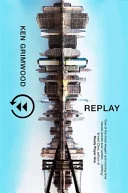
Replay
 76
76

Replay
Ken Grimwood’s 'Replay' tackles the perennial wish fulfillment of a second chance, but frames it within a stark, existential loop. Jeff Winston’s predicament—dying at 43 and waking up at 18 with full knowledge of his future—is immediately engaging. Grimwood masterfully illustrates the initial euphoria of power: wealth, love, and success become attainable. Yet, the narrative’s strength lies not in triumphant wish fulfillment, but in the creeping despair. The repeated cycles, while offering chances to correct mistakes, ultimately reveal the futility of trying to engineer happiness. A particularly poignant aspect is Jeff’s struggle to connect authentically with people who are experiencing their lives for the first time, while he is burdened by foreknowledge. The limitation, perhaps, is the somewhat predictable emotional arc of repeated attempts at perfection. Still, the exploration of whether knowing the future liberates or imprisons the soul is handled with considerable grace. 'Replay' succeeds as a melancholic meditation on life's unrepeatable moments.
📝 Description
76
Ken Grimwood's 1986 novel 'Replay' begins with a man dying at 43 and waking up 25 years younger.
Jeff Winston dies at 43 and finds himself back at age 18 in 1963. This cycle repeats, each death sending him back to the same starting point with all his accumulated memories. He has countless chances to relive his life, to make different choices, to pursue different paths, and to try and find happiness or fulfillment. The narrative examines the weight of knowing the future, the illusion of control over destiny, and the very nature of reality when one can repeatedly rewrite their personal history. Grimwood focuses on the emotional and psychological toll this takes on Winston, rather than the mechanics of the phenomenon itself. The book questions whether true contentment can be achieved by altering external circumstances or if it requires internal transformation. It is a story about second chances, but also about the potential futility of them when the core self remains unchanged.
Readers drawn to philosophical science fiction will find much to consider. The novel appeals to those who ponder the impact of individual choices, the illusion of agency, and the search for meaning in a life that seems both predetermined and infinitely revisitable. It also suits individuals fascinated by alternate realities and the psychological burden of living with perfect recall of past timelines. Grimwood's unique perspective on temporal recursion offers a deeply personal look at a familiar science fiction concept.
Published in 1986, 'Replay' arrived during a period of renewed interest in speculative fiction that examined consciousness and temporal paradoxes. It followed authors like Philip K. Dick, who explored the nature of reality and predestination. Grimwood's novel stands apart by concentrating on the personal and emotional consequences of temporal loops, rather than complex scientific explanations or elaborate world building. Its focus on the individual's internal experience of reliving a life connects it to traditions that question the solidity of linear time and the nature of the self across multiple existences.
💡 Why Read This Book?
• You will explore the psychological burden of omniscience and the potential for existential ennui, even with foreknowledge of events like the 1960s cultural shifts, which Jeff witnesses repeatedly. • You will gain a unique perspective on the nature of authentic connection, understanding how Jeff's repeated lives impact his relationships, particularly with characters like Pamela, who he meets in different life iterations. • You will contemplate the concept of 'perfect' lives and discover whether achieving wealth and success, as Jeff attempts by leveraging his knowledge of stock market trends, leads to genuine contentment.
⭐ Reader Reviews
Honest opinions from readers who have explored this book.
❓ Frequently Asked Questions
What is the central premise of Ken Grimwood's 'Replay'?
The central premise involves Jeff Winston, who dies at 43 and repeatedly wakes up at age 18 in 1963 with all his memories intact, allowing him to relive his life with foreknowledge.
When was Ken Grimwood's 'Replay' first published?
'Replay' was first published in 1986, becoming a notable work in speculative fiction that year.
Does 'Replay' focus on the science of time travel or the personal impact?
The novel primarily focuses on the personal and psychological impact of reliving one's life, rather than the scientific mechanics of how the phenomenon occurs.
What are some of the challenges Jeff Winston faces in 'Replay'?
Jeff faces challenges such as the emotional isolation of knowing the future, the difficulty of forming genuine relationships, and the existential dread of endless repetition.
Is 'Replay' considered a science fiction or fantasy novel?
'Replay' is broadly classified as speculative fiction, blending elements of science fiction (due to the temporal loop premise) with a strong focus on human drama and philosophical inquiry.
What is the significance of the year 1963 in 'Replay'?
The year 1963 marks the starting point of Jeff Winston's repeated life cycles, placing him at the beginning of the 1960s and its unfolding cultural and historical events.
🔮 Key Themes & Symbolism
The Burden of Foreknowledge
The narrative studies the psychological toll of possessing complete knowledge of future events, from personal relationships to historical occurrences. Jeff Winston's ability to predict outcomes, whether stock market fluctuations or personal tragedies, transforms his experience of life from one of discovery to one of predetermined paths. This theme questions whether omniscience is a gift or a curse, exploring how knowing the end of the story can paradoxically diminish the richness of the journey and lead to a profound sense of detachment.
The Illusion of Control
Central to 'Replay' is the exploration of whether true control over one's destiny is possible, even with the advantage of repeated lives. Jeff attempts to engineer perfect outcomes, achieve wealth, and secure happiness, often leveraging specific knowledge like the outcomes of the Vietnam War or technological advancements. However, the novel illustrates that external manipulation rarely yields lasting internal satisfaction, suggesting that true agency may lie not in altering events, but in one's internal response to them.
Authenticity and Connection
The novel critically examines the nature of authentic human connection when one participant is living a life out of sequence. Jeff's relationships are constantly challenged by his unique perspective; he knows the future joys and sorrows of loved ones, creating a barrier to genuine present-moment engagement. This theme questions whether love and friendship can flourish when one person experiences time non-linearly, highlighting the potential for profound loneliness even amidst repeated social interactions.
The Search for Meaning
Ultimately, 'Replay' is a narrative about the enduring human quest for meaning in the face of existential repetition. As Jeff cycles through his life, the initial excitement of rewriting his past gives way to a deeper search for purpose beyond material success or perfected relationships. The novel probes whether meaning is found in the accumulation of experiences, the mastery of circumstances, or in a more ephemeral, perhaps spiritual, understanding of existence.
💬 Memorable Quotes
Direct passages from the work, attributed to the author.
“He died at forty-three. He woke up eighteen.”
— This stark, declarative sentence immediately establishes the novel's central premise and the protagonist's predicament, setting a tone of existential shock and the beginning of a cyclical journey.
“He had all the advantages. All the advantages in the world.”
— This phrase captures Jeff Winston's initial perception of his situation—possessing foreknowledge of decades of history, from economic trends to personal events, granting him immense power.
“The trick was to live each life as if it were the only one.”
— This reflects Jeff's evolving philosophy as he grapples with the endless repetition, suggesting a potential path to peace or meaning lies in embracing the present moment despite his unique temporal condition.
“He knew what was coming. He knew it all.”
— This highlights the profound isolation and burden of Jeff's knowledge, emphasizing how his awareness of the future separates him from the natural unfolding of life for others.
“Wealth was easy. Love was hard.”
— This concise statement expresses the core thematic conflict: while external achievements are attainable through foreknowledge, genuine emotional connection and fulfillment remain elusive and complex.
🌙 Esoteric Significance
Tradition
While not explicitly aligned with a single esoteric lineage, 'Replay' engages with concepts resonant in Gnostic and Hermetic traditions, particularly the idea of cyclical existence and the potential for liberation through gnosis (knowledge). The protagonist's repeated lives can be seen as a form of existential purgatory or a learning cycle, where true enlightenment comes not from manipulating external events but from internal understanding and acceptance. It carries the Hermetic principle of 'As Above, So Below,' implying that the macrocosmic cycles of time and existence are mirrored in the microcosm of an individual's repeated life.
Symbolism
The primary symbol is the 'replay' itself, representing the endless cycle of birth, death, and rebirth, akin to Samsara in Eastern philosophies but framed within a Western individualistic narrative. Jeff's recurring age of 43, the point of death, can symbolize a mid-life crisis or a peak of experience from which he is forced to descend. The year 1963 serves as a recurring temporal anchor, a specific point in history that becomes both a prison and a potential crucible for transformation, symbolizing the unchanging nature of his starting point against the mutable possibilities of his choices.
Modern Relevance
The themes of 'Replay' continue to resonate in contemporary discussions surrounding consciousness, simulation theory, and existential psychology. Thinkers and communities exploring the nature of reality, the impact of memory, and the search for meaning in a seemingly chaotic world often find parallels in Grimwood's narrative. Its exploration of living with perfect recall anticipates modern anxieties about digital footprints and the permanence of information, while its focus on emotional authenticity remains a touchstone for self-help and philosophical inquiry in the 21st century.
👥 Who Should Read This Book
• Readers interested in existential philosophy and the nature of consciousness will appreciate the deep dive into Jeff Winston's repeated life cycles and his struggle for meaning. • Fans of speculative fiction that prioritizes character development and emotional resonance over hard science will find a compelling narrative in 'Replay's' exploration of time loops. • Individuals contemplating the impact of choices, regret, and the pursuit of happiness will connect with Jeff's journey as he attempts to perfect his life across multiple timelines.
📜 Historical Context
Published in 1986, Ken Grimwood's 'Replay' emerged during a period when speculative fiction was increasingly exploring themes of consciousness, identity, and temporal anomalies. It followed in the wake of influential works like Kurt Vonnegut's 'Slaughterhouse-Five' (1969), which also used non-linear narrative structures to examine trauma and the human condition. While not explicitly tied to any specific esoteric movement, 'Replay' tapped into a broader cultural fascination with determinism versus free will, a philosophical debate that has roots stretching back to ancient Greek thought and continued through Enlightenment thinkers like Immanuel Kant. The novel's reception was generally positive, with critics noting its emotional depth and relatable protagonist, distinguishing it from more technically complex science fiction narratives of the era. Its success allowed Grimwood to continue exploring similar thematic territory.
📔 Journal Prompts
Jeff's repeated experience of the 1960s cultural shifts.
The concept of 'living each life as if it were the only one'.
The emotional isolation stemming from foreknowledge.
The pursuit of wealth versus authentic connection.
The ultimate meaning found (or not found) in repeated existence.
🗂️ Glossary
Temporal Loop
A narrative device where a character or characters experience a period of time repeatedly, often retaining memories from previous iterations.
Foreknowledge
The ability to know future events before they happen, a key element empowering and burdening the protagonist, Jeff Winston.
Existential Dread
A feeling of anxiety and despair arising from the contemplation of life's meaninglessness, freedom, and isolation, central to Jeff's experience.
Gnosis
In a philosophical or spiritual context, direct experiential knowledge or insight, often associated with liberation or enlightenment.
Determinism vs. Free Will
The philosophical debate concerning whether all events are predetermined or if individuals have genuine freedom to make choices.
Samsara
In Eastern religions, the cycle of death and rebirth, a concept echoed by the protagonist's repeated lives.
Mid-life Crisis
A period of emotional turmoil in middle age characterized by a desire for change and a re-evaluation of one's life, symbolized by Jeff's recurring death age.
This book appears in 1 collection
🔮 Readers Also Liked
Browse all →







From the “Reincarnation” Collection
View all →






More Free Occult Philosophy Books
View all →