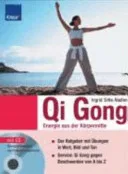
Qi Gong
 75
75

Qi Gong
Ingrid Sitte-Nadler’s "Qi Gong" offers a structured entry into a practice often presented through fragmented, contemporary lenses. The strength of this 2003 publication lies in its attempt to ground the reader in the historical and philosophical bedrock of Qi Gong, moving beyond mere exercise routines. It effectively delineates the core concepts of qi, jing, and shen, placing them within the context of Traditional Chinese Medicine. However, the work occasionally feels more like an academic survey than an experiential guide. While it meticulously explains the theoretical framework, the practical application of the exercises themselves could be more vividly described for a reader seeking immediate somatic engagement. A particularly illuminating section discusses the concept of 'meridians' as pathways for qi, underscoring the energetic anatomy that is central to the practice. Despite this slight imbalance, Sitte-Nadler provides a solid, informative foundation for understanding Qi Gong's enduring significance.
📝 Description
75
Ingrid Sitte-Nadler's 2002 book examines Qi Gong as a system for cultivating vital energy.
Ingrid Sitte-Nadler's work details Qi Gong, an ancient Chinese practice combining synchronized movements, breathing, and meditation. It functions as a system to cultivate and balance the body's vital energy, known as 'qi.' This discipline harmonizes mind, body, and spirit, going beyond mere physical exercise.
The book addresses foundational principles of Qi Gong, showing how these practices were historically integrated into daily life and spiritual cultivation. It is for individuals seeking a deeper understanding of mind-body connection beyond contemporary fitness trends. Those interested in traditional Chinese medicine, Taoist philosophy, and self-cultivation will find value here. Practitioners of related arts like Tai Chi may also benefit from the broader context provided.
Qi Gong's history spans millennia in China, stemming from shamanistic rituals, Taoist alchemy, and Buddhist meditation. Its development is linked to Traditional Chinese Medicine's view of health as balanced qi flow. While modern standardization occurred in the mid-20th century, Sitte-Nadler's text acknowledges its ancient origins and diverse historical manifestations.
This book positions Qi Gong within the broader context of internal alchemy and contemplative traditions originating in China. It touches upon the energetic principles central to Taoist cultivation and Buddhist meditation, practices aimed at refining the body and spirit. The text acknowledges the historical evolution from early shamanistic practices to more formalized systems intertwined with Traditional Chinese Medicine, highlighting Qi Gong's role in self-transformation and achieving a state of balanced vitality.
💡 Why Read This Book?
• Gain a foundational understanding of 'qi' as the vital life force, as explained through the historical context provided by Sitte-Nadler's research into ancient Chinese practices. • Learn about the interconnectedness of 'jing' (essence) and 'shen' (spirit) with 'qi,' a concept explored in detail, offering a holistic view of well-being beyond the physical. • Understand the distinction between 'Dong Gong' (moving exercises) and 'Jing Gong' (still exercises), providing a clearer framework for approaching different Qi Gong methodologies.
⭐ Reader Reviews
Honest opinions from readers who have explored this book.
❓ Frequently Asked Questions
When was Ingrid Sitte-Nadler's "Qi Gong" first published?
Ingrid Sitte-Nadler's "Qi Gong" was first published in 2003, offering a comprehensive look at the practice during that period.
What is the primary goal of Qi Gong as described in the book?
The book describes Qi Gong's primary goal as cultivating and balancing the body's vital energy, known as 'qi,' to harmonize mind, body, and spirit.
Does the book focus on the spiritual or physical aspects of Qi Gong?
The book aims to present a holistic view, integrating the physical movements and breathing with the underlying spiritual and philosophical principles of Qi Gong.
What are the 'meridians' mentioned in the context of Qi Gong?
Meridians are conceptual pathways within the body through which 'qi' is believed to flow, central to understanding the energetic anatomy in Qi Gong and Traditional Chinese Medicine.
Is this book suitable for complete beginners to Qi Gong?
Yes, the book is structured to provide a solid foundation, explaining core concepts and historical context, making it suitable for those new to the practice.
What is the relationship between Qi Gong and Traditional Chinese Medicine (TCM)?
The book explains that Qi Gong is deeply intertwined with TCM, as both view health through the lens of balanced qi flow and energetic harmony within the body.
🔮 Key Themes & Symbolism
Cultivating Vital Energy (Qi)
The central theme is the cultivation and balancing of 'qi,' the vital life force. Sitte-Nadler explores how various Qi Gong techniques, from gentle movements to focused breathing, are designed to enhance the flow of qi through the body's energetic pathways, known as meridians. This process is presented not just as a health practice but as a means of achieving greater vitality and spiritual alignment, drawing upon millennia of Chinese philosophical understanding of life energy.
Mind-Body Harmony
This work emphasizes the inseparability of the mind and body in achieving well-being. Qi Gong practices are depicted as tools for synchronizing mental focus with physical action and breath, fostering a state of integrated consciousness. By calming the mind and directing intention, practitioners can influence their physical state, leading to reduced stress, improved circulation, and a deeper sense of internal balance. This holistic approach is a hallmark of many esoteric traditions.
Historical Roots and Evolution
Sitte-Nadler situates Qi Gong within its rich historical context, tracing its lineage from ancient Taoist and Buddhist practices to its more recent standardization. Understanding this evolution is key to appreciating the depth and diversity of Qi Gong. The text highlights how the practice has been adapted and interpreted across different eras, offering insights into its enduring appeal and its role in Chinese culture and medicine.
Energetic Anatomy
A significant aspect explored is the concept of energetic anatomy, particularly the system of meridians. These are not physical structures but pathways through which qi is understood to flow. The book explains how specific postures, movements, and breathwork in Qi Gong are intended to clear blockages and optimize the circulation within these meridians, thereby influencing physical health and emotional equilibrium.
💬 Memorable Quotes
Direct passages from the work, attributed to the author.
“Qi is the fundamental energy that animates all life.”
— This statement captures the core tenet of Qi Gong and related philosophies, defining qi as the essential life force that permeates and drives existence, the understanding and cultivation of which is central to the practice.
“The practice aims to harmonize jing, qi, and shen.”
— This highlights the tripartite nature of human vitality as understood in traditional Chinese thought, where essence (jing), vital energy (qi), and spirit (shen) are interconnected components that must be balanced for optimal health and consciousness.
“Meridians serve as channels for the circulation of vital energy.”
— This explains the crucial concept of energetic pathways within the body, underscoring that Qi Gong's efficacy relies on promoting the smooth and unimpeded flow of qi through these specific, though not anatomically defined, channels.
“Stillness cultivates internal awareness.”
— This refers to the 'Jing Gong' or still practices within Qi Gong, suggesting that by quieting the body and mind, one can enhance introspection and a deeper connection to one's internal energetic state.
“Movement activates and directs the flow of qi.”
— This contrasts with stillness, focusing on the dynamic aspect of Qi Gong ('Dong Gong'), where coordinated physical actions are used to stimulate and guide the circulation of vital energy throughout the body.
🌙 Esoteric Significance
Tradition
Qi Gong is deeply rooted in Taoist traditions, emphasizing alignment with the natural order (the Tao) and the cultivation of internal energies (qi, jing, shen). It shares common ground with Buddhist meditation practices, particularly Chan (Zen) Buddhism, in its focus on mindfulness and present-moment awareness. Sitte-Nadler's work positions Qi Gong not just as a health system but as a path for spiritual cultivation, aligning with broader esoteric aims of achieving harmony between the microcosm (human body) and the macrocosm (universe).
Symbolism
Key symbols in Qi Gong include the 'meridian' system, representing the energetic pathways that are invisible yet crucial to life force flow, akin to subtle body concepts in other traditions. The interplay of 'yin and yang' is fundamental, governing the balance of opposing yet complementary forces within the body and the practice itself. The 'three treasures' – jing (essence), qi (vital energy), and shen (spirit) – are symbolic representations of the fundamental constituents of human existence that Qi Gong seeks to nurture and integrate.
Modern Relevance
Contemporary practices in mindfulness, somatic therapy, and integrated medicine often draw upon principles that echo Qi Gong's emphasis on mind-body connection and energy cultivation. Thinkers and practitioners in fields like holistic health, sports psychology, and even certain branches of psychotherapy implicitly or explicitly engage with concepts of energetic flow and mental-physical integration that Qi Gong has explored for centuries. Its principles continue to inform wellness retreats and personal development programs worldwide.
👥 Who Should Read This Book
• Individuals new to Eastern contemplative practices seeking a structured introduction to the foundational principles of Qi Gong, its history, and its energetic concepts. • Practitioners of other internal arts, such as Tai Chi or certain yoga styles, who wish to deepen their understanding of the energetic theories and philosophical underpinnings common to these disciplines. • Those interested in Traditional Chinese Medicine and holistic health who want to explore the self-cultivation aspects that complement diagnostic and treatment modalities.
📜 Historical Context
Published in 2003, Ingrid Sitte-Nadler's "Qi Gong" emerged during a period of increased global interest in Eastern contemplative and movement practices. While Qi Gong had been widely popularized and in some cases secularized in China from the 1950s onwards, Western audiences were increasingly seeking authentic, deeper understandings. Sitte-Nadler's work arrives as a counterpoint to purely fitness-oriented renditions, seeking to anchor the practice in its ancient Taoist and Buddhist philosophical roots. It engages with the intellectual currents of the time that explored holistic health and mind-body connections, often drawing parallels with Western concepts like bioenergetics but remaining rooted in its Chinese origins. This era saw scholars like Livia Kohn extensively documenting Taoist practices, and Sitte-Nadler's book fits within this broader academic and popular engagement with Chinese esoteric traditions.
📔 Journal Prompts
The concept of 'qi' as vital energy.
The interplay between 'Dong Gong' and 'Jing Gong' in your personal practice.
The significance of 'meridians' for energetic flow.
Balancing 'jing,' 'qi,' and 'shen' in daily life.
The role of 'yin and yang' in your own energetic states.
🗂️ Glossary
Qi
The fundamental vital life force or energy believed to animate all living things and permeate the universe. Its cultivation and balanced flow are central to Qi Gong.
Jing
Often translated as 'essence,' it refers to the fundamental generative and reproductive energy of the body, considered one of the three treasures. It is associated with physical vitality and form.
Shen
Referred to as 'spirit' or 'consciousness,' it is the third of the three treasures. Shen is associated with mental clarity, emotional balance, and spiritual awareness.
Meridians
Conceptual pathways or channels within the body through which qi is believed to circulate. They form an energetic map that influences health and well-being.
Dong Gong
Literally 'moving work,' referring to the dynamic forms of Qi Gong that involve synchronized movements and breath.
Jing Gong
Literally 'still work,' referring to the static or meditative forms of Qi Gong that focus on posture, breathing, and mental concentration.
Yin and Yang
The fundamental Taoist concept of dualistic, complementary, and interdependent forces that govern all phenomena in the universe, including the body's energetic balance.