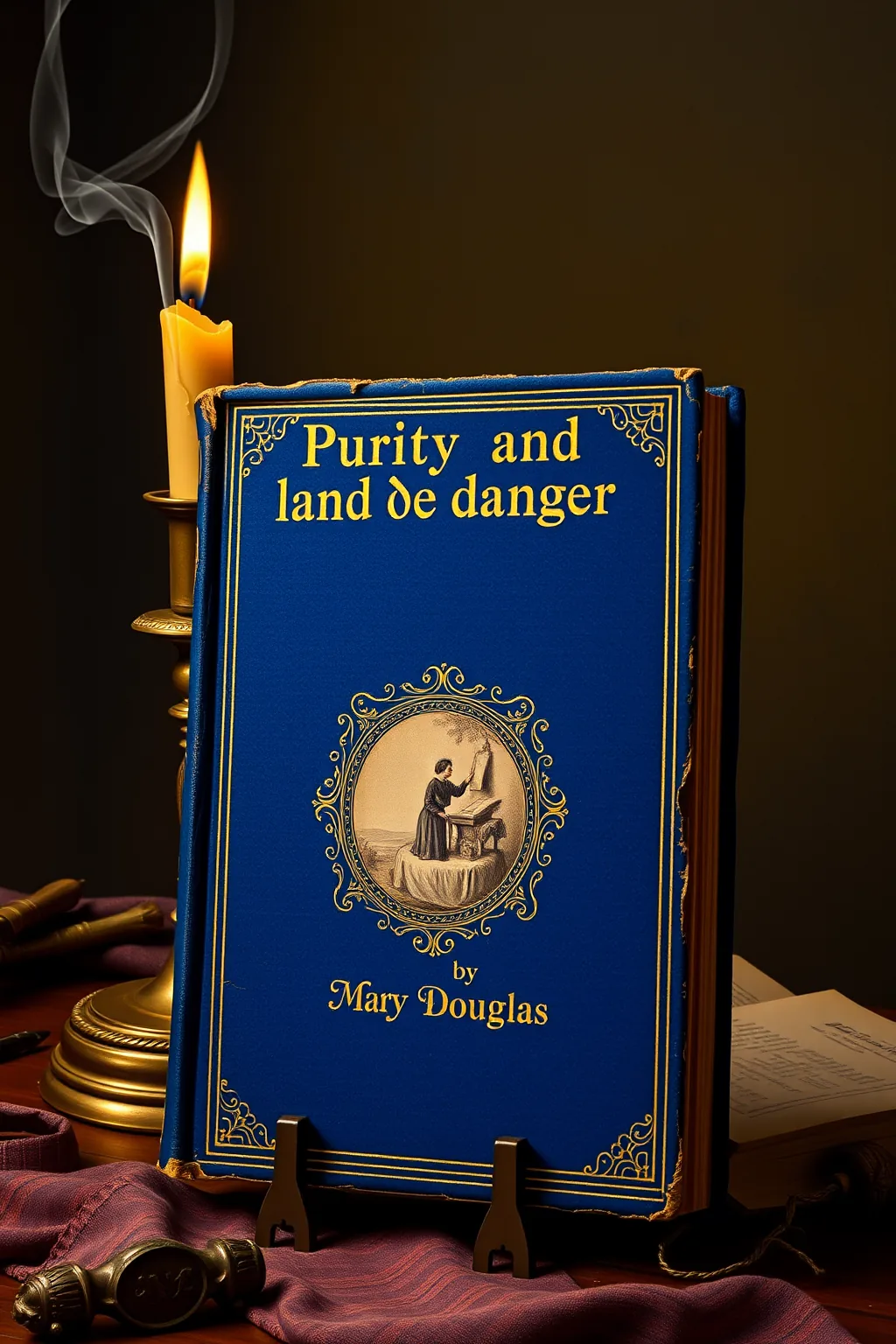
Purity and danger
 70
70

Purity and danger



Mary Douglas's 'Purity and Danger' remains an indispensable cornerstone for anyone serious about understanding the underpinnings of ritual and belief. Douglas's anthropological rigor, applied to the universal human concerns of what is deemed acceptable or anathema, provides a powerful framework for decoding sacred texts and occult practices. She brilliantly illustrates how concepts of purity and pollution are not merely arbitrary rules but fundamental mechanisms for constructing social reality and managing existential anxieties. This work offers invaluable insights for scholars of comparative religion, ritual studies, and esoteric traditions, illuminating the symbolic grammar that underpins seemingly disparate practices across cultures. It is a challenging yet immensely rewarding read for those seeking to grasp the profound psychological and sociological roots of religious and magical systems.
📝 Description
70
First published in 1966, Mary Douglas’s Purity and Danger examines how societies classify the pure and the impure.
Mary Douglas’s Purity and Danger analyzes the fundamental role of classification in creating social order. She argues that societies define themselves by what they deem pure and, by extension, what they consider dangerous or polluting. This process involves establishing boundaries, often through taboos, rituals, and sacrifices, to manage perceived disorder.
Douglas discusses how these classifications are not arbitrary but are deeply embedded in social structures and belief systems. She examines the symbolic language used to maintain these distinctions, showing how concepts of holiness, dirt, and anomaly help societies make sense of the world. The book connects these ideas to the human need to categorize and control the environment, revealing how social order is built on shared understandings of what belongs and what does not.
This work offers a framework for understanding the anxieties that arise when these boundaries are crossed. It shows how the management of the uncanny and the marginal is central to maintaining cultural norms and a sense of collective identity. Douglas’s analysis highlights the power of symbolic systems in shaping human experience and social cohesion.
While not strictly an esoteric text in the sense of occult practices, Purity and Danger resonates with esoteric traditions by examining the underlying symbolic structures that societies use to create meaning and order. It addresses the human impulse to discern sacred from profane, a concept central to many mystical paths. The book’s focus on ritual, impurity, and the management of the anomalous provides a lens through which to understand the symbolic logic that often underpins ritualistic traditions and the creation of sacred spaces and times found in various spiritual disciplines.
💡 Why Read This Book?
Uncover the hidden logic behind taboos and rituals that shape human societies and spiritual practices. 'Purity and Danger' offers a profound lens through which to understand the symbolic language of the sacred and profane. Ideal for seekers of esoteric knowledge, cultural anthropologists, and students of comparative religion interested in the deep structures of belief.
⭐ Reader Reviews
Honest opinions from readers who have explored this book.
❓ Frequently Asked Questions
What is the central thesis of 'Purity and Danger'?
The central thesis is that human societies create order by defining and categorizing, leading to the concepts of purity and pollution. What is anomalous or outside these categories becomes dangerous and must be ritually managed or expelled.
How does this book relate to esoteric studies?
It provides a foundational understanding of how purity, pollution, and taboo operate as universal symbolic systems, crucial for interpreting ritualistic practices, magical traditions, and the construction of sacred space in various esoteric paths.
Who is the intended audience for this book?
The book is intended for a broad audience interested in anthropology, sociology, religious studies, and philosophy, but its insights are particularly valuable for those exploring the symbolic and ritualistic dimensions of human culture and belief.
Does the book offer practical applications for magic or ritual?
While not a grimoire, it offers profound theoretical insights into the psychological and social functions of ritual and symbolic purity, which can inform and deepen a practitioner's understanding of their own practices.
What does Mary Douglas mean by 'danger' in the context of purity?
Danger refers to the threat posed by things that blur boundaries or defy classification, disrupting the social and symbolic order. This perceived threat necessitates rituals and taboos to maintain a sense of control and coherence.
🔮 Key Themes & Symbolism
The Anthropology of Pollution and Purity
Douglas examines how societies classify the world, establishing boundaries between the pure and the impure. This classification system is not arbitrary but deeply embedded in social structures and moral codes, dictating what is sacred, what is profane, and what must be avoided. The concept of pollution is intrinsically linked to the transgression of these boundaries, representing a threat to the established order. Understanding this framework is crucial for deciphering the symbolic logic of ritual, taboo, and the management of perceived disorder across diverse cultures, offering a clear insights into the human condition.
The Nature of Taboo and Social Order
Taboos are presented not as mere prohibitions but as vital mechanisms for maintaining social cohesion and cosmic order. They arise from the inherent human need to create structure and meaning in a potentially chaotic universe. By identifying and enforcing taboos, societies define their collective identity and moral compass. Douglas reveals how these prohibitions, often concerning bodily functions, death, or the sacred, serve to reinforce social hierarchies and manage anxieties about the unknown, making them central to both secular and spiritual governance.
Ritual as a Means of Managing Ambiguity
Ritual is explored as the primary means by which societies confront and neutralize the 'danger' inherent in ambiguous or anomalous phenomena. Through acts of purification, sacrifice, and symbolic transformation, rituals restore order, reaffirm boundaries, and reintegrate individuals or communities into the social fabric. Douglas demonstrates how these performative actions are not simply symbolic gestures but powerful tools for shaping perception, reinforcing beliefs, and working through the liminal spaces between the known and the feared, thus playing a critical role in spiritual and cultural continuity.
💬 Memorable Quotes
Direct passages from the work, attributed to the author.
“There can be no society without risk.”
— This statement underscores the fundamental link between societal existence and inherent dangers, both physical and existential, which social structures and beliefs attempt to mitigate.
“Dirt is matter out of place.”
— A concise definition highlighting that dirt is not an intrinsic quality but a relational one, defined by its context and deviation from an established order.
“The body is a model which sanctions social reality.”
— This insight connects the physical human body, with its natural processes, to the broader societal structures and moral codes that govern human behavior and perception.
“We are bound to find the danger of pollution in the body.”
— This points to the inherent association of the physical body, with its biological functions, as a primary site for the conceptualization and experience of purity and pollution.
💡 Key Ideas
Editorial paraphrase of the work's core concepts — not direct quotes.
The danger which is identified with the social system is not a danger of pollution but of dissolution.
This quote distinguishes between the ritualistic fear of contamination and the more profound societal fear of disintegration and loss of collective identity.
🌙 Esoteric Significance
Tradition
While not directly tied to a single esoteric tradition, Douglas's work provides a universal grammar for understanding the symbolic underpinnings of many esoteric paths. Her analysis of purity, pollution, and taboo speaks to the foundational principles found in Hermeticism, Kabbalah, alchemy, and shamanic practices, where the manipulation of symbolic boundaries and the management of energies are paramount for spiritual transformation and achieving higher states of consciousness.
Symbolism
Key symbols explored include the body itself (as a microcosm and site of purity/pollution), boundaries (physical and conceptual), anomalies (things out of place), and the transformative power of ritual. These symbols are not mere representations but active forces in maintaining or disrupting cosmic and social order, forming the symbolic language through which spiritual truths and hidden dangers are communicated and managed within esoteric frameworks.
Modern Relevance
In an era often characterized by information overload and blurred boundaries, Douglas's insights into order, classification, and the management of perceived threats remain remarkably relevant. Her work offers a framework for understanding contemporary anxieties surrounding identity, social cohesion, and the digital realm, and provides tools for critically examining the symbolic systems that govern our modern lives and spiritual quests.
👥 Who Should Read This Book
This important work is essential for serious students of cultural anthropology and comparative religion, offering a foundational understanding of how societies construct meaning. Seekers of esoteric knowledge will find it useful for decoding the symbolic language of rituals and taboos found in various mystical traditions. Practitioners of magic and ritual will gain a deeper theoretical appreciation for the psychological and social underpinnings of their practices. Academics and philosophers will benefit from its rigorous analysis of human cognition and social organization, while general readers interested in the profound forces that shape human belief systems will find it an clear and thought-provoking read.
📜 Historical Context
Published in 1966, Mary Douglas's 'Purity and Danger' emerged during a period of significant intellectual ferment in anthropology, moving beyond functionalism towards structuralism and symbolic analysis. The post-war era saw a growing interest in the 'primitive mind' and the universal structures of human thought. Douglas's work challenged prevailing notions by positing that seemingly irrational beliefs about purity and pollution held profound social and cognitive logic. It responded to Lévi-Strauss's structuralist approach, offering a more nuanced understanding of how classification systems, particularly concerning the body and the sacred, shape social order and individual experience. The book's impact resonated across disciplines, influencing sociology, religious studies, and even literary theory, by providing a powerful analytical tool for understanding cultural meaning-making.
📔 Journal Prompts
Identify a personal 'taboo' and explore its origins and purpose in your life.
Analyze a recent experience of 'pollution' (social, spiritual, or physical) and how it was resolved.
How do contemporary societal boundaries reflect the concepts of purity and danger discussed by Douglas?
Reflect on a ritual you participate in and how it relates to maintaining order or managing ambiguity.
Consider an object or idea that is considered 'anomalous' in your culture and the 'danger' it is perceived to represent.
🗂️ Glossary
Purity
In Douglas's context, purity signifies a state of wholeness, integrity, and conformity to an established order or category. It is the opposite of pollution and is often associated with the sacred and the well-formed.
Danger
The threat posed by that which is anomalous, ambiguous, or outside established classifications. It is the potential disruption of the social and symbolic order, often associated with pollution and the breakdown of boundaries.
Pollution
The state of being contaminated, defiled, or rendered impure by contact with things that transgress established categories or boundaries. It signifies a threat to the integrity of the social or symbolic order.
Taboo
A prohibition or restriction imposed on certain actions, objects, or people, often based on beliefs about purity, danger, or sacredness. Taboos serve to maintain social order and reinforce classifications.
Anomalous
Deviating from what is standard, normal, or expected. In Douglas's theory, anomalous things are often perceived as dangerous because they blur boundaries and challenge established categories.
This book appears in 2 collections
🔮 Readers Also Liked
Browse all →







More by Mary Douglas
All books →
From the “Ritual Magic” Collection
View all →







More Free Magic & Ritual Books
View all →