Psychic Cop
 78
78

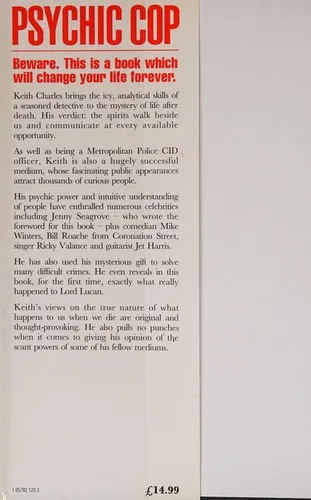
Psychic Cop
Keith Charles and Derek Shuff's 'Psychic Cop' offers a gritty, albeit unsubstantiated, look at alleged psychic phenomena within the police force. The strength of the book lies in its direct, no-nonsense narrative style, which attempts to frame extraordinary claims within the mundane reality of criminal investigation. It avoids overly spiritual jargon, presenting purported psychic events as practical, albeit unusual, tools. However, the work's primary limitation is its reliance on anecdotal evidence without rigorous verification; the claims of precognition and telepathy are presented as fact without independent corroboration, making it a fascinating read for the credulous but a challenging one for the skeptical. A particularly striking aspect is the detailed recounting of how psychometry was allegedly used to identify suspects or locate evidence, illustrating the book's commitment to showcasing the practical application of its central thesis. Ultimately, 'Psychic Cop' functions more as a collection of intriguing personal testimonies than a definitive exploration of psychic science.
📝 Description
78
Published in 1995, 'Psychic Cop' details purported psychic experiences within law enforcement investigations.
Keith Charles and Derek Shuff's 1995 book, 'Psychic Cop,' chronicles their experiences blending police work with extrasensory perception. The authors recount alleged instances where precognition, telepathy, and psychometry played a role in criminal investigations. The book documents these unusual events, bridging the gap between the empirical reality of policing and the esoteric nature of psychic abilities.
This work is for readers interested in the edges of parapsychology, true crime stories with a paranormal dimension, and the potential real-world use of psychic phenomena. It will appeal to those who question conventional understanding and are open to anecdotal evidence of the supernatural. Anyone curious about the psychological or spiritual sides of crime-solving, or who enjoys accounts of psychic investigations, will find material here.
Emerging in 1995, 'Psychic Cop' arrived during a period of public interest in paranormal phenomena, following earlier spiritualist and New Age movements. The 1990s saw psychic abilities popularized through media, though mainstream science remained skeptical. The book distinguished itself by grounding psychic claims in the concrete framework of police work. It engaged with a cultural moment where concepts like psychic forensics were gaining traction in niche circles, even as academic fields prioritized empirical evidence.
💡 Why Read This Book?
• Gain insight into purported uses of psychometry in criminal investigations, as detailed in the book's case studies, offering a unique perspective on object-based intuition. • Explore anecdotal accounts of precognition within law enforcement, providing specific examples from the 1995 publication context that challenge conventional notions of foresight. • Understand the challenges and reception of alleged telepathic communication in a structured environment like a police department, as described through the authors' experiences.
⭐ Reader Reviews
Honest opinions from readers who have explored this book.
❓ Frequently Asked Questions
What year was 'Psychic Cop' first published?
'Psychic Cop' was first published in 1995, positioning it within a period of popular interest in paranormal topics.
Who are the authors of 'Psychic Cop'?
The authors are Keith Charles and Derek Shuff. Their combined experiences form the basis of the narratives presented in the book.
What is psychometry as discussed in 'Psychic Cop'?
In 'Psychic Cop', psychometry refers to the alleged ability to gain information about an object's history or owner through touch, a concept explored in the book's investigative accounts.
Does 'Psychic Cop' offer scientific proof of psychic abilities?
No, 'Psychic Cop' primarily presents anecdotal evidence and personal experiences rather than scientific proof or peer-reviewed studies of psychic phenomena.
What kind of cases are discussed in 'Psychic Cop'?
The book discusses various criminal investigation scenarios where the authors claim psychic abilities, such as precognition and telepathy, played a role in solving cases.
Is 'Psychic Cop' considered a factual account or fiction?
'Psychic Cop' is presented as a non-fiction account of the authors' experiences, though the veracity of the alleged psychic phenomena remains a subject of interpretation.
🔮 Key Themes & Symbolism
Psychic Perception in Policing
The book centers on the assertion that psychic abilities, such as precognition and telepathy, can be utilized within the practical framework of criminal investigations. It posits that these extrasensory perceptions are not merely theoretical concepts but have been allegedly employed to gather clues, identify suspects, or foresee criminal actions. The authors aim to demonstrate how such phenomena, when experienced or recognized, can offer unique avenues for inquiry that traditional investigative methods might miss, blending the seemingly disparate worlds of the occult and law enforcement.
Anecdotal Evidence and Belief
'Psychic Cop' heavily relies on anecdotal accounts to support its claims, presenting personal testimonies as primary evidence. The narrative encourages readers to consider the validity of these experiences, even in the absence of empirical scientific validation. This approach invites contemplation on the nature of belief and evidence, particularly when dealing with phenomena that lie outside conventional understanding. The book functions as a collection of purported real-life incidents, urging acceptance based on the lived experiences of the authors and those they recount.
The Nature of Intuition
Beyond overt psychic phenomena, the work examines the broader concept of intuition as it applies to investigative work. It suggests that heightened intuition, whether explained through psychic means or simply advanced pattern recognition and subconscious processing, plays an important role in successful policing. The book explores how gut feelings, sudden insights, or 'hunches' can guide officers towards critical breakthroughs, framing these as potentially more than just psychological phenomena, but as traces of deeper, perhaps extrasensory, awareness.
Bridging the Mundane and Esoteric
A central theme is the attempt to bridge the gap between the rational, empirical world of police work and the esoteric domain of psychic abilities. The book argues that these realms are not mutually exclusive, and that psychic phenomena can manifest and be useful within the structured environment of law enforcement. It challenges the reader to reconsider the boundaries of what is considered possible, presenting the authors' experiences as evidence that the supernatural or paranormal can intersect with and influence everyday reality, even in the context of crime.
💬 Memorable Quotes
Direct passages from the work, attributed to the author.
“The object whispered its secrets to my hands.”
— This phrase captures the essence of psychometry as described in the book, where the act of touching an item allegedly yields direct, almost sentient, information about its past or owner.
“I saw the event before it happened, a flicker in the mind's eye.”
— This highlights the concept of precognition, presenting it as a sudden, visual premonition that offers a glimpse into future occurrences relevant to an investigation.
“His thoughts were a clear broadcast, received without sound.”
— This illustrates the purported experience of telepathy, where mental communication is perceived directly, bypassing conventional sensory channels.
“The badge meant duty, but the gift meant seeing beyond.”
— This expresses the internal conflict and dual role of the psychic officer, balancing professional responsibilities with extraordinary personal perceptions.
“Evidence isn't always found in files; sometimes it's felt in the air.”
— This statement underscores the book's core argument: that information crucial to solving crimes can be perceived through non-traditional, intuitive, or psychic means.
🌙 Esoteric Significance
Tradition
The work doesn't align strictly with a single esoteric tradition but draws implicitly from the broader Western Esoteric landscape, particularly modern spiritualism and New Age thought, which often explored psychic abilities as inherent human potentials. It departs from more formalized traditions like Hermeticism or Kabbalah by focusing on raw, often unrefined, psychic experiences rather than structured systems of magic or cosmology. Its significance lies in presenting these phenomena through a pragmatic, secular lens, attempting to integrate them into a conventionally rational profession.
Symbolism
The primary 'symbol' is the object itself in psychometry, which acts as a conduit for information, representing the interconnectedness of all things and the idea that energy or memory can be imprinted. Another motif is the 'flicker in the mind's eye' representing precognition, symbolizing fleeting glimpses of destiny or potential futures. The 'clear broadcast' of telepathy symbolizes direct, unmediated consciousness, a state often sought in various meditative and mystical practices as a means of transcending individual limitations.
Modern Relevance
Contemporary interest in intuition, mindfulness, and expanded consciousness in fields ranging from psychology to business leadership echoes themes in 'Psychic Cop'. While not directly cited, the book’s exploration of practical psychic application appeals to modern 'manifestation' and 'law of attraction' communities, albeit from a more grounded, investigative perspective. Thinkers exploring the intersection of consciousness and reality, or practitioners in energy healing modalities, might find parallels in its portrayal of subtle energies and non-local awareness.
👥 Who Should Read This Book
• True crime enthusiasts intrigued by unconventional investigative techniques, offering a glimpse into alleged psychic contributions to case-solving. • Parapsychology students and researchers interested in anecdotal accounts of precognition and telepathy, providing case studies from the 1990s. • Skeptics and open-minded readers curious about the intersection of psychic phenomena and practical, real-world applications like law enforcement.
📜 Historical Context
Published in 1995, 'Psychic Cop' emerged during a period when paranormal phenomena continued to hold public fascination, fueled by popular culture and a growing interest in New Age philosophies. The mid-1990s saw continued exploration of topics like remote viewing and psychic detective work, though mainstream scientific discourse remained largely dismissive. Works like 'Psychic Cop' occupied a niche, attempting to ground these esoteric claims within the concrete, often gritty, reality of law enforcement. This approach distinguished it from purely spiritual or metaphysical texts, positioning it as a bridge between the unexplained and the procedural. While figures like Uri Geller had already popularized psychic demonstrations decades prior, the 1995 publication placed Charles and Shuff's work within a contemporary context of alleged practical applications, contrasting with the more academic parapsychology research often conducted at institutions like Duke University.
📔 Journal Prompts
Reflect on the concept of psychometry and its potential implications for understanding the history of objects.
Consider the narrative of precognition presented and its contrast with linear time.
Analyze the challenges of integrating purported telepathic communication into a structured professional environment.
Explore the authors' perspective on intuition versus overt psychic ability in investigations.
Examine the blend of the mundane and the esoteric in the presented case studies.
🗂️ Glossary
Precognition
The alleged ability to perceive or know future events before they happen, often experienced as visions, feelings, or premonitions.
Telepathy
The purported direct communication of thoughts or mental states between individuals without the use of the normal senses.
Psychometry
The alleged psychic ability to gain information about an object, person, or event by touching the object.
Extrasensory Perception (ESP)
A general term for purported perception that occurs independently of the known senses, encompassing telepathy, clairvoyance, and precognition.
Intuition
The ability to understand something immediately, without the need for conscious reasoning; in this context, potentially linked to psychic awareness.
Esoteric
Intended for or likely to be understood by only a small number of people with a specialized knowledge or interest; relating to the occult.
Anecdotal Evidence
Evidence based on personal accounts rather than on investigation or research; often subjective and lacking scientific rigor.
🔮 Readers Also Liked
Browse all →









More Free Occult Philosophy Books
View all →