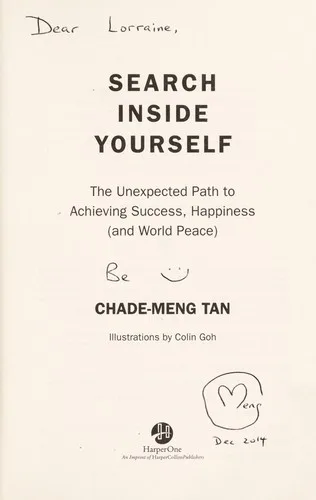
Search inside yourself
 76
76

Search inside yourself
Chade-Meng Tan's "Search Inside Yourself" offers a refreshing, no-nonsense approach to inner development, particularly for those wary of overt spirituality. Its strength lies in its pragmatic, Silicon Valley-informed methodology, presenting mindfulness not as an arcane practice but as a skill to be engineered. The concept of "Artificial Intelligence for the Inner World" is a clever framing device, making complex ideas digestible. However, its very pragmatism can sometimes feel a touch clinical, occasionally stripping away the deeper, more mysterious dimensions often associated with inner work. The section on "Emotional Knowing," while practical, could benefit from a more nuanced exploration of the inherent paradoxes within human feeling. Ultimately, the book serves as an excellent primer for cultivating basic emotional intelligence and self-awareness in a secular context.
📝 Description
76
Chade-Meng Tan's 2012 book translates mindfulness principles into practical steps.
Originally developed as internal training at Google, Chade-Meng Tan's "Search Inside Yourself" presents a structured method for cultivating inner peace and emotional intelligence. The book breaks down complex ideas into actionable techniques, making them accessible for everyday life. Tan's central idea is that understanding and managing one's own mind forms the basis for personal happiness and effective interaction with others. It is designed for people seeking a practical path to personal growth, especially those who find traditional spiritual or self-help books too abstract. Professionals looking to improve focus, lessen stress, and build better relationships will find value here, as will anyone interested in applying mindfulness in secular contexts.
Published in 2012, "Search Inside Yourself" arrived as secular interest in mindfulness and contemplative practices grew, particularly in tech circles. Tan's work integrated these ideas into a corporate setting, drawing on neuroscience and psychology that affirmed meditation's benefits. His approach, framed as 'Artificial Intelligence for the Inner World,' uses systematic methods to understand and refine emotional responses. This application of rational frameworks to inner states echoes historical movements that sought to systematize spiritual or psychological development, though Tan's is notably grounded in modern corporate training.
💡 Why Read This Book?
• Learn the "Two-Brain" model to understand how your rational and emotional minds interact, a concept first systematically applied in corporate settings at Google. • Acquire practical "Mindfulness" techniques, directly derived from contemplative traditions but presented as applicable skills for daily stress reduction and focus. • Explore "Emotional Knowing" and "Emotional Mastery" to develop a more scientific and manageable approach to understanding and regulating your own feelings, a core tenet of Tan's program.
⭐ Reader Reviews
Honest opinions from readers who have explored this book.
❓ Frequently Asked Questions
What is the "Two-Brain" concept in Search Inside Yourself?
The "Two-Brain" concept refers to the distinction between the rational mind (responsible for logic and analysis) and the emotional mind (governing feelings and instincts). Tan uses this to explain how to achieve better emotional intelligence and self-awareness, a key part of his 2012 book.
How does Search Inside Yourself apply mindfulness to the workplace?
The book presents mindfulness as a practical skill for enhancing focus, reducing stress, and improving communication, specifically tailored for professional environments. It was developed from training programs at Google, aiming to boost employee well-being and productivity.
What is "Emotional Knowing" according to Chade-Meng Tan?
"Emotional Knowing" in Tan's framework is the ability to recognize, understand, and label one's own emotions accurately. It's a foundational step toward achieving "Emotional Mastery," as outlined in his 2012 book for cultivating inner peace.
Is Search Inside Yourself a spiritual book?
While drawing on contemplative traditions like Buddhism, "Search Inside Yourself" is framed as a secular, practical guide to emotional intelligence. Its focus is on actionable techniques for personal development, not religious doctrine.
When was Search Inside Yourself first published?
Chade-Meng Tan's "Search Inside Yourself" was first published in 2012, aiming to bring principles of mindfulness and emotional intelligence to a broader audience, especially within the corporate world.
What does "Artificial Intelligence for the Inner World" mean in the book?
This metaphor suggests applying systematic, rational, and intelligent methods to understand and manage one's inner emotional life, much like developing artificial intelligence for external tasks. It’s a central idea in Tan's 2012 work.
🔮 Key Themes & Symbolism
Mindfulness as Applied Skill
Tan frames mindfulness not as a mystical pursuit but as a trainable skill akin to learning a new technology. He details exercises for cultivating present-moment awareness, emphasizing its utility in a professional setting. This secularization makes contemplative practices accessible, moving them from monastery to the modern office, a key innovation since the early 2000s when such ideas began entering corporate wellness.
Emotional Intelligence Framework
The book systematically breaks down emotional intelligence into components like "Emotional Knowing" (self-awareness of feelings) and "Emotional Mastery" (regulating those feelings). This structured approach, reminiscent of engineering principles, provides concrete steps for readers to develop self-understanding and improve interpersonal interactions, directly challenging the notion that emotions are inherently chaotic.
Inner Peace as an Engineering Problem
Tan's central thesis treats the cultivation of inner peace and happiness as a problem that can be solved through intelligent design and systematic application. By using metaphors like "Artificial Intelligence for the Inner World," he explains complex psychological and contemplative concepts, making them approachable for a pragmatic, results-oriented audience, a significant departure from traditional introspective methods.
The Two-Brain Model
This conceptual model differentiates between the analytical, logical brain and the emotional, instinctual brain. Understanding this duality, as presented in Tan's work, is crucial for navigating internal conflicts and developing a more integrated sense of self. It provides a cognitive map for readers to better comprehend their own reactions and make conscious choices, a concept gaining traction in popular psychology since the late 20th century.
💬 Memorable Quotes
Direct passages from the work, attributed to the author.
“The ultimate goal of the practice is to find happiness.”
— This statement distills the entire aim of the book's techniques. It posits that mindfulness and emotional intelligence are not ends in themselves, but tools designed to achieve a state of genuine well-being and contentment in life.
“The practice of mindfulness is the practice of paying attention.”
— This highlights the fundamental simplicity of mindfulness as presented by Tan. It emphasizes that the core of the practice lies not in complex rituals but in the deliberate act of focusing one's awareness on the present moment.
“The ability to be happy is a skill.”
— This reframes happiness from a passive state to an active, learnable ability. It empowers the reader by suggesting that through dedicated practice and the application of specific techniques, one can cultivate lasting happiness.
“If you want to change the world, you have to change yourself first.”
— This is a call to personal responsibility and internal transformation as the prerequisite for external impact. It underscores the book's core message that individual self-mastery is the foundation for creating positive change in the wider world.
💡 Key Ideas
Editorial paraphrase of the work's core concepts — not direct quotes.
We want to achieve world peace, but world peace can only be achieved by inner peace.
This quote establishes a direct link between individual internal states and the broader external world. It suggests that genuine peace and harmony in society begin with cultivating tranquility and understanding within oneself.
🌙 Esoteric Significance
Tradition
While not strictly adhering to a single esoteric lineage, "Search Inside Yourself" draws heavily from Buddhist contemplative traditions, particularly Vipassanā meditation, and integrates principles akin to Stoic philosophy regarding emotional regulation. It secularizes these practices, stripping away religious dogma to present them as universally applicable psychological tools, a common trend in modern "esotericism lite" movements aiming for broader appeal.
Symbolism
The book uses the metaphor of "Artificial Intelligence for the Inner World" as a central symbolic concept, representing the systematic, logical application of techniques to the subjective realm. Another implicit symbol is the "Two Brains" model, illustrating the duality of human consciousness—rational versus emotional—which readers are encouraged to harmonize, echoing ancient alchemical ideas of integrating opposing forces.
Modern Relevance
Tan's work is highly relevant today, influencing contemporary corporate wellness programs, leadership training, and the burgeoning field of "applied neuroscience." Thinkers and practitioners in positive psychology, emotional intelligence coaching, and even certain branches of secular Buddhism echo his emphasis on practical, evidence-based techniques for well-being and peak performance.
👥 Who Should Read This Book
• Professionals in high-stress environments seeking practical tools to manage anxiety and improve focus, directly benefiting from the "Mindfulness" techniques developed for Google. • Individuals curious about applying contemplative principles without engaging with religious doctrine, appreciating the "Emotional Knowing" framework as a secular path to self-understanding. • Leaders and managers aiming to enhance team dynamics and cultivate a more positive workplace culture, leveraging the "Emotional Mastery" concepts for better interpersonal skills.
📜 Historical Context
Chade-Meng Tan's "Search Inside Yourself," released in 2012, arrived at an important moment for the secularization of mindfulness and contemplative practices. The early 21st century saw a surge of interest in neuroscience and psychology exploring the tangible benefits of meditation, moving it from esoteric circles into mainstream discourse. Tan's work was particularly significant for its origin within Google, a leading tech company, making it a prime example of the "mindfulness in the workplace" movement gaining momentum. This contrasted with earlier, more overtly spiritual explorations of consciousness prevalent in movements like Transcendental Meditation in the mid-20th century. While figures like Jon Kabat-Zinn had already popularized secular mindfulness with MBSR (Mindfulness-Based Stress Reduction) in the 1970s, Tan's approach offered a distinct "engineering" perspective, resonating strongly with a tech-oriented demographic. The book's reception was largely positive, cementing the idea that emotional intelligence and inner peace could be systematically developed.
📔 Journal Prompts
Your "Two-Brain" model integration: Identify a recent situation where your rational and emotional minds conflicted.
Mindfulness practice: Describe a moment you successfully applied present-moment awareness to a challenging task.
Emotional Knowing exercise: List three emotions you frequently experience and their common triggers.
Emotional Mastery goal: What is one specific emotional response you wish to manage more effectively?
Happiness skill: Reflect on a small, deliberate action you can take today to cultivate your own happiness.
🗂️ Glossary
Mindfulness
The practice of paying attention to the present moment, non-judgmentally. In Tan's context, it's a skill developed through specific exercises to improve focus and self-awareness.
Two-Brain Model
A conceptual framework distinguishing between the rational mind (logic, analysis) and the emotional mind (feelings, instinct), positing that understanding their interaction is key to emotional intelligence.
Emotional Knowing
The ability to accurately recognize, identify, and label one's own emotions as they arise.
Emotional Mastery
The skill of effectively managing one's emotions, including understanding their causes and regulating responses to maintain inner peace and well-being.
Artificial Intelligence for the Inner World
Tan's metaphor for applying systematic, intelligent, and rational methods to understand and cultivate one's inner emotional landscape and achieve happiness.
Happiness
Presented not as a fleeting emotion but as a skill that can be cultivated through practice, mindfulness, and emotional intelligence.
Compassion
An essential component of emotional mastery, involving understanding and care for oneself and others, fostering connection and reducing suffering.
🔮 Readers Also Liked
Browse all →









More Free Occult Philosophy Books
View all →