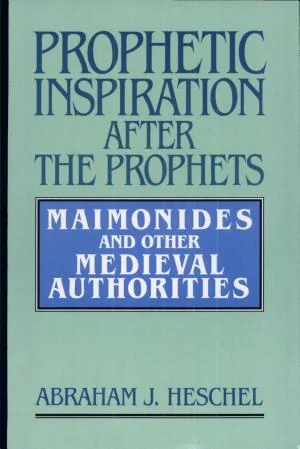
Prophetic Inspiration After the Prophets
 71
71

Prophetic Inspiration After the Prophets
Heschel’s scholarly rigor is evident in "Prophetic Inspiration After the Prophets," particularly in his meticulous examination of medieval Jewish texts. He effectively challenges the monolithic view that prophecy ceased abruptly, presenting a compelling case for its continuation in subtler forms. The strength of this work lies in its detailed exploration of figures often overlooked in broader discussions of Jewish thought, bringing their complex ideas about divine inspiration into sharper relief. A limitation, however, is the density of the academic prose, which, while necessary for scholarly accuracy, may prove challenging for readers unfamiliar with medieval Hebrew philosophical discourse. Heschel’s argument regarding the medieval perception of prophecy, particularly how it was reinterpreted rather than wholly abandoned, is particularly striking. This book is a crucial corrective for understanding the dynamic nature of prophetic belief within Jewish tradition.
📝 Description
71
Abraham Joshua Heschel's 1996 work revisits Jewish understandings of prophecy after the biblical era.
Abraham Joshua Heschel’s "Prophetic Inspiration After the Prophets" challenges the common notion that prophecy ceased entirely with the biblical prophets. Published in 1996, this collection of Heschel's scholarship argues that a transformed experience of prophetic inspiration persisted within Jewish intellectual history. He meticulously examines medieval Jewish thinkers who maintained this belief, presenting their views on divine communication.
The book is for scholars of Jewish theology and history, students of religious thought, and anyone interested in the evolution of mystical and prophetic traditions. It appeals to readers who question established doctrines and seek a deeper understanding of how spiritual experiences are interpreted and perpetuated across historical epochs. Those interested in the reception of prophecy beyond its classical era will find substantial material here.
Heschel’s research focuses on the Middle Ages, a period when Jewish philosophy and mysticism were actively reinterpreting foundational texts. His work engages with intellectual currents that sought to preserve or adapt the concept of divine communication in a post-prophetic era, contrasting with the prevailing scholarly consensus that prophecy concluded with figures like Malachi.
This book engages with the tradition of Jewish mysticism and philosophy, particularly the Kabbalah, which often grappled with the nature and transmission of divine knowledge beyond explicit scriptural revelation. Heschel investigates how medieval thinkers within these traditions conceptualized spiritual experiences and divine communication in the absence of overt prophecy, seeking to understand the continuity of inspired states and their interpretation within a post-prophetic framework. It situates itself within the intellectual history of Judaism, examining how esoteric concepts were adapted and understood across centuries.
💡 Why Read This Book?
• Gain insight into the medieval Jewish debate on prophecy, learning how scholars like Abraham ibn Ezra discussed divine inspiration long after the classical prophets, a concept often overlooked in standard theological histories. • Understand Heschel's rigorous methodology, appreciating how he reconstructs arguments from scattered Hebrew articles to demonstrate a sustained belief in prophetic possibilities within the medieval era. • Explore the concept of 'ruach ha-kodesh' (holy spirit) as a form of continuing divine guidance, as examined by Heschel, offering a nuanced view of spiritual experience beyond explicit prophetic utterances.
⭐ Reader Reviews
Honest opinions from readers who have explored this book.
❓ Frequently Asked Questions
Did prophecy truly end with the ancient prophets according to Heschel?
Heschel argues that the traditional view of prophecy ending entirely with the biblical prophets is not wholly accurate. He demonstrates that medieval Jewish scholars debated and believed in the possibility of continued prophetic inspiration, though perhaps in a transformed manner.
What is the significance of Heschel's research into Hebrew articles?
Much of Heschel's research on medieval views of prophecy existed only in Hebrew articles. This book makes that scholarship accessible, revealing a more complex understanding of prophecy's persistence than previously recognized by many.
Who were the main figures Heschel discusses regarding post-prophetic inspiration?
While the book focuses on the broader intellectual current, Heschel's work engages with the ideas of medieval Jewish scholars and mystics who grappled with the concept of divine inspiration after the era of biblical prophets.
What is the standard Jewish view on the end of prophecy Heschel challenges?
The standard view, particularly within Rabbinic Judaism, is that prophecy ceased with the ancient prophets, typically dated to the early Second Temple era. Heschel's work questions the universality and strictness of this cessation.
Is this book about modern prophecy or ancient prophets?
The book focuses on the intellectual history of belief in prophetic inspiration *after* the era of the ancient biblical prophets, specifically examining medieval Jewish thought on the subject.
What is 'nevu'ah' in the context of Heschel's study?
'Nevu'ah' is the Hebrew term for prophecy. Heschel analyzes how this concept, and the possibility of experiencing it, was understood and debated by Jewish scholars during the Middle Ages.
🔮 Key Themes & Symbolism
The Persistence of Nevu'ah
Heschel meticulously reconstructs arguments from medieval Jewish thinkers who, contrary to the prevailing view, believed that prophetic inspiration, or 'nevu'ah,' did not entirely cease with the biblical prophets. This theme explores how figures like Maimonides and later mystics conceived of divine communication continuing, albeit in altered forms, challenging the rigid timeline of prophecy's end.
Medieval Jewish Intellectual Currents
The work explores the complex philosophical and theological field of the Middle Ages, examining how Jewish scholars grappled with the implications of prophecy's perceived cessation. It highlights the internal debates and reinterpretations surrounding divine guidance, prophecy, and the role of the 'yetzer hara' in impeding spiritual connection.
Reinterpreting Divine Communication
This theme centers on the nuanced ways medieval thinkers understood spiritual experiences after the classical prophetic period. Heschel illustrates how concepts like 'ruach ha-kodesh' (holy spirit) and prophetic dreams were analyzed, suggesting a continuity of divine-human interaction that extended beyond the pronouncements of recognized prophets.
Scholarly Methodology
A significant aspect is Heschel's groundbreaking approach to piecing together arguments from scattered Hebrew sources. This theme underscores the importance of diligent textual analysis in uncovering overlooked traditions and challenging established historical narratives within religious scholarship.
💬 Memorable Quotes
Direct passages from the work, attributed to the author.
“The standard view is that prophecy ended early in the Second Temple era.”
— This statement captures the traditional Jewish understanding that Heschel aims to complicate. It sets the stage for his exploration of how this widely accepted endpoint was, in fact, a subject of ongoing debate and reinterpretation among medieval scholars.
“Belief in the possibility of continued prophetic inspiration.”
— This phrase points to the central thesis Heschel supports, revealing that the capacity for divine inspiration was considered a living possibility by many medieval Jewish thinkers, even if it differed from ancient prophecy.
“His studies of prophetic inspiration among Jewish scholars of the Middle Ages.”
— This points to the specific focus of Heschel's scholarship – not the biblical prophets themselves, but the intellectual tradition that followed, particularly how medieval scholars engaged with the concept of prophecy.
“These articles were written in Hebrew.”
— This factual detail underscores a primary reason Heschel's research remained obscure for so long. It emphasizes the linguistic and scholarly barrier his work overcomes by synthesizing these difficult-to-access sources.
💡 Key Ideas
Editorial paraphrase of the work's core concepts — not direct quotes.
Heschel demonstrated that this view is not altogether accurate.
This paraphrased concept highlights Heschel's core contribution: proving through extensive research that the absolute cessation of prophecy was not the unanimous or final word within Jewish intellectual history.
🌙 Esoteric Significance
Tradition
This work engages primarily with the esoteric dimensions of Rabbinic and Kabbalistic Judaism. It explores how the concept of prophecy, a foundational element in Jewish tradition, was reinterpreted and sustained within mystical frameworks, particularly during the Middle Ages. Heschel’s research aligns with esoteric traditions that seek direct divine experience and revelation, even when formal prophetic channels are believed to be closed.
Symbolism
Key symbols explored include 'Ruach Ha-Kodesh' (Holy Spirit), representing a continuing, perhaps subtler, form of divine inspiration than overt prophecy. The concept of 'Yetzer Hara' (Evil Inclination) also functions symbolically, representing the internal obstacles to receiving divine insights. Heschel examines how these internal and external spiritual dynamics were understood to influence the possibility and perception of prophetic connection.
Modern Relevance
Contemporary scholars of Jewish mysticism, comparative religion, and the history of spiritual experience draw heavily on Heschel’s work. Thinkers exploring the evolution of divine-human dialogue and the persistence of ecstatic or prophetic experiences in post-biblical eras find his research indispensable. It informs modern discussions on how spiritual authority and inspiration are understood in secularizing or post-religious contexts.
👥 Who Should Read This Book
['• Scholars of Jewish philosophy and mysticism seeking to understand the historical nuances of prophetic belief beyond the biblical era.', '• Students of comparative religion interested in how different traditions conceptualize continuing divine inspiration after classical periods.', '• Esoteric practitioners and theologians who explore the continuity of spiritual experience and revelation across historical epochs.']
📜 Historical Context
Abraham Joshua Heschel's "Prophetic Inspiration After the Prophets" emerged from a rich, yet often fragmented, field of medieval Jewish scholarship. The prevailing view, solidified by figures like Maimonides, held that prophecy ceased around the time of the Second Temple. This intellectual climate was characterized by philosophical rationalism, nascent Kabbalistic traditions, and a deep engagement with biblical exegesis. Heschel’s work directly contested this established narrative by unearthing and synthesizing arguments from numerous medieval Hebrew texts, many previously confined to obscure articles. He engaged implicitly with scholars like Judah Halevi, who explored divine communication, and explicitly with the philosophical schools that debated the nature of prophecy. While not met with formal censorship, Heschel's meticulous scholarship effectively challenged decades of accepted interpretation, providing a vital corrective to the understanding of Jewish mystical and prophetic traditions.
📔 Journal Prompts
The concept of 'nevu'ah' as debated by medieval Jewish scholars.
Heschel's reconstruction of arguments from Hebrew articles.
The distinction between biblical prophecy and later forms of divine inspiration.
The role of the 'Yetzer Hara' in hindering spiritual connection.
Reinterpretations of 'Ruach Ha-Kodesh' in post-prophetic Judaism.
🗂️ Glossary
Nevu'ah
The Hebrew term for prophecy, referring to divine revelation or communication from God to a human being. Heschel examines how this concept was understood and debated after the era of the biblical prophets.
Ruach Ha-Kodesh
Literally 'Holy Spirit.' In Jewish thought, it often refers to a divine influence or inspiration that can be experienced even after the cessation of formal prophecy, a concept central to Heschel's study.
Yetzer Hara
The 'Evil Inclination' or 'Evil Urge.' In Jewish theology, it represents the innate human tendency towards sin or selfish desires, which can impede one's spiritual receptivity and connection to the divine.
Second Temple Era
The period in Jewish history roughly from the rebuilding of the Temple after Babylonian exile (c. 516 BCE) until its destruction by the Romans (70 CE). It is traditionally considered the endpoint for biblical prophecy.
Medieval Jewish Scholars
Intellectuals and theologians who lived and wrote during the Middle Ages (roughly 5th to 15th centuries CE). Heschel focuses on their specific interpretations and debates regarding prophecy and divine inspiration.
Hebrew Articles
Scholarly essays or papers written in the Hebrew language. Heschel drew upon numerous such articles, often previously untranslated or difficult to access, to build his case.
Divine Inspiration
The concept of receiving guidance, insight, or revelation from a divine source. Heschel explores how this was understood to continue beyond the period of recognized biblical prophets.
This book appears in 1 collection
🔮 Readers Also Liked
Browse all →








From the “Prophecy” Collection
View all →




More Free Occult Philosophy Books
View all →