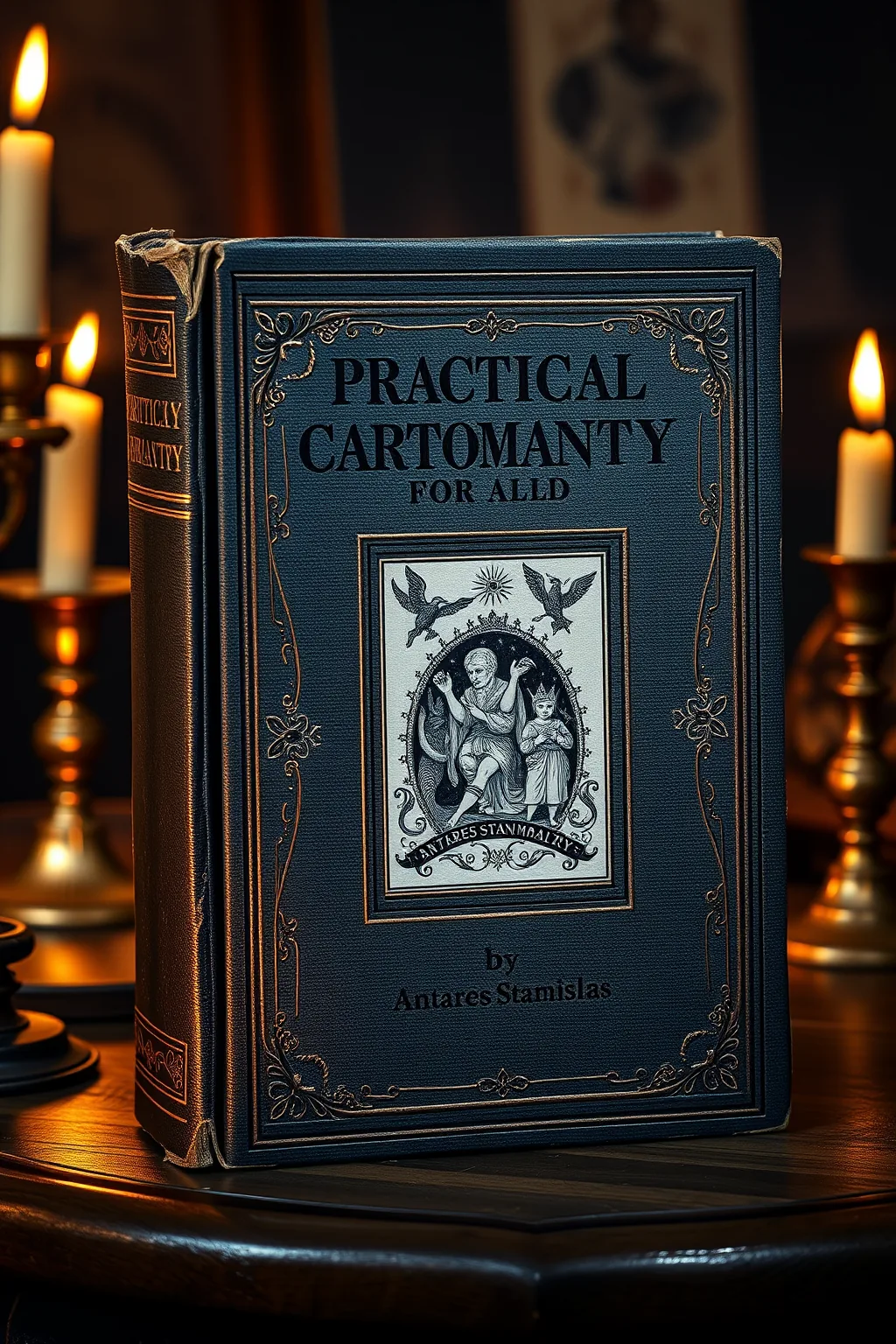
Practical Cartomancy for All 3rd
 71
71

Practical Cartomancy for All 3rd
Antares Stanislas's 'Practical Cartomancy for All' (3rd ed.) offers a direct entry into the practice of Tarot divination, eschewing elaborate theory for applied technique. The author's evident decades of experience lend weight to the methods presented, particularly the 'method of the septenary,' a fresh approach to card spreads that replaces an earlier one. This edition’s strength lies in its focus on tangible, repeatable processes, making it accessible for those who want to *do* rather than merely *read about* divination. However, the text could benefit from more explicit discussion on the ethical considerations of reading for others, a crucial aspect often overlooked in practical guides. The section detailing sequential extractions, while clear, feels somewhat detached from the symbolic depth inherent in many Tarot archetypes, prioritizing mechanics over nuanced interpretation. Stanislas provides a functional toolkit for the aspiring cartomancer.
📝 Description
71
Published in its third edition, Antares Stanislas's 'Practical Cartomancy for All' refines divination games first presented in 2016.
This guide offers a structured approach to Tarot reading, focusing on actionable methods developed by Antares Stanislas over two decades. The third edition introduces the 'method of the septenary' spread, replacing the previous 'reversed pyramid' layout. Stanislas treats divination as a skill built through consistent practice, detailing specific card-spreading techniques and sequential extraction processes designed for clear, practical interpretation. The book suits individuals seeking to learn or enhance their Tarot skills, whether they are novices interested in proven methods or experienced readers aiming to broaden their interpretive tools. It favors a direct, no-nonsense style grounded in consistent application, distinguishing itself from purely academic or speculative works.
Antares Stanislas's work follows a tradition of cartomancy that codified reading techniques after early 20th-century innovations in Tarot imagery. Unlike purely academic or speculative analyses, 'Practical Cartomancy for All' prioritizes tangible methods honed through practice. It positions Tarot reading as a skill developed through consistent application of tested games and interpretive processes, aiming for clarity and actionable guidance rather than historical discourse.
💡 Why Read This Book?
• Gain a practical understanding of the 'method of the septenary' spread, a specific technique for card arrangements detailed in this third edition, offering a structured approach to divination that differs from other common spreads. • Learn specific divination games and sequential extraction methods that Antares Stanislas has employed successfully for over twenty years, providing a curated set of practices honed through extensive personal application. • Acquire actionable techniques for Tarot reading that move beyond theory, focusing on the practical execution of spreads and interpretations as demonstrated by the author's long-standing practice.
⭐ Reader Reviews
Honest opinions from readers who have explored this book.
❓ Frequently Asked Questions
What new method is introduced in the 3rd edition of 'Practical Cartomancy for All'?
The third edition of 'Practical Cartomancy for All' introduces the 'method of the septenary,' a new card spreading and sequential extraction technique. This method replaces the 'reversed pyramid' technique previously explained in the second edition.
How long has the author been practicing the methods in this book?
Antares Stanislas has been successfully using and refining the methods and divination games presented in 'Practical Cartomancy for All' for over twenty years, indicating a depth of practical experience.
Is this book suitable for complete beginners in Tarot?
Yes, the book is designed as a practical text for Tarot reading, aiming to provide accessible methods and divination games for those looking to learn or improve their skills.
What distinguishes this book from other Tarot guides?
Its focus is on illustrating and explaining specific, repeatable methods and divination games that the author has personally tested over two decades, offering a curated, practice-oriented approach.
When was the first edition of 'Practical Cartomancy for All' published?
The first publication date for 'Practical Cartomancy for All' was December 9, 2016. This refers to the initial release, with subsequent editions like the third building upon it.
Does the book cover the historical origins of Tarot?
The book emphasizes practical application and methods of divination rather than extensive historical or theoretical exploration. Its focus is on teaching how to read cards using established, author-tested techniques.
🔮 Key Themes & Symbolism
Applied Divination Methods
The core of this work lies in its dedication to practical, repeatable techniques for Tarot reading. Stanislas moves beyond general theory to illustrate specific card spreads and 'divination games.' The introduction of the 'method of the septenary' in the third edition exemplifies this focus on evolving and refining workable systems. The emphasis is on structured approaches that practitioners can apply consistently to gain insights from the cards, making divination a skill to be honed through disciplined practice.
Sequential Extraction
A key concept explored is sequential extraction, where the order and manner of drawing cards are integral to the reading's structure and interpretation. This method, detailed within the book's practical frameworks, suggests a deliberate process of unfolding information. It moves the practice of cartomancy from a static arrangement to a dynamic sequence, allowing for a more nuanced narrative to emerge from the cards drawn, as guided by the specific rules of the chosen spread.
Experience-Based Practice
Stanislas grounds the book's content in his personal, extensive experience, stating he has successfully used these methods for over twenty years. This creates a sense of authority derived from practice rather than solely from academic research or theoretical speculation. The book functions as a distillation of this long-term engagement, offering techniques that have demonstrably worked for the author, providing readers with a reliable foundation built on real-world application.
Methodical Tarot Spreads
The book systematically presents various card spreads, including the newly added 'method of the septenary.' These spreads are not arbitrary but are presented as structured tools for divination. By detailing specific layouts and the logic behind them, Stanislas equips readers with a versatile toolkit. The focus on methodical arrangement underscores the belief that a well-structured question and spread can lead to clearer, more actionable answers from the Tarot.
💬 Memorable Quotes
Direct passages from the work, attributed to the author.
“This practical text for Tarot reading collects and illustrates the methods and divination games that the author has been successfully using for over twenty years.”
— This statement highlights the book's core value proposition: providing tested, practical techniques derived from extensive personal experience, positioning it as a reliable guide for serious students of cartomancy.
“In this new and third edition, Antares Stanislas adds the method of the septenary, another method for card spreading and sequential extractions that substitutes the one that was illustrated and explained in the second edition, the method of the reversed pyramid.”
— This detail points to the specific evolution of the book's content, emphasizing the addition of a new, significant technique ('method of the septenary') and indicating that the work is regularly updated based on the author's ongoing practice and development.
“After some observations in the field, the author responds to particular qu”
— This fragment suggests the book addresses specific reader needs or common challenges encountered in practical divination, implying that the methods discussed are responsive to real-world application and perhaps common points of confusion.
“The book illustrates divination games and card spreading methods.”
— This straightforward statement defines the book's content as focused on the practical 'how-to' of Tarot reading, offering readers concrete exercises and structured approaches rather than abstract interpretations.
💡 Key Ideas
Editorial paraphrase of the work's core concepts — not direct quotes.
The author responds to particular questions based on extensive field observations.
This paraphrased concept indicates that the advice and methods within the book are not purely theoretical but are informed by the author's practical experience and observations made while actively engaging in cartomancy.
🌙 Esoteric Significance
Tradition
This work fits within the practical, Western esoteric tradition of cartomancy, which gained significant traction in the late 19th and early 20th centuries. While not explicitly tied to a single lineage like Hermeticism or Kabbalah, it draws upon the established practice of Tarot as a divinatory tool, a practice influenced by earlier occult revivalists. It departs from purely symbolic or philosophical treatments by prioritizing the functional application of spreads and readings, making it a bridge between esoteric theory and tangible practice.
Symbolism
While the book's primary focus is on method, the underlying symbolism of the Tarot cards themselves is implicitly engaged through the act of divination. Specific symbols within the cards gain practical meaning through their placement in spreads like the 'method of the septenary.' For instance, the sequential extraction process imbues the order of cards—and their inherent symbolic narratives—with a temporal or causal significance, allowing archetypal imagery to speak to specific inquiries.
Modern Relevance
Contemporary practitioners and teachers of Tarot divination often seek structured, reliable methods. Works like Stanislas’s appeal to modern readers who may find existing literature either too esoteric, historically dense, or lacking in clear, actionable techniques. It speaks to those interested in developing a consistent, effective personal practice, bridging the gap between the foundational Rider-Waite-Smith tradition and the practical demands of daily divination.
👥 Who Should Read This Book
• Aspiring cartomancers seeking structured learning paths and proven techniques for reading Tarot cards. • Tarot readers looking to expand their repertoire with new spreads and divination games, such as the 'method of the septenary' introduced in the third edition. • Individuals interested in a practical, experience-based approach to divination that emphasizes repeatable methods honed over years of practice.
📜 Historical Context
Antares Stanislas's 'Practical Cartomancy for All,' particularly its third edition published around 2016, emerges within a vibrant, ongoing discourse on Tarot divination. While the early 20th century saw figures like Aleister Crowley and A.E. Waite establishing distinct Tarot systems and decks that influenced Western esotericism, Stanislas’s work positions itself within a lineage focused on the *application* of these tools. Unlike academic approaches that might dissect Tarot's historical roots or its place in movements like Theosophy, Stanislas provides a practitioner's manual. The book’s emphasis on specific, evolving methods, such as the introduction of the 'method of the septenary,' distinguishes it from works that might focus on foundational symbolism or historical interpretations. It speaks to a contemporary need for clear, effective techniques in an age where Tarot reading is widely practiced but often lacks systematic training beyond individual mentorship or foundational texts.
📔 Journal Prompts
Reflect on the 'method of the septenary' and how its structure might influence the interpretation of a card sequence compared to other known spreads.
Consider the author's twenty years of practice; how might this extensive experience shape the selection and presentation of the divination games within the book?
Analyze the concept of sequential extraction as presented; what potential advantages does this method offer for understanding unfolding events or processes?
Compare the 'method of the septenary' to the 'reversed pyramid' method mentioned; what might be the practical implications of this substitution for a reader?
Explore the author's focus on 'practical' methods; how does this emphasis differ from books that focus primarily on Tarot symbolism or history?
🗂️ Glossary
Cartomancy
The practice of divination using cards, most commonly referring to Tarot cards but also including playing cards.
Method of the Septenary
A specific card-spreading technique introduced in the third edition of 'Practical Cartomancy for All,' involving a seven-card layout for divination.
Method of the Reversed Pyramid
A card-spreading technique previously featured in the second edition of the book, which was substituted by the 'method of the septenary' in the third edition.
Divination Games
Structured exercises or layouts using Tarot cards designed to elicit specific insights or answers to questions through interpretation.
Sequential Extractions
A method of drawing cards in a specific order, where the sequence itself contributes to the interpretation of the divination.
Tarot Reading
The practice of interpreting the symbolic meaning of Tarot cards, typically drawn in specific arrangements (spreads), to gain insight into questions or situations.
Practical Text
A book focused on providing actionable methods, techniques, and hands-on guidance rather than extensive theoretical or historical discussion.