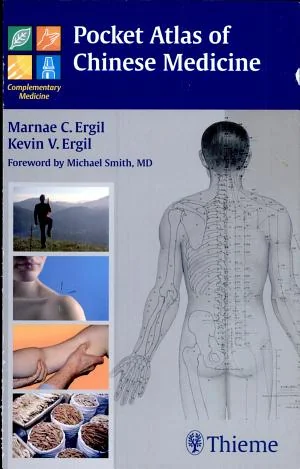
Pocket Atlas of Chinese Medicine
 76
76

Pocket Atlas of Chinese Medicine
The Pocket Atlas of Chinese Medicine by Marnae C. Ergil and Kevin Ergil functions less as a profound text and more as an exceptionally well-organized field guide. Its strength lies undeniably in its illustrative clarity; the visual representations of meridian pathways and acupuncture points are sharp and informative, far surpassing the often-muddy diagrams found in less focused works. The 2009 publication date positions it as a relatively modern synthesis of traditional knowledge, aiming for accessibility. However, this very conciseness can feel like a limitation. While it offers a synoptic view, readers seeking deep theoretical exploration or nuanced clinical application might find the explanations too brief. A notable section on the Five Elements theory, for instance, provides a solid introduction but doesn't deeply explore the philosophical underpinnings or varied applications across different schools of thought within TCM. It is a capable primer, best suited for initial orientation rather than advanced study. The Erigils have produced a functional, visually competent atlas that serves its purpose efficiently.
📝 Description
76
First published in 2009, the Pocket Atlas of Chinese Medicine simplifies complex TCM theories with clear illustrations.
Marnae C. Ergil and Kevin Ergil's Pocket Atlas of Chinese Medicine presents a condensed overview of Traditional Chinese Medicine (TCM). The 2009 volume uses detailed illustrations to make core TCM principles accessible. It covers fundamental concepts and practices that have shaped healing traditions over centuries.
The book is useful for students of medicine, both Eastern and Western, offering a comparative study. Practitioners can use it as a quick reference for specific points. It also serves as an introduction for those interested in alternative health and the philosophical underpinnings of TCM. The atlas aims to clarify concepts that might appear obscure to newcomers, prioritizing visual aids for understanding.
Published as interest in complementary and alternative medicine grew in the West, this atlas connects millennia-old Eastern medical philosophies with contemporary medical understanding. It reflects a move toward holistic health, viewing the body's energies as interconnected systems, in contrast to some more reductionist Western medical approaches.
Traditional Chinese Medicine is rooted in ancient Taoist philosophy, viewing the body as an energetic system. Concepts like Qi (vital energy), Yin and Yang, and the Five Elements form its theoretical framework. These principles are not merely biological but also cosmological, seeking harmony within the individual and between the individual and the universe. The practice of acupuncture, moxibustion, and herbalism aims to restore balance to these energetic flows, reflecting a worldview where health is a state of equilibrium.
💡 Why Read This Book?
• Gain a foundational understanding of Qi, Yin/Yang, and the Five Elements (Wu Xing) as presented in the atlas's structured explanations, allowing you to grasp the fundamental energetic principles of Chinese Medicine. • Master the visual layout of the meridian system and key acupuncture points, as detailed in the atlas's illustrations, enabling precise identification for study or reference. • Appreciate the diagnostic methods, such as pulse and tongue assessment, described in the text, offering a glimpse into the holistic diagnostic approach that characterizes Chinese Medicine since ancient times.
⭐ Reader Reviews
Honest opinions from readers who have explored this book.
❓ Frequently Asked Questions
When was the Pocket Atlas of Chinese Medicine first published?
The Pocket Atlas of Chinese Medicine was first published in 2009, making it a relatively contemporary resource for understanding traditional Chinese medical concepts.
Who are the authors of the Pocket Atlas of Chinese Medicine?
The book is authored by Marnae C. Ergil and Kevin Ergil, who are recognized experts in the field of Chinese Medicine.
What are the core concepts covered in the atlas?
The atlas covers fundamental concepts like Qi, Yin and Yang, the Five Elements theory, meridian pathways, and diagnostic methods such as pulse and tongue examination.
Is the Pocket Atlas of Chinese Medicine suitable for beginners?
Yes, its illustrated format and concise explanations make it an excellent resource for beginners interested in exploring Chinese Medicine.
What types of medical practices are discussed in the book?
The book discusses key treatment modalities including acupuncture, herbal medicine, and Tui Na massage, offering a broad overview of therapeutic approaches.
Does the atlas focus on a specific historical period of Chinese Medicine?
While rooted in ancient traditions, the atlas synthesizes these concepts for a modern audience, reflecting the state of TCM understanding around its 2009 publication.
🔮 Key Themes & Symbolism
Energetic Anatomy
The atlas meticulously charts the unseen energetic field of the human body according to Traditional Chinese Medicine (TCM). Central to this is the concept of Qi, often translated as vital energy, which flows through a network of pathways known as meridians. Understanding these meridians is crucial, as blockages or imbalances in Qi flow are believed to be the root of illness. The book illustrates these pathways, connecting specific organs to their energetic circuits, providing a map for practitioners and students to comprehend how physical and emotional health are intrinsically linked through this vital force.
Holistic Balance
A core part of Chinese Medicine, as presented in this atlas, is the principle of maintaining balance. This is most famously represented by the concept of Yin and Yang, two complementary yet opposing forces whose dynamic equilibrium is essential for health. The atlas explores how this duality manifests in the body and how imbalances can lead to disease. Furthermore, the Five Elements theory (Wu Xing) — Wood, Fire, Earth, Metal, and Water — provides another framework for understanding these interconnected relationships and achieving a state of holistic harmony within the individual.
Diagnostic Frameworks
The Pocket Atlas introduces readers to the distinctive diagnostic methods employed in Chinese Medicine, which differ significantly from Western approaches. It highlights the importance of observing the body's subtle signs, particularly through pulse diagnosis and tongue examination. The subtle variations in pulse quality and the appearance of the tongue (color, coating, shape) are presented as windows into the internal state of the organs and the flow of Qi. These methods underscore the holistic nature of TCM, aiming to identify root causes of disharmony rather than just symptomatic relief.
Therapeutic Modalities
Beyond diagnosis, the atlas provides a concise overview of the primary therapeutic interventions within Chinese Medicine. Acupuncture, involving the insertion of fine needles at specific points along the meridians, is detailed as a method to regulate Qi flow. Herbal medicine, utilizing complex formulations of natural substances, is presented as a powerful way to address internal imbalances. The book also touches upon other techniques like Tui Na (therapeutic massage) and dietary therapy, showcasing the diverse and integrated toolkit available for restoring health.
💬 Memorable Quotes
Direct passages from the work, attributed to the author.
“Qi is the fundamental life force that animates all beings and processes.”
— This statement captures the central concept of Qi in Chinese Medicine, emphasizing its role not just as energy but as the very essence of life and activity within the body and the cosmos.
“The balance of Yin and Yang determines health or disease.”
— This highlights the core principle of duality and equilibrium in TCM. Health is viewed as a state of dynamic harmony between opposing forces, while illness arises from their imbalance.
“Meridians form a network for the circulation of Qi throughout the body.”
— This explains the anatomical basis of TCM's energetic system, likening the body's energetic pathways to a circulatory system for vital energy, crucial for maintaining physiological function.
“Diagnosis involves observing the tongue and palpating the pulse.”
— This points to the unique diagnostic tools of Chinese Medicine, which rely on detailed physical observation and tactile assessment to understand internal conditions.
“The Five Elements provide a framework for understanding interrelationships.”
— This references the Wu Xing theory, illustrating how TCM categorizes natural phenomena and bodily functions into five interacting elements to map complex relationships and cycles.
🌙 Esoteric Significance
Tradition
While not strictly aligning with a single Western esoteric lineage like Hermeticism or Kabbalah, Chinese Medicine shares fundamental principles with many esoteric traditions. Its focus on vital energy (Qi) echoes concepts like Prana in Yoga or the Astral Light in Western occultism. The emphasis on interconnectedness, balance, and the influence of celestial and terrestrial forces on human health aligns with a broader worldview found in esoteric philosophies that see the microcosm (human) reflecting the macrocosm (universe). The atlas, by detailing these principles, offers a tangible system rooted in observation and practice that speaks to the holistic and energetic perspectives central to many esoteric pursuits.
Symbolism
The atlas employs detailed symbolism inherent in Chinese Medicine. The Yin and Yang symbols, representing dynamic duality and interdependence, are fundamental. The Five Elements (Wu Xing) – Wood, Fire, Earth, Metal, Water – are not merely physical substances but represent phases, qualities, and interrelationships that pervade nature and the human body, symbolizing cycles of creation and control. The meridian system itself can be viewed as a symbolic map of the body's energetic geography, where each point and channel holds specific energetic significance and potential for intervention, mirroring the symbolic cartography found in other esoteric systems.
Modern Relevance
Contemporary thinkers and practitioners in fields ranging from integrative medicine to somatic psychology increasingly draw upon the principles outlined in works like the Pocket Atlas. The focus on Qi, meridians, and holistic balance offers alternative frameworks for understanding chronic illness, stress, and psychosomatic conditions. Practices like acupuncture and mindfulness-based therapies, informed by TCM concepts, are now widely accepted or explored in Western healthcare. Furthermore, the atlas's clear presentation of these ancient ideas makes them accessible to modern esoteric practitioners seeking to integrate Eastern energetic models into their own systems of practice and understanding.
👥 Who Should Read This Book
• Students of Western Esotericism seeking to understand energetic systems beyond the Hermetic or Kabbalistic traditions will find the atlas's depiction of Qi and meridians clear. • Practitioners of holistic health modalities, including acupuncturists, herbalists, and bodyworkers, can use this concise guide as a quick reference for core TCM principles and anatomical maps. • Individuals exploring comparative philosophy and medicine will benefit from the atlas's clear explanation of a sophisticated system that views health through a lens of energetic balance and interconnectedness.
📜 Historical Context
The Pocket Atlas of Chinese Medicine, published in 2009, arrived during a period of increasing global interest in Traditional Chinese Medicine (TCM). While TCM’s origins stretch back millennia, its integration into Western medical discourse and practice was a more recent phenomenon, gaining significant momentum through the latter half of the 20th century. The book emerged at a time when complementary and alternative medicine (CAM) was moving from the fringe to more mainstream consideration. It sought to provide a clear, accessible overview for a Western audience grappling with concepts that differed vastly from the prevailing biomedical model. Contemporaries like Ted Kaptchuk, whose work 'The Web That Has No Weaver' (first published 1983, revised 2000) had already established a benchmark for explaining TCM to Westerners, paved the way for such syntheses. The Erigils' atlas contributes to this ongoing effort to explain TCM, presenting its core theories and practices in a structured, visually-aided format that aims to bridge cultural and philosophical divides in healthcare.
📔 Journal Prompts
The concept of Qi flow through meridians: How does this energetic map compare to your understanding of bodily systems?
Reflect on the Yin and Yang principles as applied to a personal habit or relationship.
Consider the diagnostic significance of the tongue and pulse as described in the atlas.
How might the Five Elements (Wu Xing) model help explain a recent personal challenge?
Visualize the meridian pathways presented in the atlas overlaid onto your own body.
🗂️ Glossary
Qi (or Chi)
The fundamental vital energy or life force that animates all living things and is central to Chinese Medicine theory. It is believed to flow through the body's meridians.
Yin and Yang
Two complementary, opposing forces whose dynamic balance is considered essential for health. Yin represents passive, cool, and dark aspects, while Yang represents active, warm, and light aspects.
Five Elements (Wu Xing)
A classical Chinese philosophical framework categorizing phenomena into five elements: Wood, Fire, Earth, Metal, and Water. They represent phases, qualities, and interrelationships in nature and the body.
Meridians
A network of pathways or channels through which Qi is believed to circulate throughout the body, connecting acupuncture points and organs.
Acupuncture
A therapeutic technique involving the insertion of fine needles into specific points on the body (acupoints) along the meridians to regulate the flow of Qi.
Tui Na
A form of therapeutic massage and bodywork used in Chinese Medicine, involving various hand techniques to move Qi and blood, and restore balance.
Pulse Diagnosis
A diagnostic method in Chinese Medicine where practitioners assess the state of the body's internal organs and Qi by palpating the pulse at different positions on the wrist.
This book appears in 1 collection
🔮 Readers Also Liked
Browse all →






From the “Acupuncture” Collection
View all →



More Free Occult Philosophy Books
View all →