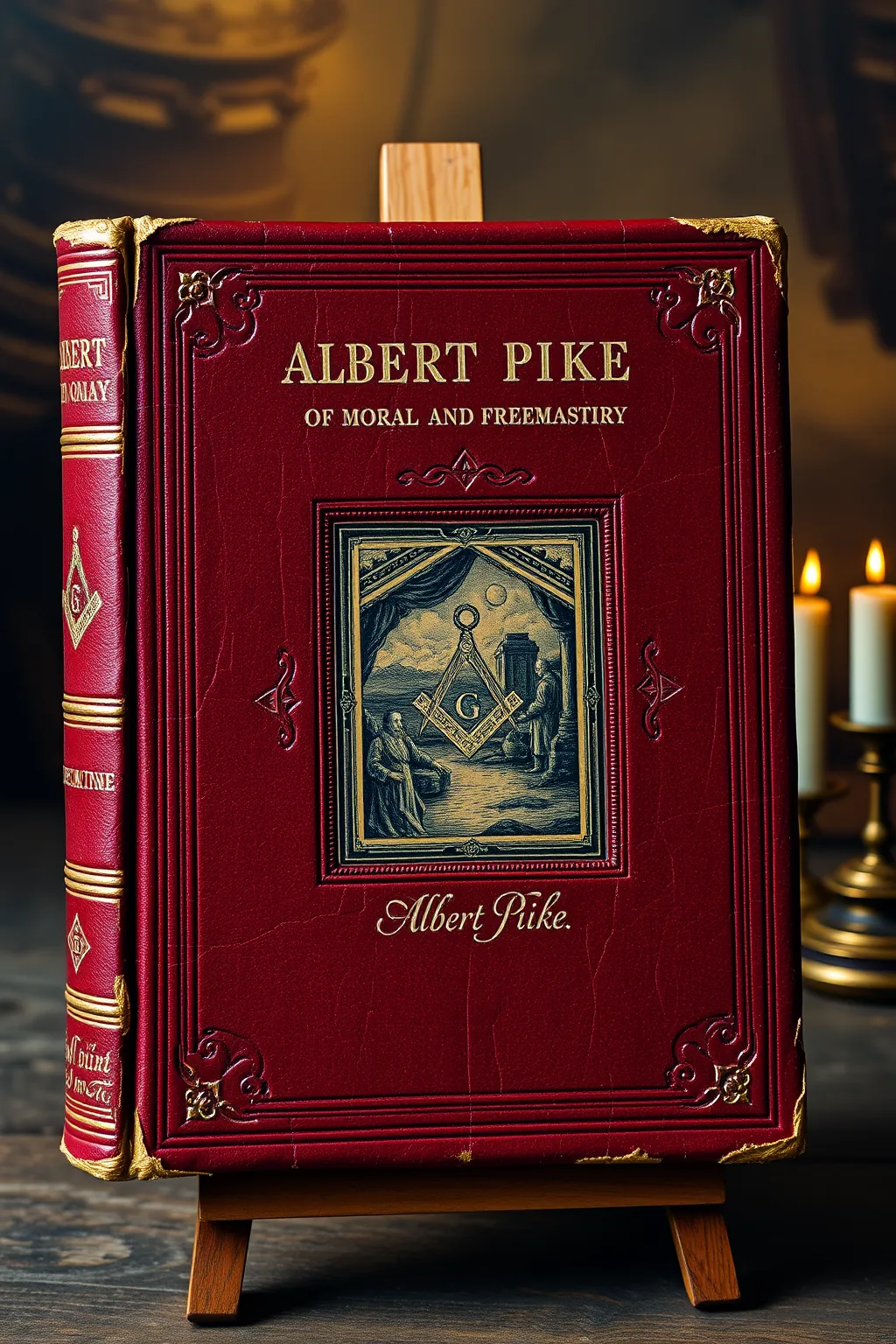
Pike, Albert Morals And Dogma Of Freemasonry
 75
75

Pike, Albert Morals And Dogma Of Freemasonry


Alaric Kestrel (Metaphysical Studies Reviewer) — Albert Pike's 'Morals and Dogma' remains an indispensable pillar for any serious student of Freemasonry and esoteric philosophy. This comprehensive exploration masterfully unpacks the intricate symbolism and layered meanings embedded within Masonic teachings. Pike's profound grasp of ancient wisdom, from Egyptian mysticism to Kabbalistic lore, illuminates the spiritual and philosophical underpinnings of the Craft. While dense, its rewards are immense for the dedicated reader seeking profound insights into self-knowledge and universal truths. It’s an authoritative guide for practitioners and scholars alike, offering a gateway to understanding the timeless quest for enlightenment.
📝 Description
75
Albert Pike's 'Morals and Dogma' was first published in 1871 as a guide for Freemasons.
Albert Pike's 'Morals and Dogma of Freemasonry,' published in 1871, is a comprehensive exploration of Masonic philosophy. The book details the symbolism, allegories, and rituals found within the degrees of Freemasonry. Pike draws upon a wide range of ancient philosophies, including Gnosticism, Hermeticism, and Kabbalah, to explain the hidden meanings behind Masonic teachings. It is structured as a series of lessons, each designed to illuminate a specific aspect of Masonic thought and practice.
The work encourages a serious approach to self-improvement and understanding. It presents Masonic teachings not just as a system of morality, but as a path toward spiritual enlightenment. Pike's intent was to provide a structured curriculum for Masons seeking a deeper comprehension of the Craft's philosophical underpinnings. The book remains a significant text for those interested in the intellectual and spiritual dimensions of Freemasonry.
This book is situated within the Western esoteric tradition, specifically as a key text for understanding Freemasonry's philosophical and symbolic framework. It engages with ideas found in Hermeticism, Gnosticism, Kabbalah, and Neoplatonism, filtering them through the lens of Masonic ritual and degrees. Pike aimed to connect the practices and symbols of Freemasonry to a broader lineage of mystical and philosophical thought, tracing a lineage of hidden wisdom. Its publication in the late 19th century also places it within a period of renewed interest in esoteric subjects.
💡 Why Read This Book?
Unravel the profound esoteric symbolism and philosophical underpinnings of Freemasonry. This book is essential for seekers of hidden knowledge, scholars of secret societies, and practitioners aiming for deeper spiritual understanding. It offers a comprehensive journey through ancient mysteries, challenging you to explore the depths of your own consciousness and the universal truths that connect humanity.
⭐ Reader Reviews
Honest opinions from readers who have explored this book.
❓ Frequently Asked Questions
Is 'Morals and Dogma' a literal guide to Masonic rituals?
While it explains the symbolism behind Masonic rituals, 'Morals and Dogma' is primarily a philosophical and allegorical exploration of the teachings, rather than a step-by-step procedural manual.
Who is Albert Pike?
Albert Pike was a prominent figure in Freemasonry, a lawyer, soldier, and prolific writer whose 'Morals and Dogma' is considered one of the most influential works on Masonic philosophy and esoteric symbolism.
Does this book contain forbidden or dangerous knowledge?
The book explores complex philosophical and esoteric concepts that may challenge conventional beliefs. Its 'danger' lies in its potential to profoundly alter one's perspective and understanding of the world.
Is 'Morals and Dogma' exclusively for Freemasons?
While rooted in Masonic teachings, the book's profound philosophical and spiritual insights are valuable to anyone interested in esotericism, comparative religion, and the history of ideas.
How should one approach reading 'Morals and Dogma'?
Approach it with an open mind, a willingness to study, and perhaps a good dictionary for arcane terms. Reading it slowly, reflecting on each chapter, and perhaps in conjunction with other esoteric texts is recommended.
🔮 Key Themes & Symbolism
The Allegory of the Square and Compasses
This central theme examines the iconic Masonic symbols of the square and compasses, not merely as tools, but as profound allegories for moral conduct, spiritual alignment, and the harmonious integration of the material and the divine. Pike dissects how these symbols represent the regulation of one's actions, the pursuit of justice, and the ultimate aspiration to build a spiritual temple within oneself. The exploration explores their representation of the four cardinal virtues and the celestial spheres, inviting the reader to contemplate the cosmic order mirrored in human endeavor and the ceaseless striving for perfection.
The Ascent of the Soul Through the Degrees
Pike meticulously details the symbolic journey of the Masonic initiate through the various degrees, portraying each as a stage in the soul's gradual ascent from ignorance to enlightenment. This theme focuses on the transformative power of esoteric education, where rituals and allegories serve as catalysts for spiritual growth. The 'Morals and Dogma' illustrates how each degree peels back layers of illusion, revealing deeper truths about existence, morality, and the nature of the divine, guiding the aspirant towards self-mastery and a profound connection with the universal consciousness.
The Unveiling of Ancient Mysteries
This theme explores Pike's synthesis of diverse ancient traditions, including Hermeticism, Gnosticism, Egyptian mysteries, and Kabbalah, to illuminate the deeper philosophical currents within Freemasonry. 'Morals and Dogma' acts as a Rosetta Stone for understanding the esoteric lineage of Western thought, revealing how foundational spiritual concepts have been preserved and transmitted through secret societies. Pike demonstrates the interconnectedness of these ancient wisdom systems, presenting Freemasonry as a modern repository for these timeless truths, designed to awaken the intellect and spirit of its adherents.
💬 Memorable Quotes
Direct passages from the work, attributed to the author.
“The universe is a thought of God.”
— This statement reflects a pantheistic or panentheistic view, suggesting that all of existence originates from and is imbued with the divine consciousness, emphasizing the interconnectedness of all things.
“Man is the measure of all things.”
— Echoing ancient Greek philosophy, this implies a focus on human potential, reason, and the subjective experience as the primary lens through which reality is understood and evaluated.
“The key to everything is tolerance.”
— This emphasizes the importance of understanding, acceptance, and empathy in navigating diverse perspectives and fostering harmony, a core tenet for both personal growth and societal cohesion.
💡 Key Ideas
Editorial paraphrase of the work's core concepts — not direct quotes.
What we do, we do for love of truth.
This quote captures the fundamental motivation behind the pursuit of esoteric knowledge and philosophical inquiry, highlighting truth as the ultimate goal and love as the driving force behind this endeavor.
Light is the symbol of truth.
A classic esoteric metaphor, this quote equates illumination with understanding, suggesting that the pursuit of knowledge and spiritual awakening is akin to emerging from darkness into clarity.
🌙 Esoteric Significance
Tradition
This work is a core part of Western Esotericism, specifically within the Hermetic, Gnostic, and Kabbalistic traditions, as interpreted through the lens of Masonic philosophy. Pike masterfully ties together threads from these ancient streams of wisdom, presenting them as integral to the initiatory path of Freemasonry. It is seen as a guide to understanding the 'inner' or 'esoteric' meaning of the Craft, transcending its purely social or fraternal aspects to reveal profound spiritual and philosophical teachings.
Symbolism
Pike's 'Morals and Dogma' is a rich compendium of esoteric symbolism, dissecting everything from geometric figures and architectural elements to celestial bodies and ancient mythological figures. He elucidates how these symbols function as keys to unlocking deeper spiritual truths, representing concepts such as the divine spark within humanity, the duality of existence, the cyclical nature of time, and the pursuit of perfect knowledge. The book argues that symbols are the language of the soul, capable of conveying truths that rational discourse alone cannot.
Modern Relevance
'Morals and Dogma' continues to be profoundly relevant for seekers of spiritual and philosophical wisdom in the modern era. In a world often characterized by superficiality and materialism, Pike's work offers a robust intellectual and spiritual framework for self-discovery and ethical development. Its exploration of ancient wisdom and symbolic language provides enduring tools for understanding the human condition, fostering personal growth, and connecting with timeless universal principles that remain vital for navigating contemporary challenges.
👥 Who Should Read This Book
This profound work is essential for dedicated Freemasons seeking to deepen their understanding of the Craft's philosophical underpinnings. It is equally vital for scholars of secret societies, comparative religion, and Western Esotericism who wish to engage with a seminal text. Aspiring mystics and seekers of hidden knowledge will find a wide range of symbolic interpretation and philosophical inquiry. Practitioners of occult arts and spiritual disciplines may discover a wealth of symbolic language and conceptual frameworks that can inform their personal practices and enhance their journey toward enlightenment.
📜 Historical Context
Written in the latter half of the 19th century, 'Morals and Dogma' emerged during a period of intense intellectual and spiritual ferment in the Western world. This era saw a resurgence of interest in ancient philosophies, mysticism, and the occult, often fueled by archaeological discoveries and a desire to find meaning beyond burgeoning industrialization and rationalism. Albert Pike, a highly educated and influential Mason, synthesized a vast array of esoteric traditions—from Hermeticism and Gnosticism to ancient Egyptian and Kabbalistic thought—presenting them within the framework of Masonic degrees. The book reflects the Victorian era's penchant for detailed scholarship and its fascination with the symbolic and the allegorical. Its publication solidified Freemasonry's reputation as a repository of ancient wisdom and profoundly influenced subsequent generations of occultists and philosophers.
📔 Journal Prompts
Reflect on the meaning of the square and compasses in your own life. How do they guide your actions and aspirations?
Consider a ritual or practice you engage in. What deeper symbolic meaning might it hold beyond its superficial form?
Which ancient tradition discussed by Pike resonates most with your personal beliefs or experiences, and why?
How does the concept of 'light' as truth manifest in your understanding of the world and your personal journey?
In what ways can the principle of 'tolerance' be applied more effectively in your daily interactions and broader worldview?
🗂️ Glossary
Esotericism
A broad category of mystical or occult traditions that focus on esoteric knowledge, often concealed from the uninitiated. It emphasizes inner spiritual experience and hidden meanings beyond literal interpretation.
Gnosticism
An ancient religious movement characterized by the belief that salvation is achieved through secret knowledge (gnosis) revealed by a divine messenger. It often posits a dualistic worldview and a complex cosmology.
Hermeticism
A philosophical and religious tradition based on the writings attributed to Hermes Trismegistus. It emphasizes the principles of 'as above, so below' and the interconnectedness of the universe through divine wisdom.
Kabbalah
A mystical tradition within Judaism that explores the divine nature and the creation of the universe through a symbolic interpretation of the Hebrew Bible and the use of the Tree of Life. It seeks hidden meanings in scripture and the cosmos.
Allegory
A story, poem, or picture that can be interpreted to reveal a hidden meaning, typically a moral or political one. In this context, it refers to the symbolic representation of deeper truths within Masonic teachings.
This book appears in 2 collections
🔮 Readers Also Liked
Browse all →







From the “Secret Societies” Collection
View all →





More Free Freemasonry & Secret Societies Books
View all →



![Moore C The New Masonic Trestle Board [ 1850][ 209p]](/img/thumb/moore-c-the-new-masonic-trestle-board-1850-209p.webp)