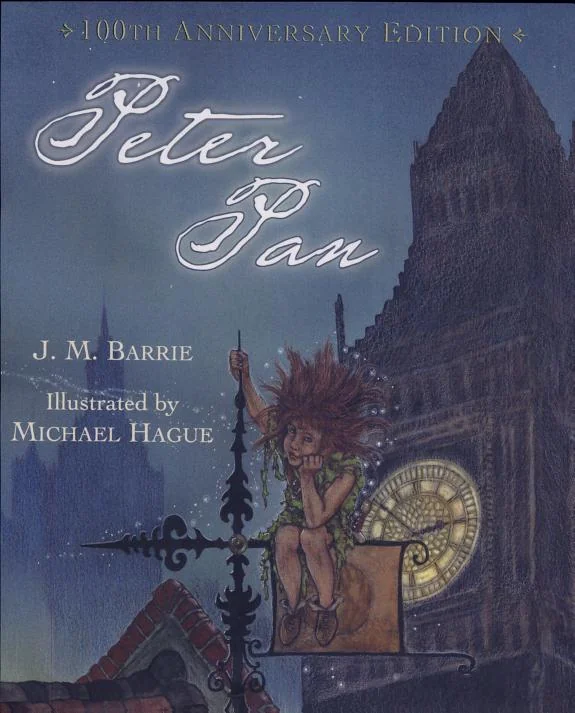
Peter Pan (100th Anniversary Edition)
 75
75

Peter Pan (100th Anniversary Edition)
Barrie's Peter Pan, particularly in this centenary edition, continues to hold a peculiar charm, yet its exploration of perpetual childhood feels less like an innocent fantasy and more like a cautionary tale on arrested development. The sheer inventive power behind Neverland and its inhabitants, like the Lost Boys and the formidable Captain Hook, is undeniable. However, the narrative's insistence on Peter's unwavering refusal to mature, while central to his character, can feel static, even unsettling, when viewed through a modern lens. The poignant moments, such as Wendy's eventual return to the Darling nursery, highlight the inherent tragedy of Peter's chosen state. A passage where Peter explains his forgetfulness, noting how children forget their dreams, hints at a deeper existential void beneath the adventure. While a landmark in children's literature, its embrace of eternal youth requires a critical re-evaluation beyond mere nostalgia. It is a classic, but one that prompts more questions about the cost of stasis than answers about freedom.
📝 Description
75
J. M. Barrie's Peter Pan, first a play in 1904, is presented here in a 100th Anniversary Edition.
This edition revisits J. M. Barrie's Peter Pan, a century after its 1911 novelization. The story centers on Peter, a boy who refuses to age, and his adventures in Neverland. This is a place where children fly, battle pirates, and live free from adult responsibilities. Peter embodies eternal youth and a resistance to growing up. The narrative invites readers to consider the allure of perpetual childhood against the backdrop of societal expectations and the passage of time. It moves beyond a simple adventure tale to touch upon deeper philosophical and psychological ideas.
Barrie's work emerged during the Edwardian era, a time when child psychology began to gain traction, influenced by emerging theories. The book reflects a romanticized view of childhood, perhaps as a contrast to the industrializing world. While Barrie was part of a notable literary circle, Peter Pan's distinct blend of fantasy and a certain melancholy sets it apart. The novel form, published in 1911, built upon the success of the earlier play, solidifying its place in popular culture.
Peter Pan's enduring appeal lies in its exploration of the puer aeternus archetype, the eternal child who resists maturation and societal demands. Neverland functions as a liminal space, a realm outside conventional time and growth, where this resistance plays out. The text touches upon themes of memory, the bittersweet nature of innocence, and the subtle melancholy associated with the loss of childhood. These elements resonate with traditions that examine the spiritual or psychological significance of youth and the challenges of integrating into the adult world.
💡 Why Read This Book?
• Understand the archetypal concept of the Puer Aeternus, the eternal boy who resists maturation, as embodied by Peter Pan in his defiance of growing up. • Explore the symbolic landscape of Neverland, a setting that represents a psychic space where childhood desires and fears are externalized and acted out. • Examine the interplay between memory and forgetting, particularly how characters like Peter Pan seem unbound by past experiences, offering a unique perspective on identity.
⭐ Reader Reviews
Honest opinions from readers who have explored this book.
❓ Frequently Asked Questions
When was Peter Pan first published as a novel?
Peter Pan was first published as a novel in 1911, though it originated as a play titled "Peter Pan, or the Boy Who Wouldn't Grow Up" which premiered in London in 1904.
What is the significance of Neverland in Peter Pan?
Neverland serves as a symbolic realm where children can escape the realities of the adult world and live out fantasies of adventure and eternal youth, free from the constraints of time and maturity.
Who is Captain Hook and what does he represent?
Captain Hook is the antagonist and pirate captain in Peter Pan. He represents the encroaching adult world, mortality, and the consequences of Peter's refusal to grow up, particularly his fear of the crocodile that swallowed a clock.
Does Peter Pan have any connection to J.M. Barrie's own life?
The character of Peter Pan is often seen as inspired by Barrie's relationship with the Llewelyn Davies boys, whom he befriended and later became guardian to after their parents' deaths.
What is the primary esoteric theme explored in Peter Pan?
The primary esoteric theme is the archetype of the Puer Aeternus, the eternal child who resists maturation and embodies a state of perpetual youth, often explored in Jungian psychology and myth studies.
Is Peter Pan considered a public domain work?
While the original play and novel are in the public domain in many countries, specific editions and adaptations may still be under copyright. The 100th Anniversary Edition likely refers to the 1911 novel publication.
🔮 Key Themes & Symbolism
The Puer Aeternus
Peter Pan embodies the Puer Aeternus, the eternal child archetype, representing perpetual youth, spontaneity, and a refusal to engage with the responsibilities and limitations of adulthood. This figure, prominent in Jungian psychology, resists integration into the collective consciousness and societal norms, preferring a state of unbound potential. Barrie's creation offers a literary exploration of this complex archetype, highlighting its allure and its inherent limitations.
Neverland as Psyche
Neverland functions as a symbolic landscape mirroring the inner world of childhood and the unconscious. It is a realm where imagination reigns supreme, free from the rational constraints of the adult world. Here, fears like Captain Hook and desires for adventure manifest concretely. The island represents a psychic space where the primal self can exist before the ego's full development, a concept resonant with Gnostic ideas of a pure, uncorrupted state.
Memory and Oblivion
A significant theme is the nature of memory, particularly Peter's inability to recall past events or people. This characteristic, while central to his identity as the boy who never grows up, also points to a detachment from personal history and a lack of linear development. This oblivion can be interpreted as a form of liberation from the burdens of the past, or conversely, as a fundamental incompleteness, a refusal to build a cohesive self through lived experience.
The Shadow of Adulthood
The adult world, personified by figures like Captain Hook and the concept of 'growing up,' is depicted as a place of danger and mortality. Hook's fear of the ticking crocodile, symbolizing the relentless passage of time and death, contrasts with Peter's carefree existence. This tension explores the archetypal conflict between the innocent, unburdened self and the encroaching reality of life's finite nature and its demands.
💬 Memorable Quotes
Direct passages from the work, attributed to the author.
“All children, except one, grow up.”
— This iconic opening statement immediately establishes the central premise of the story: Peter Pan's unique status as an anomaly in the human condition, forever outside the developmental trajectory of aging.
“It is sad that Mrs. Darling never saw Peter dance.”
— This phrase underscores the tragic element of Peter's existence and his mother's inability to witness his full, uninhibited self. It highlights the missed connections and the sacrifices inherent in his refusal to mature.
“You always say that, and you always forget.”
— This observation, likely directed at Peter, points to his characteristic forgetfulness and inability to retain memories or learn from past experiences, a defining trait that separates him from the grown world.
“Peter, being Peter, was quite unable to be a proper father.”
— This statement reflects Peter's fundamental nature and his inability to fulfill conventional adult roles, such as fatherhood, due to his arrested development and self-centered focus on eternal boyhood.
“Peter was not yet born.”
— This enigmatic statement suggests Peter's existence outside the normal cycle of birth and life, reinforcing his mythical status as an eternal, perhaps even pre-existent, entity rather than a conventional human child.
🌙 Esoteric Significance
Tradition
Peter Pan aligns with archetypal psychology, particularly the concept of the Puer Aeternus, the eternal child, a theme explored by Carl Jung. This archetype represents boundless potential, creativity, and a refusal to be constrained by societal norms or the limitations of the material world. While not directly tied to a specific esoteric lineage like Hermeticism or Kabbalah, it speaks to Gnostic ideas of a pure, unfallen consciousness existing outside the corrupting influence of the mundane realm.
Symbolism
Neverland is a primary symbol, representing a psychic space or a liminal realm where the rules of the ordinary world do not apply. It is a manifestation of the collective unconscious or the individual psyche's desire for freedom from temporal constraints. The crocodile with the ticking clock symbolizes mortality and the relentless march of time, the very forces Peter Pan evades. Peter himself symbolizes eternal youth, spontaneity, and the refusal to integrate into the adult ego structure.
Modern Relevance
The archetype of the Puer Aeternus continues to be relevant in contemporary discussions of arrested development, creativity, and the challenges of transitioning into adulthood. Thinkers and artists exploring themes of eternal youth, escapism, and the tension between imagination and reality often draw parallels to Peter Pan. Practices focusing on inner child work or reclaiming lost creativity can find symbolic resonance in Neverland and Peter's persistent defiance of the grown-up world.
👥 Who Should Read This Book
['• Students of archetypal psychology: To analyze the embodiment of the Puer Aeternus and its psychological implications beyond childhood.\n', '• Comparative mythology scholars: To examine the Peter Pan myth within broader narratives of eternal youth and resistance to temporal progression.\n', '• Writers and artists: To draw inspiration from the symbolic field of Neverland and the concept of maintaining creative freedom against societal pressures.']
📜 Historical Context
The novelization of Peter Pan in 1911 arrived during a fertile period for children's literature, which was increasingly exploring psychological depth and imaginative freedom. The Edwardian era, while outwardly proper, harbored undercurrents of fascination with childhood innocence, often contrasted with the perceived repressions of Victorian society. J.M. Barrie’s work emerged alongside the growing influence of psychoanalysis, although his approach was more whimsical than clinical. It offered a counterpoint to the more didactic or morally instructive tales popular at the time. Notably, while figures like Beatrix Potter focused on animal narratives and Rudyard Kipling explored imperial themes, Barrie created a unique mythology centered on the refusal to grow up. The play, first performed in 1904, achieved immense popularity, and its subsequent novelization cemented its place in the cultural lexicon, though its darker undertones and melancholic themes were sometimes overlooked in favor of its adventurous facade.
📔 Journal Prompts
Peter Pan's refusal to grow up: Explore the allure and consequences of arrested development.
The symbolism of Neverland: Consider what this dreamlike realm represents in your own inner landscape.
Captain Hook's fear: Reflect on the symbolic representation of mortality and time in the narrative.
Wendy's choice: Analyze the tension between imaginative freedom and the responsibilities of adulthood.
The nature of memory in Peter's character: Consider the role of recollection in forming identity.
🗂️ Glossary
Puer Aeternus
Latin for 'eternal boy.' In psychology, it refers to an archetype representing perpetual youth, spontaneity, and a refusal to mature or accept adult responsibilities.
Archetype
In Jungian psychology, a universal, inherited pattern of thought or imagery derived from the experience of the species, such as the mother, the hero, or the shadow.
Neverland
The mythical island where Peter Pan and the Lost Boys live. It symbolizes a field of eternal childhood, imagination, and escape from the adult world.
Lost Boys
Children who have fallen out of their prams when their nurses were looking over their shoulders, and who, if not claimed in seven days, are sent to Kensington Gardens, and there they are made carefree by Peter.
Ticking Crocodile
A crocodile that swallowed a clock, its ticking serving as a constant reminder of time's passage and impending death, a source of great fear for Captain Hook.
Pygmalion
Refers to the myth of Pygmalion, a sculptor who fell in love with his own creation. In Peter Pan, it relates to the idea of shaping or creating an idealized version of oneself or others, such as Peter's idealized view of himself.
Second Star to the Right
A direction given by Peter Pan to Wendy and her brothers to find Neverland. It signifies a point of departure into a magical, imaginative realm.
This book appears in 1 collection
🔮 Readers Also Liked
Browse all →








From the “Fairies” Collection
View all →




More Free Occult Philosophy Books
View all →