Pagan Degrees for Children
 80
80

Pagan Degrees for Children
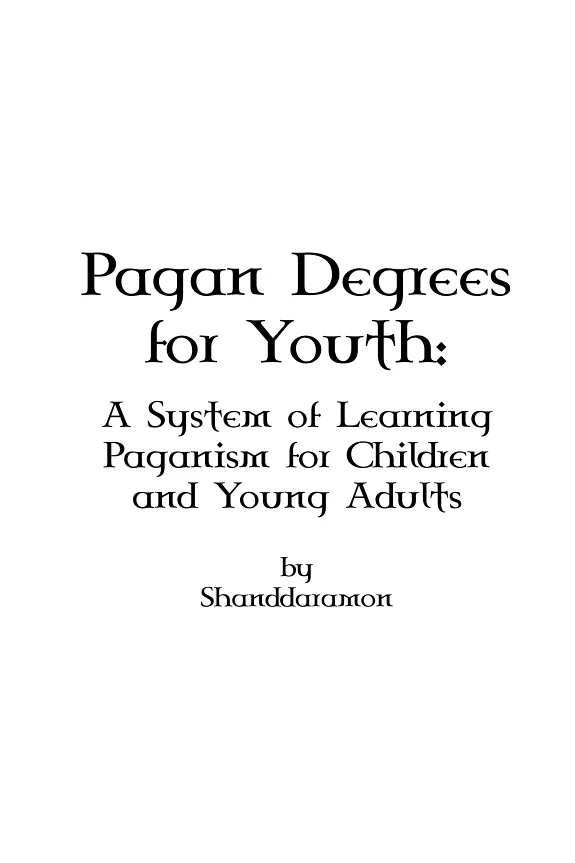
Shanddaramon's "Pagan Degrees for Children" presents a commendable effort to codify Pagan learning for a juvenile audience, a task often left to informal instruction. The tiered structure, moving from Neophyte to Mage, provides a clear developmental path. Its primary strength lies in the granular breakdown of the Neophyte Degree into multiple levels, which realistically addresses the attention spans and learning capacities of very young children. However, the book occasionally struggles to balance esoteric depth with the simplicity required for its target age group. For instance, the explanation of concepts like "elemental forces" within the Neophyte stages, while simplified, could still benefit from more concrete, relatable examples for a 5-year-old. The Achievement Awards are a clever motivational tool, but their criteria are not always explicitly detailed in the provided text. This work serves as a functional primer, but its ultimate effectiveness hinges on the facilitator's ability to elaborate and adapt its content.
📝 Description
80
Shanddaramon published Pagan Degrees for Children in 2009, a structured curriculum for young Pagans.
Pagan Degrees for Children, by Shanddaramon, presents a structured learning system for individuals aged 5 to 18 interested in Paganism and ethical living. First released in 2009, the book organizes this education into three distinct degrees: Neophyte, Apprentice, and Mage. Each degree requires the completion of specific goals and the earning of Achievement Awards, all designed to be age-appropriate and attainable for children and adolescents. The Neophyte Degree, in particular, is broken down into smaller levels to encourage early engagement and a sense of accomplishment for the youngest learners.
This work is intended for children and young adults, aiming to bridge the gap between complex esoteric concepts and youthful comprehension. It also functions as a guide for parents, educators, and guardians who wish to introduce Pagan principles and values in an organized and accessible format. The system's tiered structure and award system are meant to foster continuous learning and a feeling of achievement, making spiritual and ethical development a concrete pursuit for younger generations.
Shanddaramon's system of Neophyte, Apprentice, and Mage degrees draws parallels with initiatory structures found in historical magical orders, such as the Golden Dawn. These older traditions used similar degrees to chart spiritual progression. Pagan Degrees for Children adapts this concept for a secular, child-focused audience, applying a graded approach to Pagan studies. The book emerged in 2009, a time when interest in Paganism was increasing, yet structured educational resources for minors were scarce.
💡 Why Read This Book?
• Learn a structured, three-degree system (Neophyte, Apprentice, Mage) for introducing Pagan concepts, offering a progressive learning path unavailable in less organized introductions. • Discover the concept of "Achievement Awards" and how they are used to mark progress, providing a tangible recognition system for young learners not found in general Pagan literature. • Gain insight into age-appropriate goal-setting for spiritual and ethical development, specifically designed for children aged 5-18, as exemplified by the Neophyte Degree's subdivided levels.
⭐ Reader Reviews
Honest opinions from readers who have explored this book.
❓ Frequently Asked Questions
What is the primary age range for Pagan Degrees for Children?
The book is designed for children and young adults between the ages of 5 and 18. It provides a structured learning system with graduated goals suitable for this broad developmental spectrum.
How does the book structure learning for younger children?
The Neophyte Degree, the initial stage, is subdivided into several smaller levels. This approach offers easily attainable goals, helping younger children build confidence and engagement with the material.
What are the main degrees presented in the book?
The book outlines three main degrees for learners: the Neophyte Degree, the Apprentice Degree, and the Mage Degree. Each represents a stage of understanding and practice.
Besides degrees, what other recognition system is included?
In addition to the degrees, the book incorporates an "Achievement Award" system. These awards are earned by meeting specific goals, reinforcing learning and celebrating milestones.
Who is the author of Pagan Degrees for Children?
The author is Shanddaramon. The book was first published in September 2009, marking an effort to create a systematic Pagan educational resource for young people.
What core concepts does the book aim to teach?
The book focuses on teaching Pagan concepts and principles of good living. It aims to instill ethical understanding and a foundational knowledge of Paganism in a child-friendly manner.
🔮 Key Themes & Symbolism
Progressive Initiation
The book structures spiritual and ethical learning through a system of three distinct degrees: Neophyte, Apprentice, and Mage. This mirrors traditional initiatory frameworks, offering a tangible path for progression. The Neophyte stage is deliberately broken into smaller levels, making the initial steps less daunting for very young children. This methodical approach aims to build a solid foundation, ensuring that learners gradually acquire knowledge and understanding, moving from basic concepts to more complex ideas as they advance through the degrees.
Child-Centric Pedagogy
A central tenet of "Pagan Degrees for Children" is its adaptation of esoteric concepts for a young audience. The curriculum is designed with the cognitive and developmental stages of children and adolescents (ages 5-18) in mind. This involves simplifying complex ideas and creating age-appropriate goals and activities. The inclusion of "Achievement Awards" further supports this child-centric approach, providing positive reinforcement and tangible markers of accomplishment, fostering motivation and a sense of progress.
Ethical Living Framework
Beyond mere doctrine, the book emphasizes "good living concepts." This suggests a focus on practical ethics and responsible behavior within a Pagan context. The degree system serves not only as a measure of esoteric knowledge but also as a guide for developing moral character. By setting specific goals for each degree and award, Shanddaramon integrates ethical development into the learning process, encouraging young readers to apply their understanding in their daily lives and interactions.
Structured Esoteric Education
The work provides a systematic framework for learning Paganism, a departure from more informal or unstructured approaches. The three-degree system (Neophyte, Apprentice, Mage) offers a clear educational pathway, akin to educational models in other disciplines. This structured method aims to provide a comprehensive and coherent introduction to Paganism, making it accessible and understandable for younger individuals who might otherwise find esoteric subjects abstract or overwhelming.
💬 Memorable Quotes
Direct passages from the work, attributed to the author.
“The Neophyte Degree is subdivided into several Levels to help give young children small and easily obtainable goals.”
— This highlights the book's core pedagogical strategy: breaking down complex learning into manageable steps. It underscores a focus on building confidence and ensuring accessibility for the youngest learners in the target age range.
“Children from the ages of 5 - 18 can work on obtaining the Neophyte, Apprentice, and Mage Degrees by meeting specific goals.”
— This statement clearly defines the intended audience and the progressive nature of the curriculum. It emphasizes that the learning journey is goal-oriented and spans a significant developmental period.
“This book provides a system of learning Pagan and good living concepts just for children and young adults.”
— This succinctly states the book's purpose: to offer a specialized educational system that integrates Pagan philosophy with ethical principles, specifically tailored for a youthful demographic.
“Provided with each Degree and Award...”
— This implies that the book offers detailed instructions or requirements associated with each level of achievement. It suggests a comprehensive resource that outlines the path to earning both degrees and awards.
“Children...can work on obtaining the Neophyte, Apprentice, and Mage Degrees...”
— This phrasing suggests an active, participatory learning process. It frames the acquisition of degrees not as passive reception but as an earned accomplishment through dedicated effort and meeting defined criteria.
🌙 Esoteric Significance
Tradition
This work draws implicitly from the Western esoteric tradition, particularly its initiatory models. While not strictly adhering to a specific lineage like Hermeticism or Kabbalah, it adopts the concept of progressive degrees (Neophyte, Apprentice, Mage) familiar from magical orders. It attempts to secularize and simplify these structures for a child audience, focusing on ethical living and foundational Pagan concepts rather than complex magical theory or ritualistic practice.
Symbolism
While the provided text doesn't detail specific symbols, the degree structure itself functions symbolically. The Neophyte represents the threshold of awareness, the Apprentice signifies active learning and skill development, and the Mage embodies mastery and integration. These stages metaphorically represent a child's journey of growth, understanding, and ethical responsibility within a Pagan framework.
Modern Relevance
In contemporary Paganism, which often emphasizes inclusivity and diverse learning paths, "Pagan Degrees for Children" remains relevant as a model for structured, age-appropriate education. It informs contemporary efforts to create accessible Pagan resources for families and youth groups. Thinkers and educators in Pagan child-rearing and interfaith education may reference its systematic approach as a means to engage young minds with spiritual and ethical concepts.
👥 Who Should Read This Book
• Parents and guardians seeking a structured method to introduce their children (ages 5-18) to Pagan principles and ethical living. • Educators or youth group leaders looking for a curriculum framework that offers progressive learning stages and motivational elements like achievement awards. • Individuals interested in comparative studies of initiatory systems and how they can be adapted for younger audiences within spiritual or ethical education.
📜 Historical Context
Published in 2009, Shanddaramon's "Pagan Degrees for Children" arrived as Paganism continued its expansion into Western popular culture, largely facilitated by online communities and increased media visibility. This period saw a proliferation of Pagan literature, yet a systematic, graded approach for children remained relatively scarce. The book's structure, employing distinct degrees like Neophyte, Apprentice, and Mage, consciously carries the initiatory systems found in established esoteric orders such as the Hermetic Order of the Golden Dawn, which utilized a similar degree structure for spiritual progression in the late 19th and early 20th centuries. While these older orders often had strict age and experiential requirements, Shanddaramon adapted the concept for a younger, secular audience. The work sought to provide a foundational understanding of Paganism and ethics in a way that was accessible and engaging for minors, filling a niche for parents and educators seeking structured guidance.
📔 Journal Prompts
Neophyte Degree goals and their relation to early childhood learning.
The Apprentice Degree's transition from foundational knowledge to practical application.
Reflecting on the concept of 'good living' within a Pagan context for young people.
How the Mage Degree might be interpreted as a culmination of ethical understanding.
The role of Achievement Awards in motivating sustained learning for children.
🗂️ Glossary
Neophyte Degree
The first level of learning in the book's system, designed for beginners and often subdivided into smaller, more accessible stages for younger children.
Apprentice Degree
The second stage of the learning system, building upon the Neophyte Degree, where learners engage with more developed concepts and practical applications.
Mage Degree
The highest degree presented in the book's system, representing a culmination of learning and understanding within the Pagan and ethical framework taught.
Achievement Awards
A system of recognition within the book, where specific goals are met, providing tangible rewards and positive reinforcement for learners' progress.
Pagan Concepts
The core ideas, beliefs, and principles associated with various Pagan traditions, presented in an age-appropriate manner for children and young adults.
Good Living Concepts
Principles and practices related to ethical behavior, responsible conduct, and moral development, integrated into the learning curriculum alongside Pagan ideas.
Levels (within Neophyte Degree)
Subdivisions of the initial Neophyte Degree, designed to offer smaller, more easily achievable milestones for very young children to encourage engagement.
This book appears in 1 collection
🔮 Readers Also Liked
Browse all →







From the “Paganism” Collection
View all →






![The Tipperary (or Clonmel) witch case : [transcripts of newspaper reports &c. concerning Bridget Cleary, burned as a witch, and the trial of her husband and neighbours for murder, in 1895]](/img/thumb/the-tipperary-or-clonmel-witch-case-transcripts-of-newspaper-reports-c-concerning-bridget-cleary-burned-as-a-witch-and-the-trial-of-her-husband-and-neighbours-for-murder-in-1895.webp)
More Free Witchcraft & Paganism Books
View all →






![The secrets of black arts!: A key note to witchcraft, devination [sic], omens, forwarnings, apparitions, sorcery, dæmonology, dreams, predictions, visions, and the Devil's legacy to earth mortals, compacts with the Devil! With the most authentic history of Salem witchcraft](/img/thumb/the-secrets-of-black-arts-b-a-key-note-to-witchcraft-devination-sic-omens-forwarnings-apparitions-sorcery-d-monology-dreams-predictions-visions-and-the-devil-s-legacy-to-earth-mortals-compacts-with-th.webp)
