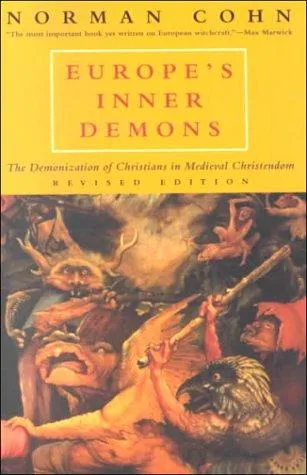
Europe's inner demons
 72
72

Europe's inner demons
Norman Cohn’s *Europe’s Inner Demons* offers a sobering, meticulously researched account of the witch hunts, arguing compellingly that these persecutions were not simply outbursts of popular madness but were deeply rooted in intellectual and theological traditions. Cohn excels at demonstrating how abstract notions of diabolism, particularly the idea of an organized Satanic cult, became concretized in the minds of judges and the populace alike. The chapter detailing the theological justifications for belief in witchcraft, tracing arguments from early Church fathers through medieval canon law, is particularly strong. However, the sheer density of historical analysis, while commendable for its thoroughness, can occasionally make the narrative challenging for a reader not already steeped in medieval and early modern European history. Cohn's focus on the intellectual history sometimes overshadows the lived experience of the accused. Nonetheless, the book remains an essential corrective to facile interpretations of this dark chapter in European history.
📝 Description
72
Norman Cohn's 1993 book dissects the witch hunts and the anxieties that drove them.
Europe's Inner Demons, published in 1993, examines the historical roots and cultural forces behind the European witch hunts. Norman Cohn moves past simple explanations to show how societal fears, religious beliefs, and intellectual trends combined to create widespread persecution. He traces the development of ideas about demonic influence and witchcraft, demonstrating how these concepts became fixed in the European mind.
The book is for students of history, religious studies, and belief systems. Readers interested in the history of paranoia, mass hysteria, and the creation of 'outsiders' will find much to consider. It appeals to those who value detailed research and are prepared to engage with historical arguments that challenge common understandings of the past.
Cohn's study emerged within a scholarly milieu that was re-examining the history of magic and witchcraft. This period saw a shift from viewing these phenomena as mere superstition to understanding them as expressions of deeper social and psychological currents. Cohn's work contributed to this trend by synthesizing ideas about how theological debates and popular fears about demonic pacts and sabbats fueled real accusations and trials.
💡 Why Read This Book?
• Understand the intellectual genealogy of witch-hunting ideology, learning how concepts like the 'demonic pact' evolved in scholastic thought and influenced judicial practices. • Grasp the societal anxieties that amplified fear of witchcraft, particularly during periods of plague and social upheaval in late medieval Europe. • Analyze the construction of the 'witch' as a figure of ultimate evil, a concept Cohn meticulously traces through theological treatises and demonological handbooks.
⭐ Reader Reviews
Honest opinions from readers who have explored this book.
❓ Frequently Asked Questions
What historical periods does Norman Cohn's *Europe's Inner Demons* primarily cover?
The book focuses heavily on the late medieval and early modern periods, roughly from the 13th century through the 17th century, when the witch hunts were most prevalent across Europe.
What is the 'demonic pact' as discussed in *Europe's Inner Demons*?
The 'demonic pact' refers to the alleged agreement between a witch and Satan, wherein the witch renounces Christianity and pledges allegiance to the devil in exchange for supernatural powers.
How does Cohn connect religious beliefs to the witch hunts?
Cohn demonstrates how theological doctrines, particularly the belief in an active Satan and his earthly agents (witches), provided the intellectual framework and justification for the persecution of individuals accused of witchcraft.
Does the book focus on specific regions of Europe?
While covering the phenomenon broadly, Cohn often draws examples from regions with significant witch trials, including the Holy Roman Empire, France, and Switzerland, illustrating the widespread nature of these beliefs.
What is the significance of the 'sabbat' in Cohn's analysis?
The 'sabbat' represents the mythical nocturnal assembly of witches, a key element in the demonological imagination that depicted witches as engaging in blasphemous rituals and conspiracies, often attributed to the Devil.
When was *Europe's Inner Demons* first published?
Norman Cohn's *Europe's Inner Demons* was first published in 1993, offering a comprehensive historical analysis of the witch hunts and their underlying belief systems.
🔮 Key Themes & Symbolism
The Devil as Organizer
Cohn meticulously details how the concept of the Devil evolved from a simple antagonist to a sophisticated organizer of heresy and evil. This transformation, particularly evident in the later medieval period, allowed for the conceptualization of witches not as isolated individuals but as part of a vast, clandestine conspiracy. The idea of the 'demonic pact' solidified this notion, positing a formal allegiance that bound witches to Satan’s hierarchical structure, thereby justifying widespread fear and persecution.
The Sabbat and Diabolical Liturgy
Central to the demonological imagination was the concept of the 'sabbat,' a nocturnal assembly where witches allegedly gathered to worship the Devil, perform blasphemous rites, and conspire against Christendom. Cohn analyzes how these imagined rituals, often grotesque inversions of Christian sacraments, served to demonize the accused and reinforce the perceived threat posed by witchcraft. This imagined liturgy became a key element in confessions extracted under duress.
Intellectual Roots of Persecution
This work underscores that the witch hunts were not solely products of ignorant superstition but were deeply intertwined with the intellectual currents of their time. Cohn traces the influence of theological debates, legal precedents, and demonological treatises that gradually solidified the belief in an organized, malevolent force of witchcraft. The intellectual framework provided by scholars and churchmen gave a veneer of legitimacy to the brutal persecution of thousands.
Societal Anxiety and Othering
Cohn argues that the intensity of the witch hunts was amplified by underlying societal anxieties, including fears of plague, famine, and social instability. The witch served as a convenient scapegoat, embodying these fears and the perceived breakdown of divine order. By identifying and persecuting 'inner demons' – those perceived as betraying God and society – communities sought to restore a sense of control and purity.
💬 Memorable Quotes
Direct passages from the work, attributed to the author.
“the belief in the existence of a Devil, in his powers and in his works, was not always part of the Christian religion.”
— This highlights Cohn's argument that the specific, malevolent conception of Satan and his direct influence through witchcraft was a later development in Christian thought, not an inherent, static doctrine.
“the image of the witch was largely a creation of the learned.”
— This interpretation emphasizes that the elaborate theories and accusations surrounding witchcraft were often products of theological and legal scholarship, which then filtered down into popular consciousness.
“what was at stake was not so much the reality of witchcraft as the reality of the Devil.”
— This suggests that the debate and belief surrounding witchcraft were fundamentally tied to the acceptance of the Devil's active agency in the world, making belief in the Devil a prerequisite for belief in widespread witchcraft.
“the witch was made responsible for the misfortunes of the community.”
— This points to the scapegoating function of the accused witch, who became the focal point for explaining and externalizing collective anxieties and calamities, from crop failures to disease outbreaks.
“the image of the sabbat was a projection of the fears and hatreds of the persecutors.”
— This interpretation suggests that the fantastical and often obscene descriptions of the witches' sabbat were not based on any reality but were rather symbolic manifestations of the persecutors' own anxieties and moral judgments.
🌙 Esoteric Significance
Tradition
While not strictly within a defined esoteric lineage like Hermeticism or Gnosticism, Cohn's work engages with the historical development of demonology, a subject that has significant cross-over with occult traditions. Many esoteric practitioners historically incorporated beliefs about demonic forces and spiritual hierarchies into their cosmologies. Cohn's meticulous tracing of how these beliefs became formalized and weaponized offers a critical historical lens for understanding the roots of certain occult concepts and their societal impact.
Symbolism
The 'demonic pact' serves as a potent symbol of ultimate spiritual betrayal and the inversion of divine order, a concept explored in various occult traditions concerning pacts with entities. The 'sabbat,' beyond its historical accusations, symbolizes a forbidden space of transgression, rebellion, and the conjuring of chaotic or forbidden powers—themes that resonate in certain modern magical practices seeking to explore liminal states or challenge societal norms.
Modern Relevance
Contemporary practitioners of ceremonial magic and those studying modern witchcraft often draw upon historical understandings of witchcraft, including Cohn's analysis. His work provides critical context for understanding the evolution of concepts like 'pact magic' and the symbolic significance of inversion and transgression in occult thought. Scholars of comparative religion and those examining the psychology of belief also continue to reference Cohn's foundational arguments about collective fear and the construction of the 'other'.
👥 Who Should Read This Book
• Historians specializing in medieval and early modern Europe seeking a deep dive into the intellectual underpinnings of the witch craze. • Students of religious studies and theology interested in the historical development of demonology and its impact on societal structures. • Scholars of sociology and cultural studies examining the mechanisms of mass hysteria, scapegoating, and the construction of belief systems.
📜 Historical Context
Published in 1993, *Europe's Inner Demons* arrived during a period of sophisticated historical inquiry into the witch hunts, moving beyond earlier folkloric or purely psychological interpretations. Cohn engaged with a collection of scholarship, building upon works that explored the social and economic factors contributing to persecution. He directly confronted the simplistic notion that witch trials were merely episodes of mass hysteria, arguing instead for the crucial role of intellectual and theological traditions. His work gained prominence in contrast to, or as a synthesis with, studies focusing on gender dynamics or peasant beliefs. The reception highlighted its detailed archival research and its strong thesis regarding the intellectual construction of demonology, solidifying its place in the academic discourse on late medieval and early modern European history.
📔 Journal Prompts
The conceptualization of the Devil as an 'organizer' of evil.
The imagined rituals and alleged conspiracies of the 'sabbat'.
The intellectual lineage of demonological thought.
The role of societal anxieties in shaping the witch figure.
The transformation of abstract diabolism into concrete persecution.
🗂️ Glossary
Demonic Pact
The alleged agreement between an individual (witch) and Satan, where allegiance is sworn to the Devil in exchange for supernatural powers or knowledge.
Sabbat
A mythical nocturnal assembly of witches, reputedly presided over by the Devil, where they engaged in blasphemous rites and conspiracies.
Demonology
The systematic study of demons and the beliefs surrounding them, often within theological or occult contexts.
Canon Law
The body of laws and regulations made by or under the authority of the Church, historically influencing legal and theological interpretations of heresy and witchcraft.
Inquisitor
An official, particularly within the medieval and early modern Catholic Church, tasked with investigating and combating heresy, including witchcraft.
Heresy
Belief or opinion contrary to orthodox religious doctrine; in the context of witchcraft, it was often seen as a form of devil-worship.
Maleficium
Harm or injury caused by supernatural means, specifically attributed to witchcraft in historical accusations.
🔮 Readers Also Liked
Browse all →






More by Norman Rufus Colin Cohn, Norman Cohn, Norman Cohn
All books →
More Free Witchcraft & Paganism Books
View all →