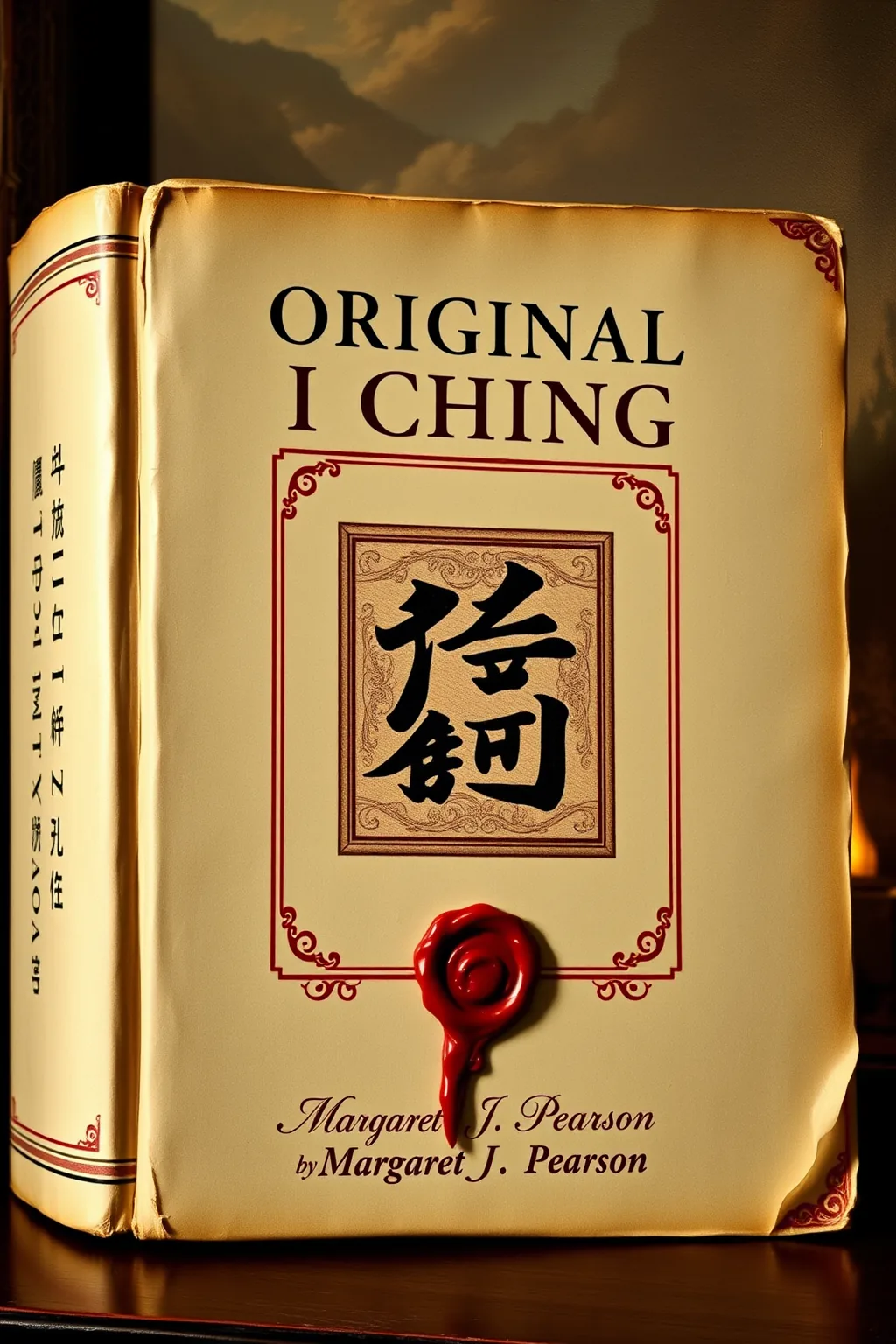
Original I Ching
 74
74

Original I Ching
Margaret J. Pearson's "Original I Ching" offers a compelling re-examination of this ancient Chinese classic. Pearson’s approach, rooted in a close reading of early textual strata, provides a refreshing perspective, moving beyond centuries of accumulated commentary to address the text's foundational layers. Her translation strives for clarity, illuminating the often-dense philosophical and divinatory passages. A particular strength lies in her meticulous annotation, which clarifies archaic terms and contextualizes the hexagrams within their earliest known usage. However, the work's scholarly focus, while admirable, may present a steep learning curve for absolute beginners to the I Ching. The emphasis on textual reconstruction, while academically rigorous, occasionally sacrifices the fluid, intuitive accessibility that some readers seek in a guide to the Book of Changes. Pearson's rendering of the concept of "the superior man" as "the noble person" is a notable interpretive choice that successfully modernizes the ethical ideals presented. Ultimately, "Original I Ching" serves as a valuable, albeit demanding, resource for serious students of the text.
📝 Description
74
Margaret J. Pearson's Original I Ching translates and interprets a divination text nearly 3,000 years old.
This book provides a translation and interpretation of the I Ching, one of the oldest known divination texts and philosophical works. Originating in China, its roots go back approximately 3,000 years. The text is structured around 64 hexagrams, each composed of six stacked lines that are either broken (yin) or solid (yang). These hexagrams are generated through a system of casting coins or yarrow stalks, intended to reflect the dynamic interplay of forces in the universe and within human affairs. Its primary function is to offer guidance during periods of transition and decision-making.
The work is intended for scholars of ancient Chinese philosophy, practitioners of divination seeking a primary text, and individuals interested in comparative religious studies. It appeals to those who wish to engage with the I Ching in a manner that respects its historical and cultural origins. Readers interested in the philosophical underpinnings of decision-making, change, and cosmic order will find its contents relevant, as will those undertaking in-depth study of East Asian thought.
The I Ching is a central text in East Asian esoteric traditions, predating many world philosophies. Its compilation and interpretation span millennia, evolving through various dynasties and intellectual movements. Early versions are attributed to figures such as King Wen and the Duke of Zhou, with later commentaries by Confucius and his followers shaping its philosophical dimension. The text has served as a cornerstone of Chinese governance, divination, and personal cultivation, influencing East Asian culture broadly. Its continuous study highlights its enduring relevance across vastly different historical periods.
💡 Why Read This Book?
• You will gain a clearer understanding of the I Ching's divinatory mechanics by exploring the specific coin-casting methods detailed in its early stages, offering a practical foundation distinct from later esoteric interpretations. • You will learn to identify the philosophical underpinnings of change as presented in the text, focusing on the interplay of yin and yang as described in the foundational chapters, providing a less allegorical view than many modern interpretations. • You will discover the ethical framework presented in the early commentaries, particularly the concept of aligning one's actions with cosmic patterns as discussed in relation to specific hexagrams, offering a concrete model for decision-making.
⭐ Reader Reviews
Honest opinions from readers who have explored this book.
❓ Frequently Asked Questions
What is the primary purpose of the I Ching according to Margaret J. Pearson's "Original I Ching"?
The "Original I Ching" emphasizes the text's primary purpose as a source of counsel for making decisions during times of change. It aims to provide wisdom by reflecting the dynamic forces of the universe and human affairs through its hexagrams.
When was the I Ching first published and who is the author of this specific translation?
Margaret J. Pearson's translation, "Original I Ching," was first published on February 7, 2012. Pearson is the author of this specific edition and translation.
How does the "Original I Ching" differ from other translations of the Book of Changes?
This translation is based on early textual strata, aiming to present a version closer to the work's origins before extensive later commentaries. It focuses on the foundational structure and philosophical intent.
What are the basic components of the I Ching as explained in the book?
The book explains the I Ching's structure based on 64 hexagrams, each formed by six lines (solid yang or broken yin). These hexagrams are generated through a divination process and represent various states and transformations.
Is "Original I Ching" suitable for absolute beginners with no prior knowledge of the I Ching?
While accessible, the translation's scholarly depth and focus on early textual layers may require more effort from absolute beginners compared to more introductory guides. Prior interest in Chinese philosophy is beneficial.
What historical period does the "Original I Ching" refer to regarding the text's origins?
The "Original I Ching" traces the origins of the text back approximately 3,000 years to ancient China, predating many other major world philosophical and religious texts.
🔮 Key Themes & Symbolism
The Dynamics of Change
The central theme is the understanding and acceptance of perpetual flux. The text posits that change is the fundamental nature of reality, driven by the interaction of yin and yang. The 64 hexagrams are not static states but represent specific junctures within this ongoing process. By studying these patterns, individuals can learn to anticipate shifts, adapt to new circumstances, and act in accordance with the prevailing cosmic currents, thereby achieving greater harmony and effectiveness in their endeavors.
Divination as Counsel
Pearson's work highlights the I Ching's function as a sophisticated divinatory tool designed to offer practical guidance. The process of generating hexagrams through methods like coin casting is presented not as mere fortune-telling, but as a means of accessing deeper wisdom. The resulting hexagrams and their associated texts serve as symbolic mirrors, reflecting the underlying dynamics of a situation and suggesting appropriate courses of action. This counsel is aimed at fostering foresight and judicious decision-making.
The Noble Person Archetype
Central to the ethical teachings embedded within the I Ching is the concept of the "noble person" (renamed from "superior man" in some older translations). This archetype embodies wisdom, integrity, and adaptability. Such individuals are characterized by their ability to remain centered amidst change, to act with foresight, and to align their personal conduct with the natural order. The text suggests that by emulating the qualities of the noble person, one can navigate life's challenges with greater success and ethical clarity.
Yin and Yang Interplay
The foundational principle of yin (passive, dark, feminine) and yang (active, light, masculine) is explored as the engine of all transformation. These forces are presented as complementary and interdependent, constantly interacting to create the phenomena of the universe. The hexagrams themselves are built from combinations of yin and yang lines, symbolizing the myriad ways these energies manifest in different situations. Understanding this dynamic interplay is key to interpreting the I Ching's guidance.
💬 Memorable Quotes
Direct passages from the work, attributed to the author.
“The I Ching provides good counsel to its users in making decisions during times of change.”
— This core statement underscores the practical, guiding nature of the text. It suggests the Book of Changes is not merely a philosophical treatise or a mystical artifact, but a functional tool for navigating life's uncertainties with wisdom.
“Since its origins about 3,000 years ago, it has become a compendium of wisdom used by people of many cultures and eras.”
— This highlights the enduring and universal appeal of the I Ching. Its longevity and cross-cultural adoption speak to the fundamental truths and insights it offers regarding the human condition and the nature of existence.
“The I Ching's purpose is universal.”
— This interpretation emphasizes that the principles and guidance offered by the I Ching transcend specific cultural or historical contexts. Its wisdom is presented as applicable to anyone seeking understanding and direction, regardless of their background.
“The text created during [an early period]...”
— This refers to the textual basis of Pearson's translation, suggesting a focus on the earliest extant forms of the I Ching. It implies an effort to strip away layers of interpretation to reach a more original understanding of the work.
“First among the ancient classics, the I Ching or Book of Changes is one of the world's most influential books.”
— This positions the I Ching at the pinnacle of ancient wisdom literature, asserting its profound historical impact. It compares its significance to other major religious and philosophical texts, asserting its foundational role in human thought.
🌙 Esoteric Significance
Tradition
The I Ching fits within the broader framework of East Asian philosophical and divinatory traditions, often intersecting with Daoism and certain schools of Chinese Buddhism. While not strictly Hermetic or Kabbalistic, its emphasis on cosmic correspondences, symbolic language, and the interconnectedness of all things shares thematic parallels with Western esoteric systems. It operates on the principle of sympathetic magic and macrocosm-microcosm relationships, seeking alignment between human actions and universal patterns.
Symbolism
The primary symbols are the yin (broken line, ●●●) and yang (solid line, ▬▬▬▬) lines, representing fundamental dualities like passive/active, dark/light, feminine/masculine. Their combination into trigrams and hexagrams creates a complex symbolic language representing all possible states of the cosmos and human experience. The 64 hexagrams are archetypal images, each with specific meanings and associated judgments, serving as a symbolic map for understanding situations and their potential transformations.
Modern Relevance
Contemporary thinkers and practitioners in fields ranging from psychology (e.g., Carl Jung's interest in synchronicity) to systems theory and even management consulting draw upon the I Ching's principles. Its focus on adaptability, pattern recognition, and understanding cyclical change continues to resonate. Modern practitioners often use it for personal development, mindfulness, and ethical guidance, seeking to integrate its ancient wisdom into contemporary life and decision-making processes.
👥 Who Should Read This Book
• Students of comparative religion and philosophy seeking to understand foundational texts of East Asian thought, particularly those interested in pre-Confucian Chinese cosmology and divination. • Practitioners of divination and esoteric arts looking for a primary source text that emphasizes the historical and philosophical underpinnings of the I Ching, moving beyond modern interpretations. • Individuals engaged in personal growth and decision-making who wish to explore ancient methods for gaining clarity and adapting to life's changes through a structured, symbolic system.
📜 Historical Context
The "Original I Ching" emerges from a tradition stretching back to the Western Zhou dynasty (c. 1046–771 BCE) in China, a period of significant philosophical and political development. This era saw the consolidation of early Chinese thought, laying groundwork for later Confucian and Daoist traditions. The I Ching, or Book of Changes, developed over centuries, with key philosophical interpretations attributed to Confucius and his disciples in the Spring and Autumn period (771–476 BCE). Its compilation represents a synthesis of earlier divination practices and nascent philosophical inquiry into cosmology and ethics. While rooted in Zhou dynasty divination, its philosophical depth was significantly expanded by the Warring States period thinkers. The text's influence was profound, serving as a reference for Chinese governance, scholarship, and personal cultivation, impacting not only China but also Korea, Japan, and Vietnam. Its reception has been remarkably consistent, revered across dynasties as a source of ultimate wisdom, unlike, for example, the sometimes-censored or suppressed philosophical texts in other cultures.
📔 Journal Prompts
The hexagram's depiction of change and its associated judgment.
The concept of yin and yang as forces in a specific life situation.
The 'noble person's' response to the circumstances presented by a hexagram.
The divinatory counsel offered for a particular decision.
The symbolic meaning of the lines within a chosen hexagram.
🗂️ Glossary
Hexagram
A figure composed of six horizontal lines, each either solid (yang) or broken (yin). There are 64 unique hexagrams, representing fundamental archetypes and situations.
Yin
The passive, receptive, dark, and feminine principle in Chinese philosophy. Represented by a broken line (●●●) in the I Ching.
Yang
The active, creative, light, and masculine principle in Chinese philosophy. Represented by a solid line (▬▬▬▬) in the I Ching.
Trigram
A figure composed of three lines, either yin or yang. The eight trigrams form the building blocks of the 64 hexagrams.
Divination
The practice of seeking knowledge of the future or the unknown by supernatural means, in this context, through the casting of lots or coins to generate hexagrams.
Noble Person
An ideal ethical and wise individual described in the I Ching, characterized by integrity, adaptability, and alignment with cosmic principles.
Book of Changes
Another name for the I Ching, emphasizing its role in understanding the processes of transformation and evolution in the universe.