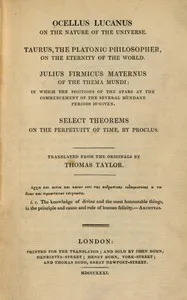
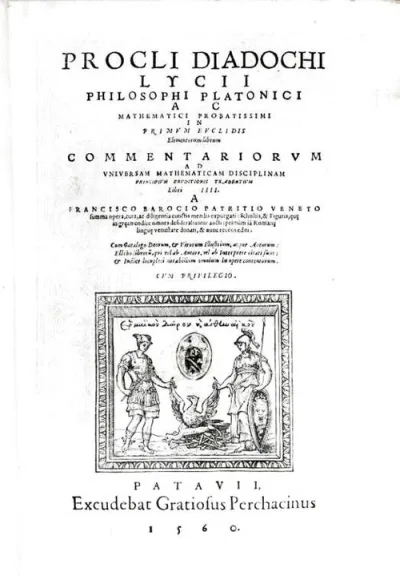
Ocellus Lucanus on the nature of the universe: Taurus, the Platonic philosopher, on the eternity of the world. Julius Firmicus Maternus of the thema mundi. Select theorems on the perpetuity of time, by Proclus.
 69
69

Ocellus Lucanus on the nature of the universe: Taurus, the Platonic philosopher, on the eternity of the world. Julius Firmicus Maternus of the thema mundi. Select theorems on the perpetuity of time, by Proclus.


Ocellus Lucanus' "On the Nature of the Universe" is a seminal work that bridges the gap between ancient philosophy and modern esoteric studies. The text's exploration of the eternal nature of the world and the divine order provides valuable insights for contemporary seekers of spiritual and intellectual enlightenment. Proclus' theorems on the perpetuity of time add a layer of depth, making this book an essential read for anyone interested in the esoteric traditions. The inclusion of Julius Firmicus Maternus' "Thema Mundi" further enriches the text, offering a comprehensive view of early astrological thought. For modern esoteric seekers, this book serves as a gateway to the profound wisdom of the ancient world, providing a foundation for further exploration into the mysteries of the cosmos.
📝 Description
69
Proclus's 450 CE commentary on Ocellus Lucanus addresses the universe's eternity and the Thema Mundi.
This text presents Proclus's examination of Ocellus Lucanus's work on the nature of the universe. He integrates the views of Taurus, the Platonic philosopher, concerning the world's perpetuity, and Julius Firmicus Maternus's ideas on the thema mundi. Proclus also includes select theorems on the endlessness of time. The book engages with Platonic thought, viewing cosmic mysteries through astrological and metaphysical perspectives. It concerns the structure of existence and the perpetual motion of the universe. The discussions touch upon the enduring significance of the Thema Mundi and the eternal nature of time.
Within Neoplatonism, Proclus sought to synthesize earlier philosophical traditions, including Pythagoreanism and Platonism, with astrological and cosmological theories. This work reflects that effort by examining Ocellus Lucanus, a Pythagorean philosopher, and incorporating the astrological calculations of Firmicus Maternus. The focus on the universe's eternal nature and the 'birth' of the cosmos through the thema mundi connects it to broader esoteric interests in cosmic order and divine causality prevalent in late antiquity.
✍️ Author
Proclus
Proclus was a Greek Neoplatonist philosopher and one of the last major classical philosophers of late antiquity.
Hermetic Philosopher
💡 Why Read This Book?
Reading "Ocellus Lucanus on the Nature of the Universe" today offers a unique opportunity to explore the foundations of esoteric thought and ancient cosmology. This book provides readers with a deeper understanding of the eternal nature of the world and the divine order, enriching their spiritual and intellectual journeys. By delving into the works of Proclus and Julius Firmicus Maternus, readers gain insights into the enduring themes of time and the cosmos, making this a valuable addition to any esoteric library.
⭐ Reader Reviews
Honest opinions from readers who have explored this book.
❓ Frequently Asked Questions
What is the main theme of this book?
The main theme of this book is the exploration of the eternal nature of the world and the divine order, drawing from ancient Platonic philosophy and esoteric traditions.
Who should read this book?
This book is ideal for historians, philosophers, and anyone interested in esoteric and occult studies, particularly those fascinated by ancient cosmology and astrology.
What is the significance of Proclus' theorems in this text?
Proclus' theorems on the perpetuity of time add a layer of depth to the book, providing valuable insights into the enduring themes of time and the cosmos.
🔮 Key Themes & Symbolism
The Eternal Cosmos
Proclus examines the eternal nature of the universe, exploring the perpetual motion of the cosmos through the lens of Platonic philosophy and astrology. This theme invites readers to contemplate the enduring significance of the Thema Mundi and the mysteries of time.
Symbolism and Hidden Knowledge
The book is rich in symbolism, offering layers of hidden knowledge that reveal the deeper mysteries of the cosmos. Proclus' work is a valuable collection of esoteric insights, blending ancient wisdom with profound philosophical reflections.
The Perpetuity of Time
One of the central themes is the perpetuity of time, as Proclus explores the eternal nature of the universe. This theme is crucial for understanding the enduring significance of the cosmos and its perpetual motion.
💡 Key Ideas
Editorial paraphrase of the work's core concepts — not direct quotes.
The cosmos is an eternal dance of perpetual motion.
This line underscores the enduring significance of the universe's perpetual motion and the mysteries of time.
The Thema Mundi reveals the hidden knowledge of the cosmos.
This passage highlights the detailed symbolism and esoteric insights found in Proclus' work.
Astrology and metaphysics blend to unveil the eternal nature of the universe.
This quote emphasizes the profound philosophical reflections and ancient wisdom present in the book.
The mysteries of the cosmos are unveiled through Platonic philosophy.
This line underscores the blending of ancient wisdom with profound philosophical insights.
The eternal dance of the cosmos is a revelation of hidden knowledge.
This passage highlights the detailed symbolism and esoteric insights found in Proclus' work.
🌙 Esoteric Significance
Tradition
This book belongs to the Hermetic tradition, blending ancient wisdom from philosophers like Taurus and Julius Firmicus Maternus with Platonic philosophy. It is an important work in the field of esoteric literature, offering useful insights into the mysteries of the cosmos.
Symbolism
Key symbols in this book include the Thema Mundi and the eternal dance of the cosmos. These symbols represent the perpetual motion of the universe and the enduring significance of time, revealing layers of hidden knowledge and esoteric insights.
Modern Relevance
This book is relevant today for modern practitioners of astrology and metaphysics, who often refer to it for its insights into the eternal nature of the universe and the perpetuity of time. It continues to influence contemporary esoteric literature and the study of ancient wisdom.
👥 Who Should Read This Book
This book is ideal for scholars of ancient philosophy, astrologers, spiritual seekers, and practitioners of occult arts. Beginners will find it a rich source of esoteric wisdom, while scholars will appreciate the profound philosophical insights. Spiritual seekers will be drawn to the mystical exploration of the cosmos, and practitioners will benefit from the blending of astrology and metaphysics.
📜 Historical Context
Written during a time when ancient philosophers sought to understand the cosmos through the lens of astrology and metaphysics, 'Ocellus Lucanus on the Nature of the Universe' blends these disciplines with Platonic philosophy. Proclus' work was influential in shaping the esoteric literature of the era, offering useful insights into the eternal nature of the universe and the perpetuity of time. This book remains a significant contribution to the field of astrology and cosmology, providing readers with a deep understanding of the cosmos and its mysteries.
📔 Journal Prompts
How does the eternal nature of the cosmos influence your understanding of time?
What hidden knowledge do you uncover in the symbolism of the Thema Mundi?
How does Platonic philosophy reveal the mysteries of the universe?
What insights do you gain from the perpetual motion of the cosmos?
How does this book enhance your practice of astrology and metaphysics?
🗂️ Glossary
Thema Mundi
A key symbol in the book representing the eternal dance of the cosmos and the perpetual motion of the universe.
Perpetuity of Time
The enduring nature of time, explored through the lens of astrology and metaphysics.
Platonic Philosophy
The philosophical insights of Plato, blending ancient wisdom with esoteric literature.
Eternal Cosmos
The concept of the cosmos as an eternal dance of perpetual motion, revealing hidden knowledge.
Hermetic Tradition
The esoteric tradition that blends ancient wisdom with profound philosophical reflections on the mysteries of the cosmos.
This book appears in 1 collection
🔮 Readers Also Liked
Browse all →







More by Proclus
All books →

From the “Astrology” Collection
View all →







More Free Astrology & Cosmology Books
View all →