Proclus
Proclus was a leading Neoplatonist philosopher who developed an elaborate philosophical system, influencing later thinkers across various traditions.
Proclus Lycius (412–485 AD) was a prominent Greek Neoplatonist philosopher, recognized as one of the last major figures of classical philosophy. He established a highly detailed Neoplatonic system that significantly impacted subsequent philosophical and religious thought, including Byzantine, Islamic, scholastic, and German idealistic traditions. His work, particularly "Platonic Theology," was considered by G. W. F. Hegel to mark a crucial transition from ancient philosophy to modernity and Christianity.
Born into a distinguished family, Proclus initially pursued law but found philosophy more compelling. He studied extensively in Alexandria and later in Athens, where he became the head of the Neoplatonic Academy. He led a disciplined life, dedicating himself to writing and philosophical pursuits. Despite facing exile due to Christian authorities, he continued his work, leaving behind a substantial body of writings that explored complex metaphysical and theological concepts.
Philosophical System and Key Concepts
Proclus's philosophy is characterized by an elaborate Neoplatonic system, building upon the foundational hypostases of The One, The Intellect, and The Soul. A key innovation was his concept of 'henads,' individual divine unities existing between The One and intelligible divinity. These henads, identified with Greek gods, served as centers of causation, imbuing chains of existence with specific characteristics and operating within a polycentric cosmos where each henad could be considered a focal point. Proclus viewed philosophy as a means to liberate the soul from worldly attachments, reconnect it with its divine origins, and facilitate its ascent towards higher realities. He supported the practice of theurgy, drawing on Iamblichus's ideas, as a method to reconnect the soul with divine powers that extend even into the material realm through specific rituals and symbolic acts.
Interpretations of Plato and Theurgy
A significant portion of Proclus's philosophical output consisted of commentaries on Plato's dialogues, which he believed were divinely inspired and intended to convey profound truths veiled from the uninitiated. He presented his own complex philosophical system as a faithful exposition of Plato's intended doctrines. In his "Commentary on the Timaeus," he elaborated on the role of the Soul as a mediator between the Forms within the Intellect and the material world, explaining how mathematical proportions structured the Soul and enabled it to imprint its rational and geometrical ideas onto the physical cosmos. Proclus also embraced theurgy, aligning with the belief that divine powers, represented by the henads, permeated all levels of reality. He saw theurgy as a practical means for the soul to ascend back through the causal chains by engaging with sacred words, actions, and objects, thereby facilitating spiritual reconnection and liberation.
Systematic Works and Mathematical Contributions
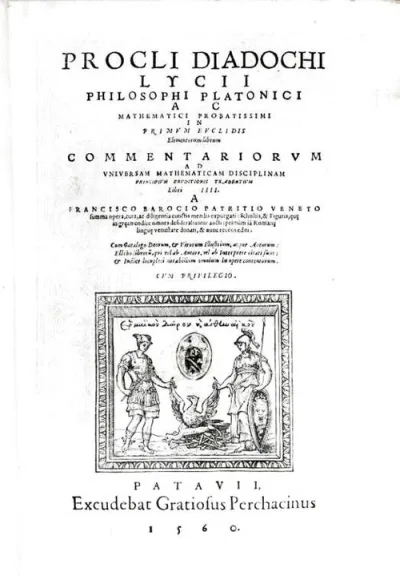
Beyond his extensive commentaries, Proclus authored major systematic works. "Elements of Theology" presented 211 propositions detailing his metaphysical system, starting from The One and concluding with the soul's descent into the material world. His "Platonic Theology" organized material from Platonic dialogues to elucidate divine hierarchies. Additionally, three essays, surviving only in Latin, addressed providence and the existence of evils. Proclus also made significant contributions to the history of mathematics through his "Commentary on Euclid's Elements." This work provided a historical sketch of early geometry, incorporating details from Eudemus of Rhodes, and offered insights into the Platonic view of mathematical objects. He is credited with listing early mathematicians associated with Plato, providing valuable chronological information.
Key Ideas
- Neoplatonic Triad (The One, Intellect, Soul)
- Henads (divine unities)
- Theurgy (spiritual ascent through ritual)
- Philosophy as soul liberation
- Plato's writings as divinely inspired
Books by Proclus
17 free public domain books · Read online or download