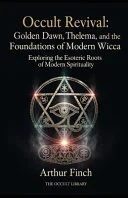
Occult Revival
 82
82

Occult Revival
Arthur Finch's 'Occult Revival' offers a much-needed academic dissection of the spiritual currents that coalesced in the late 19th and early 20th centuries, culminating in the foundations of modern Wicca. Finch excels at mapping the intricate relationships between the Hermetic Order of the Golden Dawn and the emergence of Thelema, demonstrating how these distinct yet interconnected streams fed into later pagan revivals. His tracing of Gerald Gardner's foundational role in Wicca, informed by these earlier traditions, is particularly illuminating. However, the work occasionally suffers from an overabundance of detail, which, while factually dense, can sometimes obscure the broader narrative flow for the less initiated reader. A more direct engagement with the personal experiences of key figures, beyond their intellectual contributions, might have added a further layer of depth. Despite this, 'Occult Revival' stands as a significant contribution to the scholarly study of Western Esotericism.
📝 Description
82
Arthur Finch's Occult Revival, published in 2026, traces the late 19th and early 20th-century occult revival.
This historical account examines the movements that shaped modern Western esotericism and spiritual practices. Finch meticulously follows the lineage of ideas and organizations from this period. The book is for students of Western Esoteric Traditions, historians of religion, and practitioners interested in the origins of contemporary occultism. It appeals to readers who value historical analysis and want a deeper understanding of groups like the Golden Dawn or Thelema.
The late Victorian and Edwardian eras saw a significant rise in spiritualism, occultism, and alternative religious thinking. Influential groups such as the Hermetic Order of the Golden Dawn were established during this time, drawing figures like Aleister Crowley and W.B. Yeats. Finch places his research within this context of esoteric exploration, a time when traditional religious and scientific views faced challenges.
Occult Revival situates itself within the broad currents of Western esotericism, specifically focusing on the late 19th and early 20th centuries. This era witnessed a significant resurgence of interest in magical, mystical, and spiritual traditions outside mainstream religious and scientific frameworks. The book examines how established systems of thought were reinterpreted and synthesized, leading to new magical orders and philosophical systems that continue to influence contemporary occult practices.
💡 Why Read This Book?
• Gain a precise understanding of the Hermetic Order of the Golden Dawn's influence, learning how its ritual structures and teachings were adapted by subsequent occultists. • Explore the specific philosophical tenets of Aleister Crowley's Thelema, understanding its departure from earlier Hermeticism and its impact on 20th-century magical thought. • Grasp the direct lineage from early 20th-century esoteric movements to Gerald Gardner's formation of Wicca, clarifying the historical debt modern witchcraft owes to these precursors.
⭐ Reader Reviews
Honest opinions from readers who have explored this book.
❓ Frequently Asked Questions
What specific historical period does 'Occult Revival' focus on?
The book primarily covers the late 19th and early 20th centuries, a period marked by significant activity in organizations like the Hermetic Order of the Golden Dawn and the development of Thelema.
How does the book connect the Golden Dawn to Thelema?
Finch details the shared membership and intellectual currents between the Hermetic Order of the Golden Dawn and the figures who would later develop Aleister Crowley's Thelema, highlighting the evolution of magical practices and philosophies.
Is 'Occult Revival' a practical guide to occult practices?
No, the book is a historical and academic study. It focuses on the history, philosophy, and interconnections of occult movements rather than providing instructional content for magical practice.
What role does Gerald Gardner play in the narrative?
Gerald Gardner is presented as a pivotal figure whose work in forming Wicca drew directly from the esoteric traditions and concepts explored in the book, particularly those stemming from the Golden Dawn and Thelema.
Who is Arthur Finch, and what is The Occult Library?
Arthur Finch is the author, and The Occult Library is the publishing entity, with this work first appearing on January 2, 2026. They specialize in scholarly works on esoteric subjects.
Does the book discuss modern Wicca in detail?
While it lays the groundwork for Wicca's origins, the primary focus is on the foundational movements like the Golden Dawn and Thelema. Modern Wicca is discussed in terms of its direct historical antecedents.
🔮 Key Themes & Symbolism
The Hermetic Order of the Golden Dawn
Finch meticulously reconstructs the structure and teachings of the Hermetic Order of the Golden Dawn, emphasizing its role as a crucible for Western Esoteric thought. The work details its initiatory system, its integration of Kabbalistic, Hermetic, and Rosicrucian elements, and its significant impact on subsequent occult organizations and individual practitioners who sought a more structured approach to magical knowledge.
Aleister Crowley and Thelema
The book critically examines the development of Aleister Crowley's magical philosophy, Thelema. It traces Crowley's intellectual journey, his break from the Golden Dawn, and the core tenets of his religion, including the Law of Thelema ('Do what thou wilt shall be the whole of the Law'). Finch highlights how Thelema offered a radical departure and a new synthesis of esoteric concepts for its time.
The Genesis of Wicca
A central theme is the direct lineage connecting the Golden Dawn and Thelema to the emergence of modern Wicca. The work details Gerald Gardner's foundational contributions, his alleged initiation into an 'old religion,' and how he synthesized elements from earlier esoteric traditions, folklore, and his own innovations to create the framework for Gardnerian Wicca.
Esoteric Synthesis and Evolution
Finch explores the broader concept of esoteric synthesis, demonstrating how different occult movements drew upon, reinterpreted, and evolved ancient wisdom traditions. The book illustrates this process by showing how Neoplatonism, Hermeticism, Kabbalah, and ceremonial magic were integrated and transformed into new systems throughout the revival period.
💬 Memorable Quotes
Direct passages from the work, attributed to the author.
“The Golden Dawn's ritual structure provided a potent matrix for Western magical experimentation.”
— This highlights how the organizational and ceremonial framework established by the Golden Dawn was not merely academic but served as a practical 'container' for developing and testing magical theories and practices.
“Crowley's interpretation of magic shifted focus from cosmic forces to individual will.”
— This points to a key philosophical divergence in Thelema, emphasizing the subjective experience and the power of individual intent as central to magical efficacy, a contrast to more externally focused magical systems.
“Gardner's 'Book of Shadows' revealed a conscious adaptation of earlier esoteric motifs.”
— This suggests that the foundational text of Wicca was not presented as entirely novel but as a deliberate reworking and recontextualization of existing occult symbolism and ritual elements.
“The revival was less a discovery of lost ancient rites and more an inventive reconstruction.”
— This interpretation frames the occult revival not as a simple uncovering of forgotten knowledge, but as a creative, modern process of synthesizing and reimagining historical and symbolic material.
“Thelema's emphasis on self-realization challenged Victorian moral constraints.”
— This captures the counter-cultural aspect of Thelema, suggesting its core principles of personal freedom and spiritual autonomy were in direct opposition to the prevailing social and ethical norms of the era.
🌙 Esoteric Significance
Tradition
This work firmly belongs within the study of Western Esotericism, specifically tracing the lineage from Hermeticism and Kabbalah through ceremonial magic to modern pagan witchcraft. It examines how these traditions were systematized and adapted during the occult revival, acting as a bridge between older esoteric philosophies and their 20th-century manifestations.
Symbolism
Key symbols explored include the Pentagram, central to Golden Dawn rituals and often employed in Wiccan practice to represent the elements and invoke/banish. The concept of the 'Magus' and the 'Scarlet Woman' from Thelema also feature, representing archetypal roles in spiritual development and the union of opposites. The Tarot, extensively used by the Golden Dawn, is implicitly present as a tool for divination and self-exploration.
Modern Relevance
Contemporary Neopagan religions, particularly various forms of Wicca and Ceremonial Magic, owe a direct debt to the movements detailed in this book. Thinkers and practitioners in eclectic witchcraft, chaos magic, and even modern interpretations of Hermeticism often draw upon the foundational texts and organizational models established during this revival period.
👥 Who Should Read This Book
['• Students of Western Esotericism: Those seeking to understand the historical development and interconnections of movements like the Golden Dawn, Thelema, and the origins of Wicca will find a detailed historical account.', "• Historians of Religion: Researchers interested in alternative spiritual movements of the late 19th and early 20th centuries will benefit from the book's factual grounding and contextualization of occultism.", '• Practitioners of Magic and Witchcraft: Individuals practicing modern magical systems can gain critical context by understanding the specific historical influences and syntheses that shaped their traditions.']
📜 Historical Context
Published in 2026, 'Occult Revival' arrives as a contemporary historical analysis of a key era. The late 19th and early 20th centuries were fertile ground for Western Esotericism, marked by widespread interest in spiritualism, Theosophy, and ceremonial magic. The Hermetic Order of the Golden Dawn, founded in 1888, became a central hub, attracting figures like W.B. Yeats and Aleister Crowley. Crowley's subsequent development of Thelema in the early 20th century represented a significant, often controversial, evolution of magical thought. This period also saw the seeds of what would become modern Wicca, largely through the work of Gerald Gardner. Finch situates his study within this intellectual milieu, where established religious and scientific paradigms were increasingly questioned. The work implicitly engages with the legacy of figures like Helena Blavatsky and the Theosophical Society, a contemporary force in alternative spirituality, by tracing the lineage of organized magical orders that offered a different path.
📔 Journal Prompts
The Golden Dawn's initiatory structure and its perceived effectiveness.
Aleister Crowley's concept of the 'True Will' and its implications for personal liberation.
Gerald Gardner's synthesis of esoteric elements in the formation of Wicca.
The evolution of magical theory from the Hermetic Order of the Golden Dawn to Thelema.
Personal reflections on the enduring appeal of the occult revival's core ideas.
🗂️ Glossary
Hermetic Order of the Golden Dawn
A late 19th-century magical order that significantly influenced modern Western esotericism. It synthesized Kabbalah, Hermeticism, Rosicrucianism, and other traditions into a structured system of ritual magic and spiritual development.
Thelema
A religious philosophy and magical system founded by Aleister Crowley, centered on the principle 'Do what thou wilt shall be the whole of the Law.' It emphasizes individual sovereignty, spiritual development, and a unique cosmology.
Wicca
A modern Pagan religion, drawing heavily on pre-Christian European traditions and occultism. Its foundations are often attributed to Gerald Gardner, who synthesized elements from various sources into what became known as Gardnerian Wicca.
Esoteric Synthesis
The process of combining, integrating, and reinterpreting diverse philosophical, religious, and magical elements from various traditions into a cohesive new system or worldview.
Ceremonial Magic
A type of ritual magic often involving elaborate procedures, specific tools, invocations, and the creation of sacred space, aiming to achieve altered states of consciousness or manifest specific results.
Kabbalah
A system of Jewish mysticism and esoteric interpretation that uses symbolic representation, most famously the Tree of Life, to understand the divine nature and the structure of the universe.
True Will
A core concept in Thelema, referring to an individual's unique purpose or destiny in life, aligned with the greater cosmic order. Discovering and enacting one's True Will is considered the primary spiritual task.