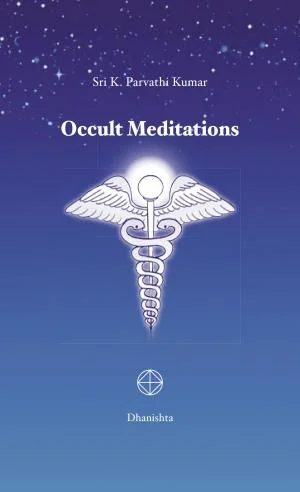
Occult Meditations
 77
77

Occult Meditations
K. Parvati Kumar’s *Occult Meditations* offers a direct, no-nonsense approach to the practice of focused consciousness, a refreshing departure from more verbose esoteric texts. Its strength lies in its clear, actionable instructions, particularly in sections detailing visualization techniques for engaging with elemental forces. The prose is unadorned, prioritizing clarity over poetic flourish, which serves the book’s instructional purpose well. However, this very directness might leave some readers wanting more theoretical depth or historical context to fully situate the practices. For instance, the chapter on 'Concentration on the Inner Planes' is pragmatically explained but could benefit from a brief mention of its antecedents in yogic dharana or Hermetic mental alchemy. Despite this limitation, the book provides a solid, accessible manual for anyone seeking to build a consistent meditation practice aimed at occult exploration. It's a functional guide for the dedicated student.
📝 Description
77
K. Parvati Kumar's 2006 book, Occult Meditations, guides practitioners in using focused consciousness for spiritual growth.
Occult Meditations, published in 2006, moves beyond theory to provide practical exercises for developing inner faculties. It aims to help readers engage with subtle energies and higher consciousness through disciplined mental practices. The book offers a framework for individuals ready to undertake active inner work, moving beyond passive study towards direct experience of spiritual realities. It is particularly suited for those interested in cultivating intuition, psychic abilities, or a cosmic connection through specific exercises.
The core of the book is the disciplined application of consciousness as a means of spiritual advancement. Kumar details the nature of the subtle body, the potency of focused intention, and the use of visualization for accessing non-ordinary states of awareness. Readers will encounter discussions on the inner planes, elemental forces, and the mechanics of esoteric contemplation.
Emerging in the early 21st century, Occult Meditations draws from the Western esoteric lineage, referencing figures like Helena Blavatsky and Hermetic traditions. It emphasizes disciplined internal practice as a counterpoint to more academic or externally focused occult approaches. The work is situated within a broader interest in synthesizing Eastern and Western mystical thought for practical spiritual application.
💡 Why Read This Book?
• Learn specific techniques for visualizing and internalizing elemental energies, as detailed in the chapter on 'Elemental Focus,' allowing for a more direct experience of these fundamental forces. • Gain practical methods for developing psychic perception through disciplined concentration exercises, moving beyond theoretical understanding to cultivating inner awareness. • Understand the role of the subtle body in occult practice, as outlined through Kumar's unique synthesis of various esoteric streams, providing a framework for deeper self-exploration.
⭐ Reader Reviews
Honest opinions from readers who have explored this book.
❓ Frequently Asked Questions
What is the primary focus of K. Parvati Kumar's Occult Meditations?
The book's primary focus is on practical, disciplined meditation and visualization techniques designed for occult practitioners. It emphasizes the development of inner faculties and direct experience of subtle realities through focused mental effort.
When was Occult Meditations first published?
Occult Meditations was first published in 2006, placing it within the contemporary resurgence of interest in practical esoteric disciplines.
Who is K. Parvati Kumar?
K. Parvati Kumar is the author of Occult Meditations, a text focused on practical occult techniques. Information regarding their specific background or other works is not extensively detailed within the book itself.
What kind of meditation techniques are presented in the book?
The book presents techniques centered on concentration, visualization of subtle energies and forms, and the cultivation of focused intention, aimed at exploring inner planes and developing psychic awareness.
Is Occult Meditations suitable for beginners in esoteric studies?
While accessible, the book assumes some familiarity with basic occult or metaphysical concepts. Beginners might find it beneficial to supplement their reading with introductory texts before diving into the more advanced practices described.
What is the main goal of the meditations described in the book?
The main goal is to achieve direct experience of higher consciousness, develop psychic faculties, and gain a deeper understanding of the subtle realms through rigorous mental discipline and focused practice.
🔮 Key Themes & Symbolism
Disciplined Consciousness
The core of *Occult Meditations* lies in the rigorous training of the mind. Kumar posits that consciousness, when properly directed through sustained focus and intent, can perceive and interact with planes of existence beyond the ordinary physical senses. This involves cultivating mental stillness, sharpening visualization abilities, and maintaining unwavering attention on specific inner targets or concepts. The text provides exercises designed to build this mental fortitude, essential for any serious occult practitioner seeking to move beyond theoretical knowledge to experiential understanding.
Subtle Body Exploration
Kumar guides the reader to understand and engage with the subtle anatomy, often referred to as the etheric or astral body. This exploration is not merely theoretical but practical, involving meditative techniques that aim to awaken awareness of these non-physical energetic structures. By focusing on centers of energy (chakras) and pathways (nadis), practitioners can learn to direct vital force, perceive subtle currents, and potentially influence their own energetic state and environment. This theme underscores the idea that the occultist operates on multiple levels of being.
Elemental Dynamics
The book looks at the practical application of elemental forces—Earth, Air, Fire, and Water—within the context of inner work. These elements are presented not just as external phenomena but as fundamental energies that can be invoked, understood, and integrated within the practitioner's consciousness. Through specific meditative practices, Kumar suggests methods for attuning oneself to the qualities of each element, thereby harnessing their power for spiritual growth, protection, or manifestation, and gaining a deeper comprehension of cosmic architecture.
Intent and Manifestation
A crucial aspect of the occult practices described is the power of focused intent. Kumar highlights how directed will, amplified by meditative states and clear visualization, can act as a force for change. The meditations serve to purify and strengthen this intent, making it a potent tool for personal transformation and, potentially, for influencing external circumstances in accordance with one's higher purpose. The book implies that true occult work involves aligning personal will with universal principles.
💬 Memorable Quotes
Direct passages from the work, attributed to the author.
“The mind is the instrument through which all occult realities are perceived and manipulated.”
— This statement emphasizes the primacy of mental discipline in esoteric practice. It suggests that external tools or rituals are secondary to the trained and focused consciousness of the practitioner.
“Concentration is the key that unlocks the subtle doors of perception.”
— This highlights the central role of sustained mental focus in accessing hidden knowledge or non-ordinary states of awareness, framing concentration as a literal gateway.
“Inner stillness allows the higher self to communicate its wisdom.”
— This interpretation points to the idea that by quieting the noise of the lower mind, one creates space for intuitive insights and guidance from one's own deeper spiritual nature.
“Visualization transforms abstract concepts into tangible inner experiences.”
— This conveys the power of imaginative faculty, as trained through meditation, to make esoteric principles and forces directly perceivable and understandable to the practitioner.
💡 Key Ideas
Editorial paraphrase of the work's core concepts — not direct quotes.
To know the elements is to understand the building blocks of manifestation.
This paraphrase suggests that comprehending the fundamental elemental forces, as described in occult traditions, is essential for understanding how reality is formed and can be influenced.
🌙 Esoteric Significance
Tradition
This work aligns with the Western Esoteric Tradition, particularly drawing from Hermeticism and later Theosophical influences, which emphasize the power of the human mind to interact with subtle realities. It departs from purely ceremonial approaches by prioritizing direct meditative practice and internal cultivation as the primary means of occult engagement, offering a distilled set of exercises focused on consciousness itself.
Symbolism
Key symbols often explored in this lineage, and implicitly within Kumar's text, include the triangle (representing divine trinity or elemental forces), the circle (wholeness, eternity), and the concept of the 'Inner Planes' as distinct energetic dimensions. The practice of invoking elemental forces also taps into ancient symbolic understandings of the cosmos as composed of these fundamental energies.
Modern Relevance
Contemporary practitioners of various meditative disciplines, from mindfulness to more specialized occult techniques, can find value in Kumar's emphasis on focused attention and visualization. Modern schools of consciousness studies and individuals exploring lucid dreaming or astral projection may also find resonance with the book's practical approach to exploring inner states and subtle energies.
👥 Who Should Read This Book
• Dedicated students of Western Esotericism seeking practical, actionable meditation techniques to deepen their understanding of occult principles. • Aspiring occult practitioners looking for structured guidance on developing mental discipline, concentration, and visualization skills for inner work. • Individuals interested in exploring the relationship between consciousness, subtle energies, and the development of psychic faculties through focused, sustained practice.
📜 Historical Context
Published in 2006, *Occult Meditations* by K. Parvati Kumar emerged in an era marked by a significant revival of interest in practical esoteric traditions. This period saw a proliferation of books and online resources catering to seekers of occult knowledge, often drawing from established Western esoteric lineages. Kumar’s work can be contextualized within this resurgence, offering a focused manual on meditative techniques that echo the disciplined practices advocated by earlier figures in Hermeticism and Theosophy. While not directly engaging with the more academic or historical analyses of occultism gaining traction at the time, such as the work of scholars like Wouter J. Hanegraaff, *Occult Meditations* represented a return to the experiential core of the occult path. Its emphasis on internal development aligns with a broader contemporary trend that sought to synthesize various spiritual traditions, often blending Western ceremonial magic with Eastern contemplative practices, moving beyond the more formalized structures of late 19th and early 20th-century occult orders.
📔 Journal Prompts
The practice of elemental attunement described in Chapter 4.
The concept of the 'Inner Planes' as a field for meditation.
Developing sustained concentration as a tool for occult perception.
The role of focused intent in transforming inner states.
Visualizing the subtle body during meditative exercises.
🗂️ Glossary
Subtle Body
Refers to the energetic, non-physical aspects of a human being, often considered to include etheric, astral, and mental bodies, which are the vehicles for consciousness and psychic experience.
Inner Planes
Hypothetical levels or dimensions of reality that are not physically perceptible but are accessible through altered states of consciousness, meditation, and psychic development.
Elemental Forces
The fundamental energies of Earth, Air, Fire, and Water, understood in occultism not just as physical substances but as archetypal forces present within the cosmos and the human constitution.
Concentration
The practice of fixing the mind's attention on a single object, thought, or point, to the exclusion of all distractions, crucial for developing mental control in esoteric work.
Visualization
The mental creation and manipulation of images, forms, or scenes within the mind's eye, used as a tool for focusing consciousness, invoking energies, or exploring inner landscapes.
Intent
The focused will or purpose behind an action or thought; in occultism, the conscious direction of energy towards a specific outcome, amplified by meditative states.
Psychic Perception
The ability to perceive information or energies beyond the normal range of the five physical senses, often developed through dedicated practice and inner training.
This book appears in 2 collections
🔮 Readers Also Liked
Browse all →








From the “Meditation” Collection
View all →





More Free Occult Philosophy Books
View all →