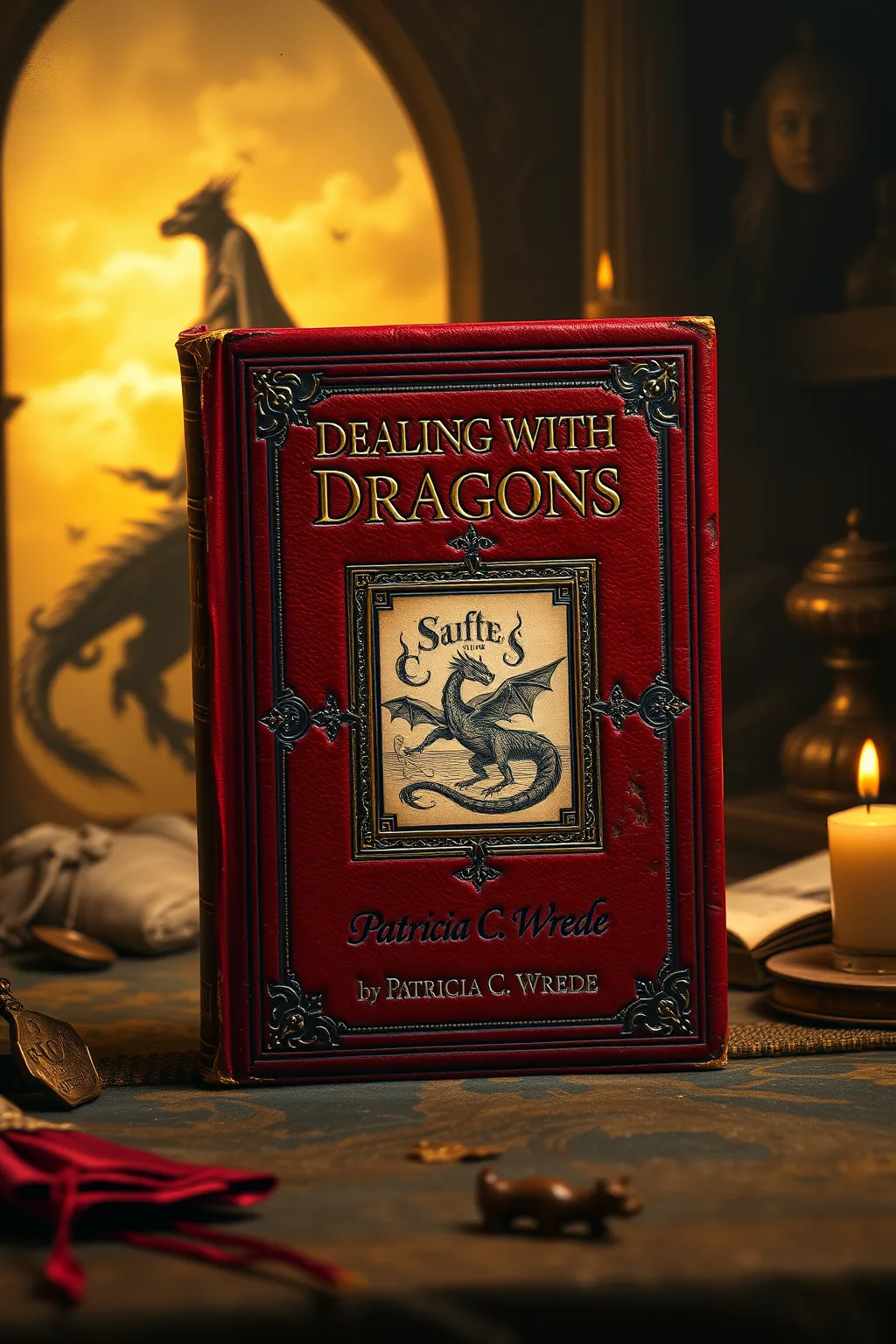
Dealing with Dragons

 76
76

Dealing with Dragons
Patricia C. Wrede's "Dealing with Dragons" approaches the fantasy genre with a refreshing lack of pretension, focusing instead on the practicalities and absurdities of interspecies diplomacy. The protagonist, Cimorene, is a refreshing departure from damsels in distress, exhibiting agency and a healthy skepticism towards traditional princessly duties. Her decision to run away and become a dragon's princess is a bold move that immediately sets the tone. While the narrative's charm lies in its straightforward prose and accessible world-building, its primary strength is the ingenious portrayal of dragons as logical, bureaucratic entities rather than mere beasts. A minor limitation might be that some plot developments feel a touch too convenient, particularly Cimorene's swift integration into dragon society. However, the book's clever inversion of fairy tale expectations, especially the chapter detailing the proper etiquette for being a princess to a dragon, solidifies its unique place. It’s a story that entertains by cleverly dissecting fantasy conventions.
📝 Description
76
Patricia C. Wrede's 2019 novel, Dealing with Dragons, reimagines dragon lore with a focus on societal structures and character development.
Dealing with Dragons centers on a princess who eschews traditional royal duties for a life among dragons. This is not a simple adventure story; the dragons are portrayed as complex beings with their own societies, laws, and philosophies, serving as catalysts for the protagonist's growth. The narrative unfolds through sharp dialogue and action, revealing the motivations of both human and draconic characters. It challenges the reader's expectations of fantasy creatures, moving beyond the common tropes of monsters to explore intelligent, non-human entities.
The book appeals to readers who enjoy fantasy that subverts conventional expectations. It is for those who appreciate character-driven plots and a thoughtful, often humorous, approach to world-building. The story moves beyond simplistic good-versus-evil narratives, inviting readers to consider different viewpoints and the complexities of intercultural understanding. It explores how perceived threats can be addressed through communication and a willingness to learn about other perspectives.
This novel engages with the esoteric tradition of reinterpreting established mythologies. Rather than presenting dragons as mere beasts or symbols of chaos, Wrede depicts them as an organized society with distinct legal and social systems. This approach echoes esoteric thought that seeks deeper, often hidden, meanings within folklore and myth, encouraging a critical look at how these narratives shape our understanding of the 'other.' The book implicitly critiques human-centric biases by giving voice and agency to non-human intelligence.
💡 Why Read This Book?
• You will learn how to approach perceived threats with logic and communication, inspired by Cimorene's practical methods for dealing with dragons, a concept explored throughout the narrative. • You will gain an appreciation for how established fantasy tropes can be deconstructed, exemplified by the book's unique portrayal of dragons as intelligent, societal beings first published in 2019. • You will experience a narrative that champions independent thought and agency, as seen in Princess Cimorene's active choices to forge her own path outside conventional expectations.
⭐ Reader Reviews
Honest opinions from readers who have explored this book.
❓ Frequently Asked Questions
What is the main conflict in Dealing with Dragons?
The primary conflict isn't a traditional battle but Cimorene's struggle against societal expectations for princesses and her quest for a more fulfilling life, which leads her to live with dragons.
How are the dragons portrayed in Patricia C. Wrede's book?
The dragons are depicted as intelligent, organized beings with their own societies, laws, and methods of communication, rather than simply monstrous creatures.
What makes Dealing with Dragons different from other fantasy stories?
It subverts common fairy tale and fantasy tropes by presenting a practical, often humorous, take on dragon-human interactions and a proactive princess.
When was Dealing with Dragons first published?
The book "Dealing with Dragons" was first published in 2019, placing it within the contemporary fantasy literature landscape.
Who is the protagonist of Dealing with Dragons?
The protagonist is Princess Cimorene, who finds royal life stifling and seeks adventure and independence by running away to become a dragon's princess.
Does this book involve traditional magic systems?
While the presence of dragons implies a magical world, the narrative focuses more on social dynamics and character interactions than on explicit magic systems.
🔮 Key Themes & Symbolism
Subversion of Archetypes
The narrative deliberately dismantles common fairy tale and fantasy archetypes. Princesses are not passive; dragons are not inherently evil. This challenges readers to question established myths and expectations. The book argues that understanding and communication are more potent than brute force or blind adherence to tradition, presenting a world where dragons have contracts and princess duties. This re-evaluation of familiar roles invites a more critical engagement with storytelling itself, suggesting that even the most ingrained narratives can be reinterpreted.
Practicality and Agency
Princess Cimorene embodies a spirit of practical problem-solving and fierce personal agency. Dissatisfied with the constraints of her royal life, she actively seeks alternatives, demonstrating that true fulfillment often comes from forging one's own path. Her approach to living with dragons is characterized by efficiency and directness, highlighting her intelligence and resourcefulness. This theme encourages readers to consider their own lives and to pursue their desires with determination, even when faced with societal pressures or conventional wisdom.
Interspecies Diplomacy
The core of the story lies in the complex relationships and interactions between humans and dragons. Instead of simple conflict, the book explores the possibility of coexistence through mutual respect and understanding. Dragons are shown to possess their own culture, laws, and social structures, necessitating a diplomatic approach from Cimorene. This theme posits that even beings perceived as fundamentally different can find common ground, provided there is a willingness to engage and acknowledge their distinct perspectives and needs.
Critique of Bureaucracy
The dragon society, with its formalized rules and processes, ironically mirrors human bureaucrational systems. This serves as a subtle critique of rigid structures that can stifle individuality and common sense. Cimorene's interactions often highlight the absurdities that arise when strict adherence to protocol overrides practical needs. The work suggests that even in a world of magic and dragons, the challenges of organized society remain, prompting reflection on how systems can be both beneficial and restrictive.
💬 Memorable Quotes
Direct passages from the work, attributed to the author.
“I don't want to be a princess. I want to be a dragon.”
— This statement expresses Princess Cimorene's rejection of societal expectations and her desire for a life of adventure and autonomy, directly challenging the traditional narrative of a princess's destiny.
“Being a princess is a lot of work.”
— This highlights the mundane and often tedious aspects of royal life that Cimorene finds unappealing, contrasting sharply with the perceived excitement of her chosen path.
“Dragons are more sensible than humans.”
— This sentiment underscores Cimorene's observation that dragons, despite their fearsome reputation, often operate with a logic and practicality that she finds lacking in human society.
“If you are going to do something, do it properly.”
— This reflects Cimorene's diligent and thorough approach to her new life, whether it involves managing a dragon's household or negotiating treaties.
💡 Key Ideas
Editorial paraphrase of the work's core concepts — not direct quotes.
It is easier to be a dragon than a princess.
This paraphrased concept emphasizes Cimorene's belief that her chosen role offers greater freedom and less restrictive social obligation than her birthright.
🌙 Esoteric Significance
Tradition
While not explicitly a work of traditional Hermeticism or Gnosticism, "Dealing with Dragons" can be approached through an esoteric lens by examining its symbolic inversions and the exploration of hidden knowledge. The dragons, possessing ancient wisdom and distinct societal structures, can be seen as archetypal forces or gatekeepers to alternative realities. Cimorene's journey is one of initiation, where she learns to navigate and understand a world vastly different from her own, seeking empowerment through knowledge and unconventional alliances, echoing themes found in various mystical traditions.
Symbolism
The dragon itself is a potent symbol across many esoteric traditions, often representing primal power, transformation, and hidden wisdom. In this work, the dragons' caves symbolize liminal spaces, thresholds between the known and unknown, where transformation can occur. Their elaborate legal codes and societal structures represent a form of ancient, perhaps forgotten, order. Cimorene's role as a princess to a dragon signifies her active engagement with these primal forces, seeking to integrate their power and knowledge into her own life rather than being consumed by it.
Modern Relevance
Contemporary fantasy authors continue to draw inspiration from works like "Dealing with Dragons" that deconstruct familiar myths. Its influence can be seen in stories that feature dragons with complex personalities and societies, moving beyond simplistic monstrous portrayals. Thinkers and writers interested in feminist interpretations of folklore and fantasy find Cimorene's agency a valuable case study. The book's success encourages a modern approach to world-building that values internal consistency and character-driven logic, influencing how new fantasy worlds are constructed and how ancient archetypes are re-examined.
👥 Who Should Read This Book
• Young adult readers seeking adventure stories that empower female protagonists to make their own choices and challenge norms. • Fantasy enthusiasts who enjoy clever subversions of fairy tale tropes and appreciate well-developed, non-human characters with unique societal structures. • Educators and parents looking for engaging literature that subtly promotes critical thinking about societal expectations and the value of communication.
📜 Historical Context
Published in 2019, "Dealing with Dragons" entered a literary landscape where fantasy authors were increasingly encouraged to subvert established tropes. While the book itself was first published much earlier (1990), its later editions and continued popularity reflect a growing appetite for narratives that challenge traditional gender roles and creature portrayals. This period saw authors like N.K. Jemisin and Brandon Sanderson gaining prominence, each in their own way pushing the boundaries of epic fantasy. The reception of "Dealing with Dragons" showcases a consistent appeal across decades, resonating with readers who appreciate intelligent, character-driven fantasy that plays with familiar elements. Its enduring presence suggests a successful navigation of the genre's evolution, aligning with contemporary trends toward more nuanced and less formulaic storytelling.
📔 Journal Prompts
Princess Cimorene's decision to leave her castle and live with a dragon.
The dragon's perspective on human royalty and princess duties.
The concept of 'proper dragon princess' etiquette.
The negotiation process between Cimorene and King Gaskell.
The societal expectations placed upon Princess Cimorene.
🗂️ Glossary
Dragon Princess
In the context of this book, a 'dragon princess' is a human woman who chooses to live with and serve a dragon, often acting as a diplomat, housekeeper, or companion, rather than fulfilling traditional royal duties.
King Gaskell
The king of the kingdom where Princess Cimorene resides. He represents the traditional societal expectations that Cimorene rebels against, embodying the structured, perhaps unadventurous, life she seeks to escape.
Morwen
A powerful witch and a key figure in the dragon society whom Cimorene encounters. Morwen represents a different form of power and wisdom, distinct from both human royalty and the dragons themselves.
The Council of Dragons
An organized body within dragon society that governs their affairs, demonstrating that dragons possess complex social and political structures, not just raw power.
Sorcery
A form of magic present in the world, often wielded by witches like Morwen. It represents a mystical force that operates outside the more logical, contractual interactions seen between Cimorene and the dragons.
The Forbidden Mountains
A dangerous and remote location where dragons often reside, symbolizing a place of exile, adventure, and separation from the conventional world.
Dragon Contracts
Formal agreements that dragons adhere to, showcasing their organized and lawful nature. These contracts often dictate terms of service or agreements with humans.
🔮 Readers Also Liked
Browse all →









More by Patricia C. Wrede
All books →



More Free Occult Philosophy Books
View all →